Editor’s Note: This story was featured in WBUR’s weekly health newsletter, CommonHealth. If you like what you read and want it in your inbox, sign up here.
As measles surges in the United States at the highest level in decades, doctors and public health officials are warning Massachusetts could be vulnerable to an outbreak.
While 96.5% of the state’s kindergarteners had received measles vaccines as of last school year, state data shows some counties dipped below the 95% threshold considered essential for herd immunity, making their students more vulnerable to infections.
So far this year, two cases of measles have been recorded in Massachusetts. But Dr. David Lyczkowski, president of the Massachusetts chapter of the American Academy of Pediatrics, said he’s watching the outbreak a couple states away in Pennsylvania, and he’s concerned.
“It is a roll of the dice,” he said. “I’m worried that it’s just a matter of time before we see an outbreak.”
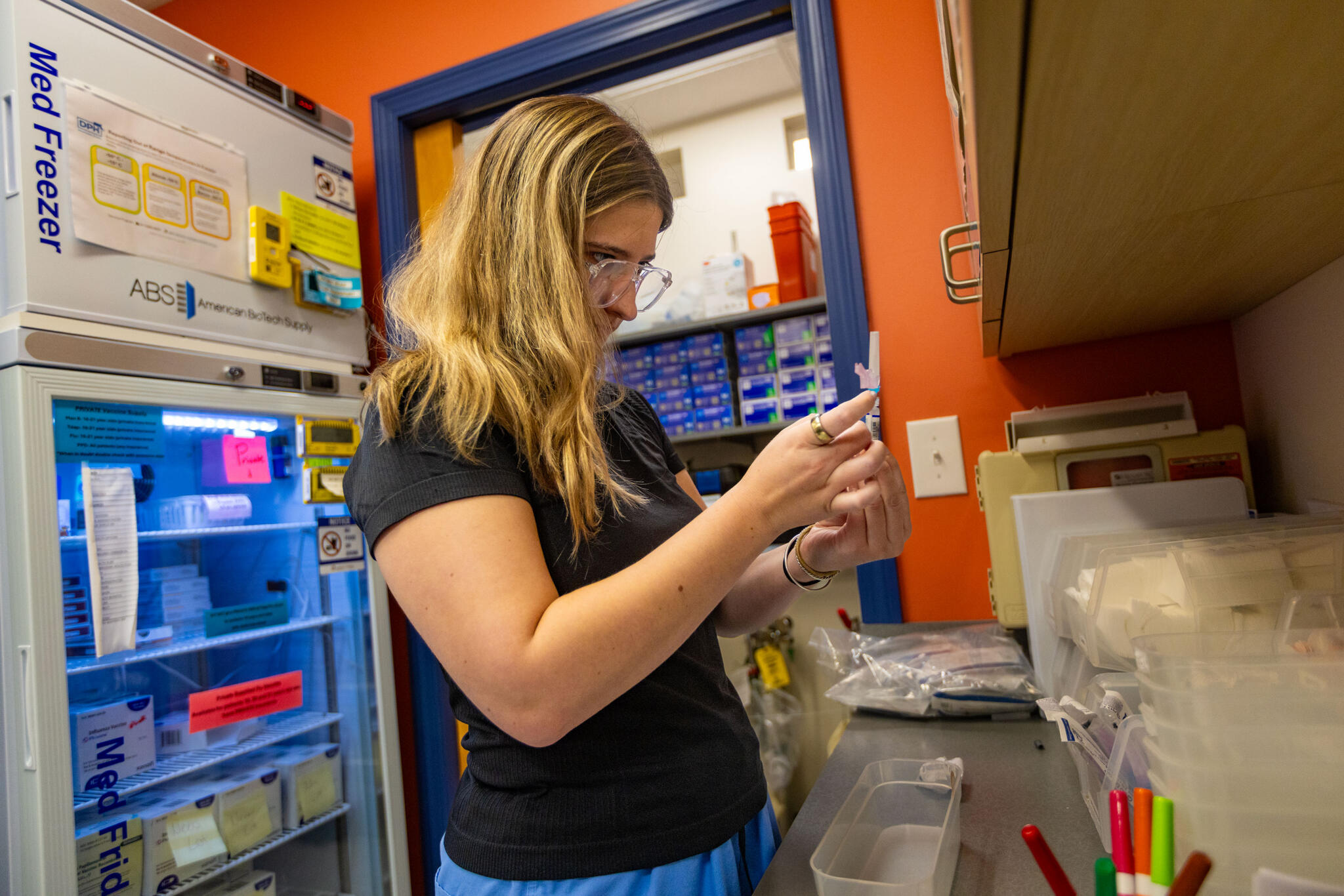
Registered nurse Danielle Capuano prepares a vaccine at Hyde Park Pediatrics. (Jesse Costa/WBUR)
Vaccination rates vary widely across communities and schools. Many schools are at 100% — meaning every kindergarten student is up to date on vaccines. But in some others, 1 out of 5 has not received their measles shots, according to data from the state Department of Public Health reviewed by WBUR. The numbers include the 2025-2026 school year; data for the current school year is not yet available.
In Franklin County in Western Massachusetts, 89.7% of kindergarteners had received their measles shots. On Martha’s Vineyard, the vaccination rate for measles was 91.2%. And in the more populous Suffolk County, which includes Boston, the rate was 94.2% — an improvement compared with prior years, but still below the 95% threshold needed to guard against the spread of the virus.
“The number of classrooms that are out there that could be the site of the next measles outbreak — it’s really alarming,” Lyczkowski said.
Across the country, measles has appeared in almost every state and is spreading more rapidly than it did last year. By the beginning of October, there were 3,887 confirmed cases in the United States this year, according to the Centers for Disease Control and Prevention — the vast majority in people who are unvaccinated. The biggest outbreak in decades is now unfolding in Pennsylvania, where state officials have tracked over 1,000 cases and five deaths associated with the disease.
“With soaring measles activity in the U.S. and abroad, it is likely that measles will be introduced into Massachusetts,” said Ann Scales, a spokesperson for the state Department of Public Health. “We are fortunate to have an overall very high rate of measles vaccination in Massachusetts but acknowledge that there are undervaccinated pockets where an outbreak of limited size could occur.”
She said if there are suspected cases of measles in Massachusetts, state officials work with healthcare providers to identify and isolate infected people as quickly as possible.
Meanwhile, pediatricians say, vaccine hesitancy is on the rise, fueled at least in part by statements from President Trump and Health and Human Services Secretary Robert F. Kennedy Jr. questioning the safety of routine childhood vaccines, despite decades of evidence that they are safe and effective, and save lives. In August, Trump signed an executive order promoting fewer vaccines for children, and advocating to break up the measles, mumps and rubella, or MMR, vaccine into three separate shots — which currently don’t exist in the U.S.
These kinds of statements often come up during patient visits at Dr. Jonathan Schwab’s office in Northampton.
“ It definitely has an effect on people either making their decisions — or certainly questioning the recommendations that I suggest,” said Schwab, a pediatrician for over 35 years.
“When you hear people who are in a high position in our country say things that are incorrect, even if you know that they’re incorrect, it starts to make you worried,” he said. “I think that’s just human nature.”
(Map courtesy Massachusetts Department of Public Health)
Vaccines are not always easy to access — families who live in rural areas face greater challenges getting medical care than people who live in more populated areas. And studies suggest families in rural areas are more likely to question the importance of vaccines.
Statewide, the number of parents choosing not to vaccinate their children for religious reasons has been ticking upward since the COVID-19 pandemic. In Massachusetts, 1,169 kindergarten students had religious exemptions last year, representing 1.6% of children statewide. That’s up from fewer than 700 children in 2020.
In Franklin County, more than 5% of kindergarten students had religious exemptions, and nearly 8% were out of compliance — meaning they had no exemption and hadn’t submitted records to show proof of vaccination.
Nationally, too, more families are seeking exemptions, and vaccination rates are falling. The CDC reports 92.4% of U.S. kindergarteners had received measles vaccines in the last school year.
Pediatricians recommend two doses of the MMR vaccine for full protection, with the first shot given at age 1 and the second between ages 4 and 6.
Dr. Elisabeth DiPietro at Hyde Park Pediatrics. She encourages families to get the measles vaccine. (Jesse Costa/WBUR)
Dr. Elisabeth DiPietro urges her patients to get all their vaccines when they’re due, especially — right now — the MMR vaccine.
When a person with measles passes through a room, infectious particles can remain in the air for hours. Nine out of 10 unvaccinated people who come in contact with the virus will catch it.
“It is very contagious,” DiPietro said.
The virus causes fever and rash, and can lead to serious long-term health problems, particularly for young children who are not immunized. In some cases, measles can lead to blindness, brain damage or death.
DiPietro, a pediatrician in Hyde Park, said she was among a group of college students who got sick with measles during an outbreak in 1987, even though she had received one dose of vaccine. She said that experience showed her just how quickly the virus can spread.
As for whether measles could show up in Massachusetts again, DiPietro says: “It’s not if — it’s when.”
“It’ll be lucky or unlucky whether or not the virus happens to travel through Western Mass. or Dukes County,” she said, noting the lower vaccination rates in those areas.
DiPietro said over the past two years, she’s noticed a big increase in hesitancy among her patients. She said more families are asking questions and raising concerns about vaccines.
“Families really struggle when they’re getting conflicting advice and information from the CDC, from the health secretary, and from the president, that’s really in conflict with their primary care pediatrician that they’ve known and trusted for years,” she said. “There’s just so much confusion and chaos.”