A series of layoffs targeting City Hall custodians have sparked the latest budget back-and-forth between Mayor Brandon Johnson and aldermen.
Johnson’s administration has pinned the recent firings of nine custodians on the 2026 budget aldermen passed against his will. The mayor’s City Council opponents have insisted the onus is on him.
But details of the city’s budget process show all sides had a hand in making the decisions that led to the custodians getting laid off.
The situation was first reported by NBC 5 Chicago.
Johnson’s budget recommendations published in October included a spending cut on contracts for office and building services in the Department of Fleet and Facility Management from $30.8 million last year to $18.5 million.
Spokesperson Cassio Mendoza confirmed Monday that the layoffs are tied to cut. The department is in the process of substantially reducing contracts, which may trigger vendors to reduce staffing, he said.
“It is unfortunate whenever City vendors or contractors reduce their workforce,” Mendoza said in a Monday statement. “The vendors/contractors make their own decisions on layoffs, terminations, and severance packages. The City is not involved with those determinations.”
A representative for the company that employed the custodians, Westchester-based A&R Janitorial Services, declined to comment.
The spending cut was inspired by the report Johnson solicited last year from consulting firm Ernst & Young to find efficiencies, according to Mendoza. The report includes a recommendation to find “improvement in efficiency and cost management” in the Department of Fleet and Facility Management.
The $12 million reduction in the Fleet and Facility Management budget suggests the nine custodians, represented by the Service Employees International Union Local 1, could be just the first contract employees laid off.
Johnson’s team said his budget included $80 million in cuts inspired by the report. But the aldermanic opponents who ultimately passed a budget argued the consulting firm’s recommendations should be used to cut far more.
But Ald. Gilbert Villegas, a leader in the push to pass the alternative budget, argued the report never specifically recommended a janitor layoff and said the mayor’s administration should have found more savings elsewhere.
“We’re talking about the lowest of the lowest positions,” he said. “You’re telling me that there’s no other areas that you can cut?”
Villegas, who has long championed pursuing savings by using new technology, such as automated timekeeping, said he disagrees with the idea that reducing spending must mean labor reductions and layoffs.
“There’s a lot of other places where we can find efficiencies,” he said. “There’s tons of opportunities to find savings.”
Mendoza pushed back against the potential savings from technology.
“There are no short-term savings from any technology that could yield the cost reductions necessary to reach the departmental goals set in this budget,” he said. “Implementing new technologies adds additional costs in the short term as well.”
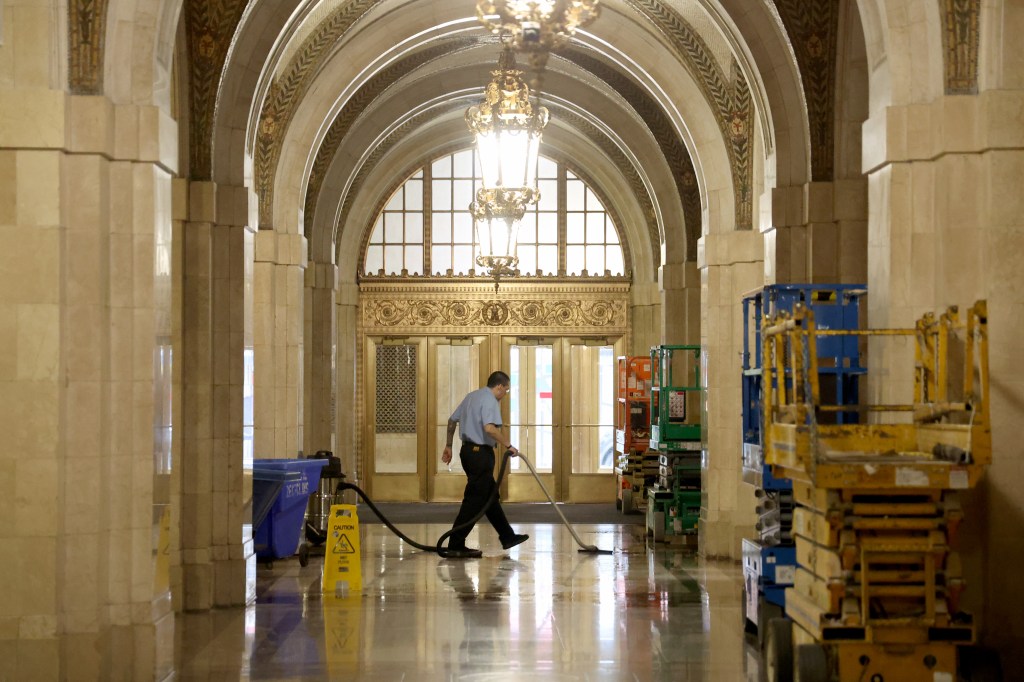
An employee pushes a cleaning cart past the mayor’s office at City Hall in Chicago on Oct. 1, 2019. (Antonio Perez/Chicago Tribune)
Asked why he and other aldermen who voted to pass the budget should not be blamed for the cut triggered by the budget, he pointed to the mayor’s initial recommendation.
The alternative budget only changed 1.4% of the mayor’s initial proposal, he said. That’s in part because the budget process is “flawed from the get-go,” he added. Only the mayor, and not aldermen, has the staff, tools and time to properly analyze the full plan, he said.
He also noted the budget needed to be passed at the end of December to avoid a government shutdown. Aldermen will try to take more control of the process next year, especially as they question Johnson’s implementation of their plans, Villegas said.
“We’re going to do more in the 2027 budget,” he promised. “This is beginning to look like it’s all political, and it’s frustrating. … Carry out the budget that passed.”
The mistrust between aldermen and the mayor cropped up in the City Council’s Finance Committee on Monday during a hearing on the city’s ongoing cashflow issues.
The renegade group of aldermen who passed the budget against Johnson’s will forced the meeting after Johnson’s administration paid only half of a roughly $260 million advance payment to help fund the city’s woefully underfunded public pensions. They also won support from 32 aldermen in a resolution demanding the full amount be paid immediately.
Underlying their effort is a belief that Johnson’s team was secretly angling to break away from the city budget they passed. Johnson had called for a smaller advance pension payment to be made during budget negotiations, but a council majority insisted upon the larger payment aimed at stabilizing the city’s pensions.
But Johnson’s team argued Monday the initial half payment was not an effort to breach the budget. His finance leaders promised the full payment will be made and pinned the delay on a late transfer of property tax revenues from the county.
“This is really about a timing issue,” Budget Director Annette Guzman said. “We have a ton of expenditures going out in the first quarter, and so we’re trying to prudently manage the cash flow as those other revenues come in throughout the year.”
According to records from the Cook County Treasurer, the city of Chicago received about 95% of its distribution — $1.68 billion of a levied $1.77 billion — by Dec. 29. That includes levies for Chicago Public Libraries and a special building improvement fund. Those disbursements would traditionally happen around August and September.
Steven Mahr, the city’s new acting chief financial officer, said he does not expect the delayed payment to be considered negatively by credit rating agencies. Though finance leaders warned the Cook County issues triggering the delay could persist, Cook County Board President Toni Preckwinkle said she did not anticipate delays related to bills due April 1.