Drone footage provides aerial perspective towards assessment of the entanglement. Photo:
Jason Moore / NOAA MMHSRP, permit 24359.
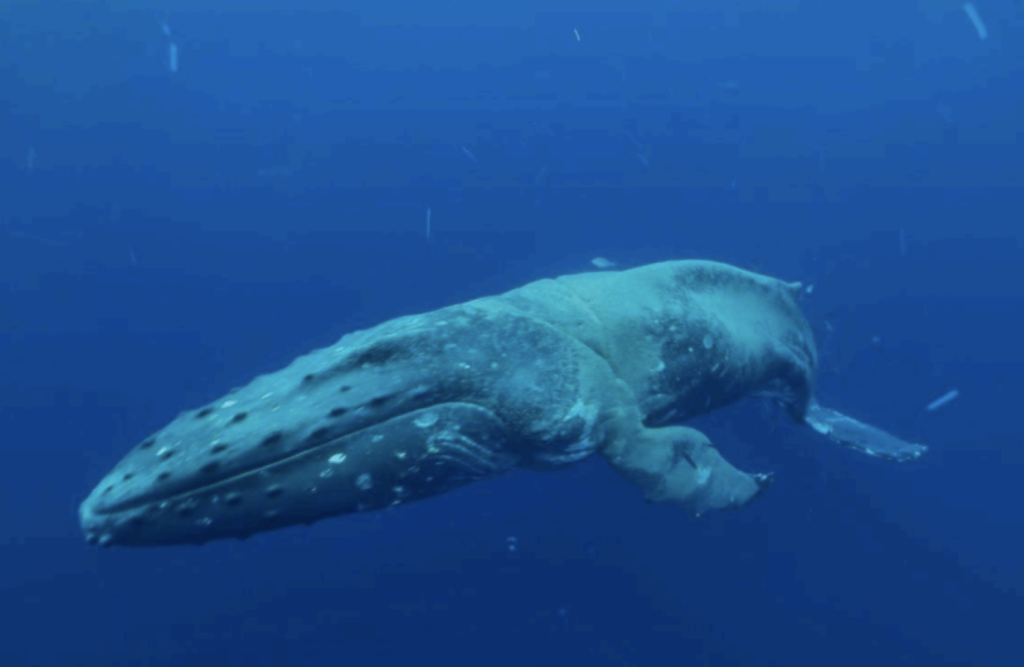
NOAA is asking Maui’s on-water community to be on the look out for a recently-entangled 40-foot female humpback whale off Lahaina, Maui. Hawaiian Islands Humpback Whale National Marine Sanctuary’s monitoring team encountered the whale, referred to as Palette, on Thursday, Jan. 22.
She was found to be in poor to moderate condition, showing moderate to strong emaciation and widespread carpets of red-colored cyamid amphipods (whale lice) across her otherwise light-colored body.
If she is spotted, please call 888-256-9840 to report her location and share photos or videos if possible, but do not approach closer than 100 yards.
Entangled-impacted humpback whale. Photo: Jason Moore / NOAA MMHSRP, permit 24359
Condition and Assessment
ARTICLE CONTINUES BELOW AD
Sanctuary staff confirmed that the whale had multiple deep entanglement wounds, encrusted with red-colored cyamid amphipods, around her rostrum (upper jaw) due to a previous mouth entanglement that also involved the thorax (chest) region.
The whale’s calm behavior allowed for close approaches, and the sanctuary team was able to thoroughly assess the animal. The nature of the deep, cyamid-covered wounds made it impossible to determine whether there was still gear present. Out of an abundance of caution, the team decided to make surgical cuts to remove any potentially remaining life-threatening wraps that may have been embedded in the wounds.
Experienced responders use a long carbon-fiber pole with a hooked knife on the end to make
surgical cuts to embedded gear. Photo: Maria Harvey / NOAA MMHSRP, permit 24359
Request to Mariners and Public Safety
Mariners are urged to keep a sharp lookout for this animal, but not approach closely or attempt to directly engage. She may be moving slowly due to impacts from her recent entanglement.
ARTICLE CONTINUES BELOW AD
Please reduce speed in and around West Maui to minimize the possibility of striking this or other whales.
Go slow, whales below
ARTICLE CONTINUES BELOW ADARTICLE CONTINUES BELOW AD
During whale season, especially in water depths of 600 feet or less, boaters are asked to maintain a speed of 15 knots or less (or safe planing speed) to minimize the risk of striking a whale. When directly approaching a whale to view it, or departing from viewing, speed should be reduced to six knots or less within 400 yards.
These speed recommendations for boating around whales were developed jointly by the sanctuary, the State of Hawaiʻi Department of Land and Natural Resources, Pacific Whale Foundation, and members of Hawaiʻi’s on-water community. These and other best practices can be found at: https://dlnr.hawaii.gov/dobor/boating-with-whales/
ARTICLE CONTINUES BELOW AD
Important Safety Warning: Approaching or attempting to free a 40-ton animal, even with good intentions, is extremely dangerous for both the whale and the would-be rescuer. Getting in the water is especially hazardous, and fatalities have occurred.
As a result, only trained, well-equipped responders authorized under NOAA Fisheries’ Marine Mammal Health and Stranding Response Program are permitted to disentangle whales. If the animal is re-sighted, life-threatening entangling gear is observed, and conditions and resources allow, an authorized response team may attempt to free the animal.
Reporting Distressed Marine Mammals
If you sight this animal or any marine mammal in distress, maintain 100 yards distance and immediately call the NOAA Fisheries’ 24/7 response Hotline at 888-256-9840. If calling is not possible, please radio the US Coast Guard on VHF CH. 16, and they will relay the report.
NOAA officials say they deeply appreciate everyone’s help in safely reporting, monitoring, and documenting compromised whales. Rapid reporting is the most effective way for the public to help these animals.
Hawaiian Islands Humpback Whale National Marine Sanctuary is one of the world’s most important whale habitats, and the only place in the United States where humpback whales mate, calve, and nurse their young. Designated in 1992, Hawaiian Islands Humpback Whale National Marine Sanctuary works to protect humpback whales and their habitat through research, education, conservation, and stewardship. The sanctuary is administered through a partnership of NOAA’s Office of National Marine Sanctuaries and the State of Hawai‘i Division of Aquatic Resources.