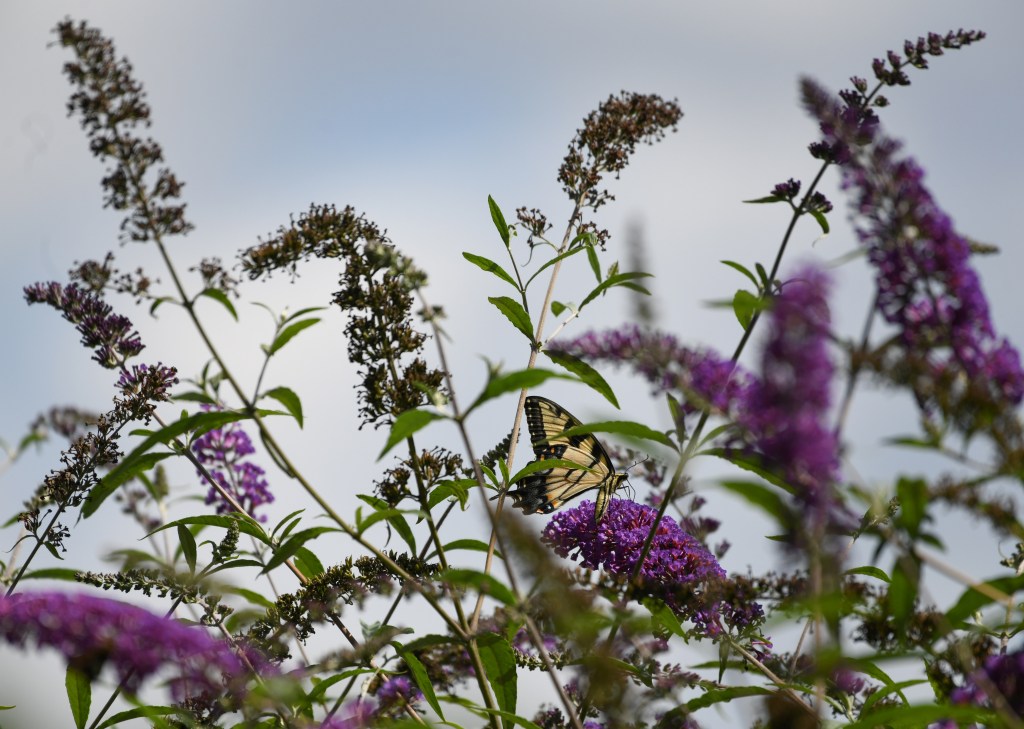
Are you getting spring fever? Tired of a long winter of shoveling? I promise you, there is hope in the unseen. As you read this, plants are gathering strength to reach to the sky. Soon, Leakin Park, Druid Hill Park, Cylburn Arboretum and every other patch of green in Baltimore will teem with new life. Some are edible, some are medicinal, some are poisonous, all are beautiful. Many are native, but too many are nonnative and invasive. Look for:
Queen Anne’s Lace — This carrot family member has a hairy stem and a white umbrella-like cluster of flowers, often with a dark red or purple center and feathery, fern-like leaves. Also known as wild carrot, it is native to Europe but is widely found in the U.S. Caution — it is sometimes confused with poison hemlock so do NOT eat it unless you are with an expert. Poison hemlock, unlike Queen Anne’s Lace, has a smooth, not hairy stem.
Chicory — Marked by beautiful, bright blue flowers, it is an immigrant from Asia. Roots and leaves are edible, and it is used as a coffee substitute.
Pokeweed — my personal favorite. A true native plant, it is only edible in the early spring by boiling the young shoots three times in fresh water each time. Made famous, at least to people of a certain age, by “Polk Salad Annie,” penned by Tony Joe White and covered by Elvis, it is a boon to migratory birds and small mammals who can safely eat its transcendent purple berries. When leading a school group, I love to crush a handful and react in horror as it looks like my hands are weeping blood.
Red clover — Another non-native, but useful as a cover crop and fodder for livestock. American pollinators have adapted and love it. It is in the legume family and fixes nitrogen in soil. It is edible.
Milkweed — Many farmers consider it a nuisance, but it is the only plant Monarch Butterfly caterpillars eat. It loves full sun. If you want butterflies in your yard, plant some. Its milky sap (hence the name) can be a skin irritant.
Dogbane — Also known as Indian hemp, dogbane is native and poisonous. Several butterfly species use it as food. Its red stems can be used to make cordage due to its fibrous bark.
Wingstem — also known as crownbeard, wingstem is a native North American treasure, with yellow blooms appearing in late summer through the fall. The leaves grow down the stem, creating a “wing.”
Carolina horsenettle — A member of the nightshade family, all parts of this plant are toxic. It has deep roots and sharp prickles. White to purple star-shaped flowers and small, yellow, tomato-shaped berries are keys to identification.
Blackberries and raspberries — Both red and black raspberries, as well as blackberries, are native to North America. The easiest way to tell the difference is that raspberries are hollow and blackberries are solid. Raspberries have round, smooth canes (stems) and blackberry canes have ridges. Raspberry thorns are soft and fuzzy, and blackberry thorns are meaner and hook-shaped.
Wineberry — Also delicious to eat, wineberry is non-native. Its canes are reddish in color and covered with spiny thorns.
Goldenrod — This North American native beauty is too often mistaken for ragweed and incorrectly deemed a nuisance. It will NOT make your eyes itch or your nose run. It is an essential native plant, hosting many pollinators. In conjunction with blue asters, it makes a stunning display.
Thistle — Best known for its brilliant purple flowerhead and prickly parts, native thistle is a major source of food for pollinators. A different species is the national flower of Scotland.
Mullein — Its tall spikes, covered with yellow flowers, make mullein easy to spot. It is non-native. You can dip the stalks in wax and use them as torches. It is used to make a popular tea, thought to soothe cold symptoms. To their sorrow, some people use its broad leaves as dunny paper — bad idea, as the leaves have fine hair that can irritate sensitive skin.
Yarrow — This yellow native beauty can be used as both a poultice and a tincture.
White avens — Also native to North America, it is a great groundcover. Bees, wasps and flies love it. Uniquely, it can grow under black walnut trees as it is not affected by their phytotoxins.
Prickly pear — This edible native cactus is found in Baltimore. Some consider it to be a superfood with many health benefits.
Carl R. Gold (cgold@carlgoldlaw.com) is a Maryland Master Naturalist.