
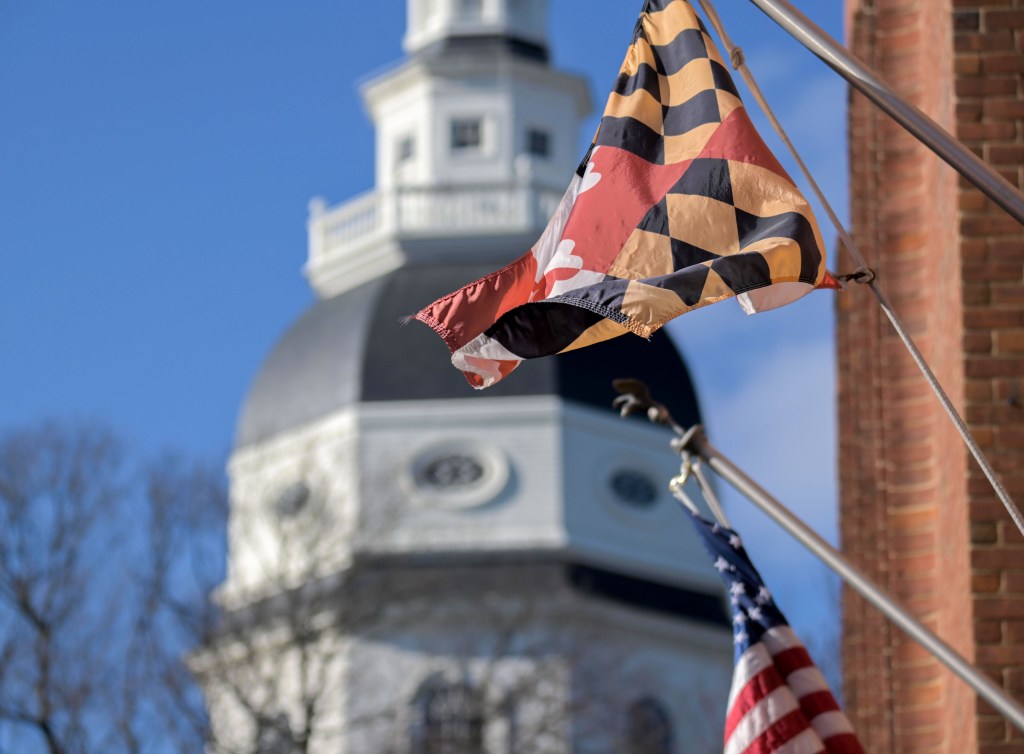
Did you know the Maryland State House has a network of underground tunnels? You’re forgiven if not, since they’re off limits to the public and media members.
Lawmakers and staff can walk underground between the State House, the Senate and House office buildings, and the Department of Legislative Services’ (DLS) spanking new building.
I got a tour last week as the Maryland General Assembly kicked off its new 90-day legislative session, and these are my impressions:
The tunnel network isn’t quite what you find beneath the U.S. Capitol. There’s a whole world down there in Washington with barber shops, subway lines with cute, little open cars, and U.S. senators’ “hideaway offices” where they can prepare for floor speeches or take naps. Some of those hideaways have spectacular Washington views from up high.
The Annapolis tunnels lack those amenities and have a spartan, bunker-like feel. But because they connect to the Department of Legislative Services building, that was the highlight of the tour.
The State House complex, in general, maintains a deliberately historic feel, connecting it to its roots. The newer buildings share the same aesthetic so that they blend in.
The DLS building — which opened about a year ago and cost more than $100 million — is modern and sleek. It still has a “new car” smell. There are cameras and TV monitors everywhere, and you need to swipe an ID card to enter many rooms, which makes it feel secretive and important.
The DLS performs a vital, and to some, little-known function. Its staff conducts research, drafting and analyzing bills.
It’s a nonpartisan entity in an increasingly partisan world.
The new building replaces one that was functionally outdated. It had cramped offices and aging mechanical systems.
And “it had bats,” said a worker in the building whom we passed on the tour.
‘Major gambling scandal’
This was The Baltimore Sun’s headline on a story I wrote in 2019: “Former Terps star McMillen predicts ‘major gambling scandal’ tied to college sports betting in future.”
Last Thursday’s hoops scandal may have been startling to some, but not to former Maryland congressman and basketball star Tom McMillen. He’s also a member of the University System of Maryland Board of Regents, whose sobering prediction came before the state legalized gambling on football, basketball, and other sports.
The indictment alleges 17 NCAA Division I men’s basketball programs — including Coppin State — were involved in a massive gambling scam to rig games.
McMillen wrote letters to Maryland state officials in 2019 saying college athletes “are vulnerable to outside gambling influences” and the state must ensure that schools have the resources to safeguard against scandals.
In an interview on Friday, McMillen said various factors have made such scandals inevitable.
“This experiment of putting big-time sports and schools together is uniquely American,” he said. “There’s not a country in the world that has gambling so intertwined with higher education.”
Fans may also know that athletes in the highest-profile sports like football and men’s basketball can get rich from endorsements and, to a lesser extent, from revenue sharing with their athletic departments.
But a typical Division I athlete may earn little to nothing from endorsements. Many such deals are modest. Maybe a gig promoting a local car company.
“This is exacerbated by the locker room differential,” McMillen said. “One player may be making a million dollars and another nothing.”
The legislative session continues on Tuesday, with over 500 prefiled bills that the General Assembly may deliberate over.
Later this week, a bill restricting the U.S. Immigration and Customs Enforcement officers’ face coverings was designated as “Senate Bill 1,” and one that I wrote about recently. A measure that may also be considered will address the use of artificial intelligence and deepfakes “in order to cause physical injury, serious emotional distress, or economic damages” will also be considered, an issue that Maryland lawmakers took up after the federal government tried to discourage states from regulating AI.
Have a news tip? Contact Jeff Barker at jebarker@baltsun.com.


