Abbey Hamilton is a junior at Yarmouth High School.
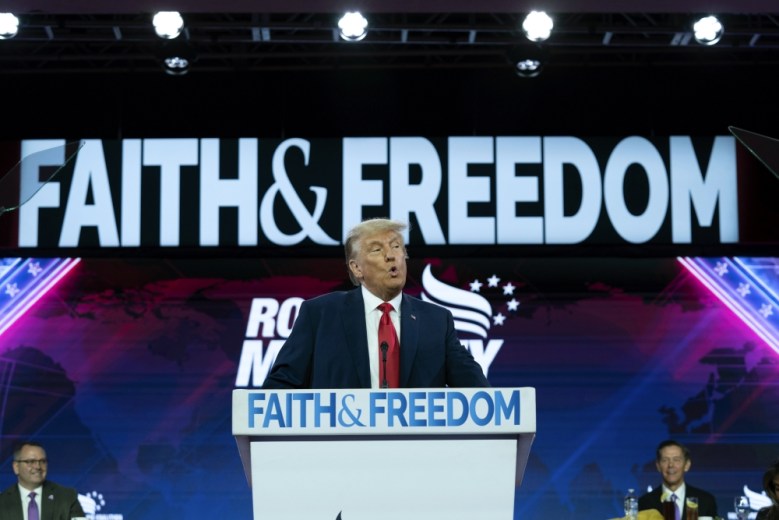
Recently, it seems as though the words “Christianity” and “conservatism” have become inextricably linked in America; this leaves a sour taste in my mouth.
By simply scrolling through social media, I’m met daily with posts from far-right politicians featuring Bible verses, including one last month from the Department of War reading, “I pursued my enemies and overtook them. I did not turn back until they were destroyed. Psalms 18:37.” The background of the post depicted two U.S. soldiers firing automatic weapons. The White House now advertises “God Bless the USA Bibles,” which include the chorus to “God Bless the USA” by Lee Greenwood, for $59.99.
Right now, searching the word “Christian” on any major news platform will generate a slew of articles about Christian nationalism, anti-immigrant sentiment and right-wing policy.
As a young person who was raised in the Church, I have found this trend to be exceedingly frustrating. MAGA extremism is completely antithetical to the teachings of Christ. You cannot claim to love your neighbor in church on Sunday and then cheer for ICE raids that undermine their dignity on Monday.
Scripture lays out the teachings of Jesus simply: be kind, be tolerant and be loving. Utilizing his words to justify the spread of hate is a dangerous distortion of truth. There is great hypocrisy in claiming to be a Christian while extending the foundational tenets of Christianity only to those you deem worthy — effectively turning mercy into a members-only club.
Finding evidence of this contradiction is as simple as opening a Bible and looking to one of the many times Jesus gave Christians the answer to the question “How should we treat each other?” Take, for example, Matthew 25:40, “Whatever you did for one of the least of these brothers and sisters of mine, you did for me.” Or Ephesians 4:32, “Be kind to one another, tenderhearted, forgiving one another, as God in Christ forgave you.”
If this is God’s vision for how humanity should treat each other, how is it God’s will to condemn the poor as lazy and suggest that those seeking refuge “go back to where they came from”? Is the far-right’s view of justice — cutting social safety net programs, reducing refugee admissions and criminalizing the homeless — truly in line with God’s intentions for society?
To this, a conservative Christian might point out that those living in poverty find themselves in that position as a result of their own actions. They might mention that refugees are a drain on American systems, and homeless people invite violence into cities. In response, I would ask them to remember that the kind of love Christianity calls us to practice is not bound by self-imposed divides.
In the eyes of God, there is no difference between you and that impoverished person, that homeless person, that refugee. The Bible states that God loves all people equally. In this regard, how you treat others is how you treat God; to treat a struggling person with respect is also to treat God with respect. For Christians, benevolence is a duty and not a choice.
It has saddened me that in an age full of divisions, Christians are sticking out, not as paragons of moral righteousness, but as proponents of intolerance.
I am constantly witnessing a turning away from Christianity among young Democrats who have come to equate the religion with irrationality and vindictive spirit — a direct result of its extremist Republican misrepresentations. This observation marks a larger trend: the number of Democrats who identify as Christian is decreasing and has already dropped from 70% to 58% in the past decade.
This is not to say that we should convert more Democrats to Christianity. In fact, I am a staunch advocate against evangelism and strong church-state connections. I take issue with the fact that we as a faith are isolating people from a belief system that is supposed to be based in inclusion, an irony so twisted it is almost laughable.
America’s perception of Christianity has been horribly stained by ultra-conservative interpretations that paint Christians as spiteful, judgmental and deeply hypocritical in their convictions.
Christians must work to rebuild this image.
We must hold ourselves to the high moral standards our religion demands and act always with the knowledge that living a “good Christian life” simply means treating people with kindness and respect. We ourselves must embody the change in rhetoric we hope to see in this country.
It is now all we can do to build bridges and pray they will not be torn down.