Candidates for Louisiana’s Fifth Congressional District are divided on whether to pass a national abortion ban — and their support for the Medicaid cuts in President Donald Trump’s One Big Beautiful Bill Act varies.
Five of the nine candidates in the race shared their views on those issues during a forum hosted by the Press Club of Baton Rouge on Monday, just eight days before Election Day.
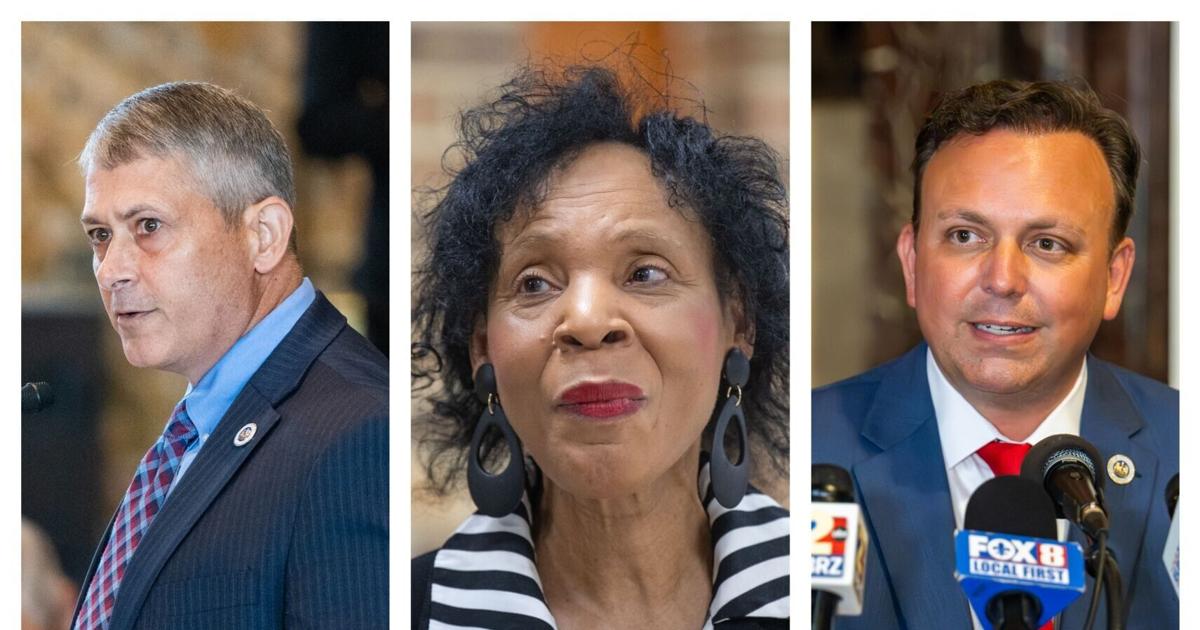
Attendees included three of the race’s five heavy-hitters: state Rep. Michael Echols, a Republican from Monroe; state Rep. Pat Moore, a Democrat from Monroe; and state Rep. Gabe Firment, a Republican from Pollock.
Austin Magee of Franklinton, who is casting himself as an independent-minded Republican, and Dan McKay, a lawyer and Democrat from Bunkie who is running to the left of Moore, also joined them.
The two other major candidates in the race — Misti Cordell, a Republican who chairs the LSU Board of Regents, and state Sen. Stewart Cathey, a Republican from Monroe — were invited to the forum but did not attend.
Antonio Wilson, a Democrat from Tallulah, and Oscar ‘Omar’ Dantzler, a Republican from Hammond, also did not go.
The 5th Congressional District, which is expected to go to a Republican, touches 24 parishes and covers northeast Louisiana. Much of the district is rural, and it includes the towns of Monroe, Bunkie, Bogalusa, Alexandria and Amite.
Voters can pick any candidate regardless of party. Unless someone gets more than 50% of the vote — an outcome that is highly unlikely with so many names on the ballot — the top two vote-getters will compete in a December run-off.
During the forum and in follow-up interviews, only McKay said he supported giving women regular access to abortion. Moore, Firment and Magee said they would support a national abortion ban.
Echols, who opposes abortion and voted to ban it in Louisiana, said during the forum that he would “100 percent support a national abortion ban” — but in a follow-up statement, he clarified that he supported states’ rights and said states should have the “autonomy to govern,” though he hopes they would also choose a ban.
Moore sought to set herself apart from the Republicans by saying she would support giving families more resources, such as access to healthcare and early childhood education, to support children after they are born.
Republicans and others “want the baby to come into the world, and that’s it,” Moore said. “That’s hypocritical. What I want to do is reduce the number of abortion, by putting and funding different things that will do that.”
Moore, McKay, Echols and Magee all said they support access to birth control. Magee said it ought to be as widely available as possible, especially if the country bans abortion; he also said he would support exceptions to abortion bans for victims of rape and incest.
Louisiana has one of the country’s strictest abortion bans. It only permits abortion in cases where a pregnancy threatens the life of the mother, or when the baby would not survive the pregnancy.
Firment and Moore said they would oppose rape and incest exceptions. Firment did not reveal whether he supports access to birth control, saying he would let his record in the Louisiana Legislature “speak for itself;” during the forum, he also said he believes “life starts at conception.”
As for the controversial cuts to Medicaid that were made through the One Big Beautiful Bill Act, Echols and Firment said some changes were needed to prevent fraud, waste and abuse. At the same time, Echols, who previously worked for a multi-state healthcare plan and has sponsored numerous healthcare-related bills in the Legislature, also said he would make improving the healthcare system a priority and argued he has the know-how to help rural hospitals.
McKay, Magee and Moore all said they opposed the Medicaid cuts, which McKay said threaten rural hospitals, including in the Fifth District.
The One Big Beautiful Bill Act is expected to reduce federal spending on healthcare and food assistance programs by $1 trillion over the next decade, largely by imposing work requirements and making states pay more for those programs.
The midterm elections, which are scheduled for Nov. 3, will determine whether Democrats take control of Congress or whether Republicans can keep their majority.
In Louisiana, early voting began Oct. 20 and will end on Tuesday at 6 p.m.