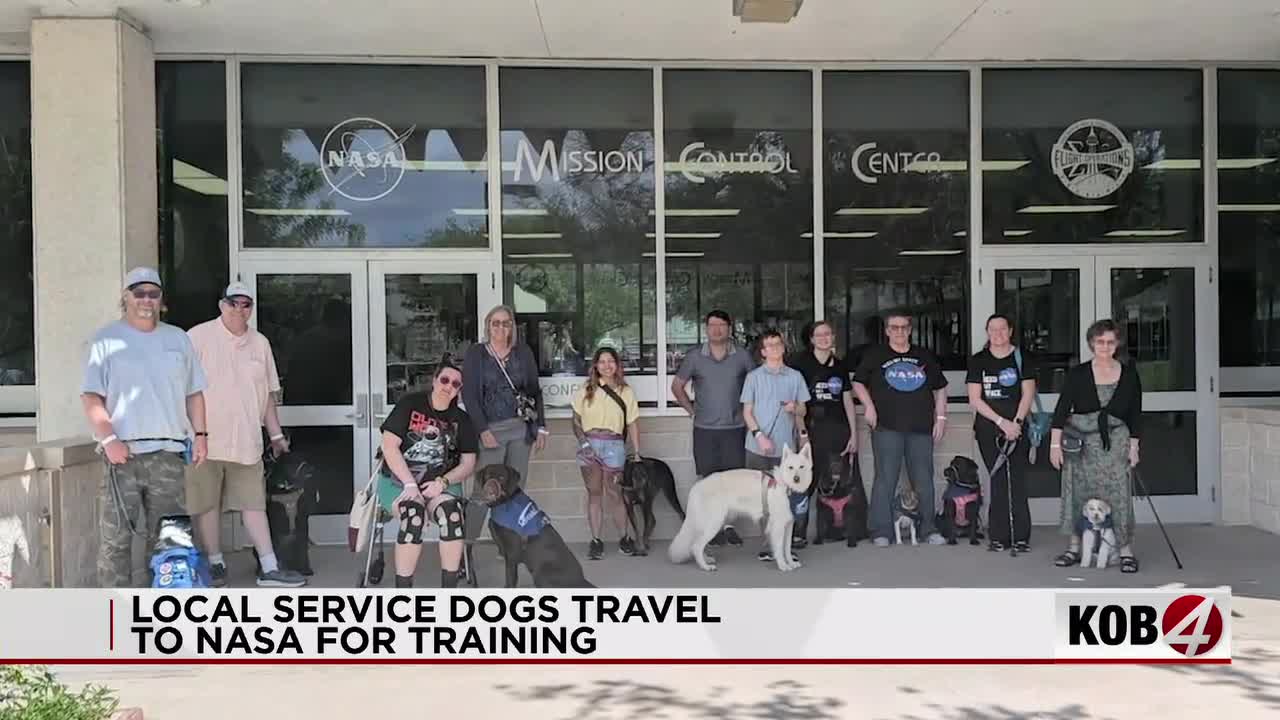
Before the Artemis II crew prepared to launch toward the Moon, a very different type of team arrived at NASA’s Johnson Space Center — service dogs and their handlers from Albuquerque.
ALBUQUERQUE, N.M. – Before the Artemis II crew prepared to launch toward the Moon, a very different type of team arrived at NASA’s Johnson Space Center — service dogs and their handlers from Albuquerque.
The Academy of Canine Excellence was invited to Houston in March, bringing eight service dogs and 16 handlers for a real‑world training experience inside one of the busiest, highest‑stress environments in the country.
While the trip may sound like fun, the academy says it served a much bigger purpose.
Training beyond the classroom
The Academy of Canine Excellence specializes in training service dogs for a wide range of needs, including autism support, seizure response, diabetes alerts, PTSD, anxiety and more.
“We do train dogs for autism, support for seizures, for diabetes, PTSD, anxiety — pretty much everything under the sun,” said Briaun Prichard, owner of the Academy of Canine Excellence.
Just as astronauts prepare for space through simulations and hands‑on experience, service dogs also need exposure to unpredictable, real‑world situations. The NASA visit allowed the dogs to practice navigating large crowds, tight spaces, loud environments and long travel days — all while staying focused on their handlers.
From the ground to the skies
For some of the dogs and handlers, the most challenging part of the trip wasn’t NASA itself — it was getting there.
“Probably the hardest thing for most of them was the airplane itself,” Prichard said. “They have to tuck into really little places and be comfortable staying there for a good period of time.”
Once at Johnson Space Center, the dogs worked through busy corridors and high‑energy environments, proving their training goes far beyond basic obedience.
“It’s not just about obedience,” Prichard said. “It’s about making sure they can act in any type of environment where their handlers want to go.”
Life‑changing support, one paw at a time
Some service dogs, like Lilly, are trained to detect changes in blood sugar — often before the handler feels symptoms.
“She specialized in blood sugar alert, so high and low blood sugar,” Prichard explained. “She can actually smell it when those different changes occur.”
Lilly signals her handler in different ways, including a nose nudge, vocal sounds or jumping up to get attention when something isn’t right.
Showing what’s possible
Prichard says trips like this are about more than training — they’re about showing people with disabilities that travel and exploration are still possible.
“One of the reasons why we do what we do is to let people know that just because they’re disabled does not mean they cannot do big things,” she said. “Going to NASA was one of those things.”
The Academy of Canine Excellence aims to plan at least two trips like this each year to continue proofing their dogs’ skills in real‑world settings.
In addition to service dog training, the academy also offers training for household pets. More information can be found on the Academy of Canine Excellence’s website and social media pages.
- For Related Stories: Emily Faith