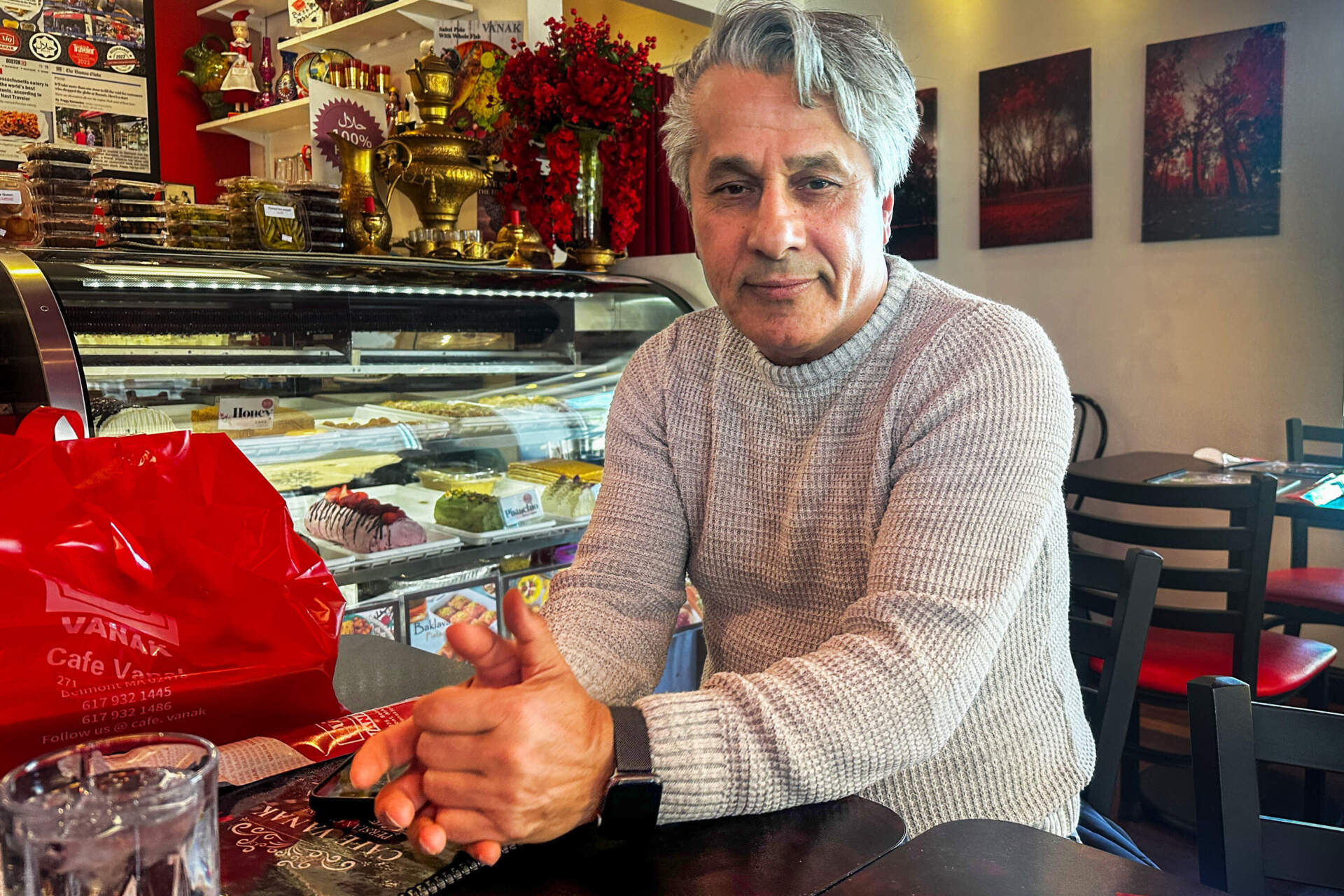
At lunchtime at Cafe Vanak in Belmont, Reza Hassanzadeh sat with the owner of the Persian restaurant, drinking black tea and talking politics in Farsi. Originally from Tehran, the 66-year-old university professor lamented the thousands of protestors killed by the Iranian regime in recent weeks.
He pulled out his phone to show photos of some of the victims.
“Those people just wanted freedom,” he said. “They were shouting: ‘Freedom for Iran! Freedom for Iran!’ All they wanted [was] to have a free life, a prosperous life.”
Iran is a vast country with 90 million people of various ethnicities. For those Iranians in the U.S., there are an array of opinions on the war President Trump has brought to their home country. And there’s no clear indication the Iranian people can replace the Islamic Republic with the kind of secular democracy many are calling for.
But the recent slaughter of Iranians by their own government received nowhere near the level of attention it deserved, according to Hassanzadeh, who is not sorry to see the U.S. and Israel striking military targets across Iran.
A group called the Human Rights Activist News Agency puts the protester death toll at nearly 6,500 — along with more than 53,000 arrests — while President Trump has cited a much higher figure. Hassanzadeh said even the president’s number could be an undercount.
And in his view, that was just the latest atrocity by the Iranian government against its own people. Now he believes that Trump, along with Israel’s Prime Minister Benjamin Netanyahu, have opened the door to potential freedom in Iran.
“We have been waiting for this for the last 47 years,” Hassanzadeh said.
“Of course we know there will be a lot of obstacles. But the main obstacle is to remove this regime from power,” he said, “and let the country flourish.”
Zohreh Beheshti and her husband, Babak Shams Asef, own the Iranian cafe in Belmont. She said the bombing campaign, and the deaths of innocent people, are too high a price to pay when the outcome is far from certain.
“It could be my sister, it could be my friend — they could be all my relatives,” she said. “So why they [have to] die? They should find another way.”
Beheshti has been in the U.S. for 30 years, and until now, she’s returned to Iran regularly to visit. Despite her opposition to the bombing campaign, she does not support the regime in Tehran.
“I hate them,” she said. “I hate them, but … I’m not sure that something good happens after this.”
Critics say the U.S. has a failing record when it comes to foreign interventions, citing countries like Libya and Afghanistan where American military might promised to bring liberation but resulted in more war.
For Himan Namdari, who’s originally from the Kurdish region of Iran, those comparisons are all but meaningless.
“Everything is different,” he said. “The culture is different, the oppression level is different, the history of those countries are different. So you cannot generalize.”
Namdari said he’s feeling a sense of “happiness, sadness, tenderness and confusion.” He said the death of Ayatollah Ali Khamenei was a dream come true for many Iranians — especially for minority groups like the Kurds.
He lives in Worcester, where he’s completing his postdoctoral studies. As a data scientist, he knows nothing in the future is guaranteed — but he said for the first time in his life, there’s hope that Iran can become a free country.
“I believe that this time, the Iranian people are ready to gain their democracy,” Namdari said.
This segment aired on March 3, 2026. Audio will be available soon.