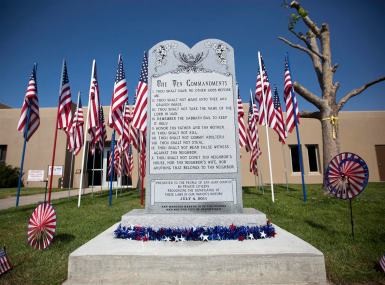
When I think about Arkansas legislators requiring public schools to display the Ten Commandments, a purely American commandment also comes to mind: The First Amendment to the U.S. Constitution.
Ratified in 1791, the amendment protects a wide range of freedoms.
Rather than rely on my interpretation, consider the amendment’s exact wording: “Congress shall make no law respecting an establishment of religion, or prohibiting the free exercise thereof; or abridging the freedom of speech, or of the press or the right of the people peacefully to assemble, and to petition the Government for a redress of grievances.”
The amendment doesn’t declare which religion should be government-endorsed because it clearly says the government is to establish no religion — not Christianity, not Islam, not Judaism.
Christians and others should be grateful for that. Otherwise, the long, arduous voyages of early Puritans, Quakers and pilgrims who came to America in search of religious freedom would now be in vain.
Besides, who decides Christianity and its beliefs? Baptists and Catholics would surely clash if the government ordered them to believe the same thing when it came to drinking anything stronger than a Shirley Temple or regulating the chastity of priests or pastors. Episcopalians, Catholics and Church of Christ members would differ on everything from gender-related issues to alcohol to the application of the commandment about “graven images” (Are we talking about statues of the Virgin Mary and Jesus? What about crosses often worn as ornamental necklaces? Who decides— the governor, the political party with the most votes, or just you, the individual?)
Megan Bailey, communications director for the American Civil Liberties Union of Arkansas, declined to say whether the organization plans to sue over the Arkansas statute, though she made the ACLU’s stance clear.
“It is a fundamental protection in America that students and parents, not politicians or school officials, get to make their own decisions about religion and religious teaching,” Bailey said. “We remain concerned about the serious violation of Arkansans’ rights under this new law and have been visiting with concerned fellow Arkansans.
“We are continuing to work with Arkansans who are worried about this intrusion on our religious liberty,” Bailey added.
Bailey said any concerned Arkansans, particularly parents of public school children, can contact the ACLU of Arkansas “to discuss their rights and options, including potentially filing litigation.”
Count me as a worried Arkansan. I still remember the time I was a sixth-grader and my teacher led a prayer that most good Southern church-goers would have admired. Yet I noticed one line in the prayer that I’d been taught did not apply today. True, I wasn’t that upset, but the point is, her prayer conflicted with what “my” church had taught. And it shouldn’t have been my school’s place to teach religion; that was my parents’ and church’s responsibility.
Legal scholar John DiPippa is no fan of the Arkansas law but believes it might survive a court challenge.
“The law is a mess but if I had to bet, I’d bet on the current makeup of the judiciary upholding the statute,” said DiPippa, dean emeritus of the UA Little Rock William H. Bowen School of Law and distinguished professor of law and public policy.
DiPippa said context and purpose “are all important” when looking at the legal issues involved in the statute.
He noted, for example, that in 1980 the U.S. Supreme Court struck down a Kentucky law that mandated posting of the Ten Commandments in public schools “because the law served no secular purpose.”
About 20 years ago, though, DiPippa recalled, the Supreme Court “decided a pair of cases upholding one display in Texas but striking down one in Kentucky.”
“Context mattered,” DiPippa explained.
“The Texas display was over 40 years old and among other statues honoring Texas history, while the Kentucky one was a standalone in a courthouse,” DiPippa said.
Unlike DiPippa, I’m no legal scholar. But I know enough about freedom and attempts to violate it, to know when a constitutional line is being crossed.
In short, street preachers can talk all day and into the night if they want as long as they follow local ordinances or don’t hit anyone over the head with the Bible, the Koran, the Book of Mormon or a concrete slab of the Ten Commandments.
But the government shouldn’t be preaching the gospel, the Koran, the Torah or the Book of Mormon. The Constitution? Now, that’s OK and more needed than ever.