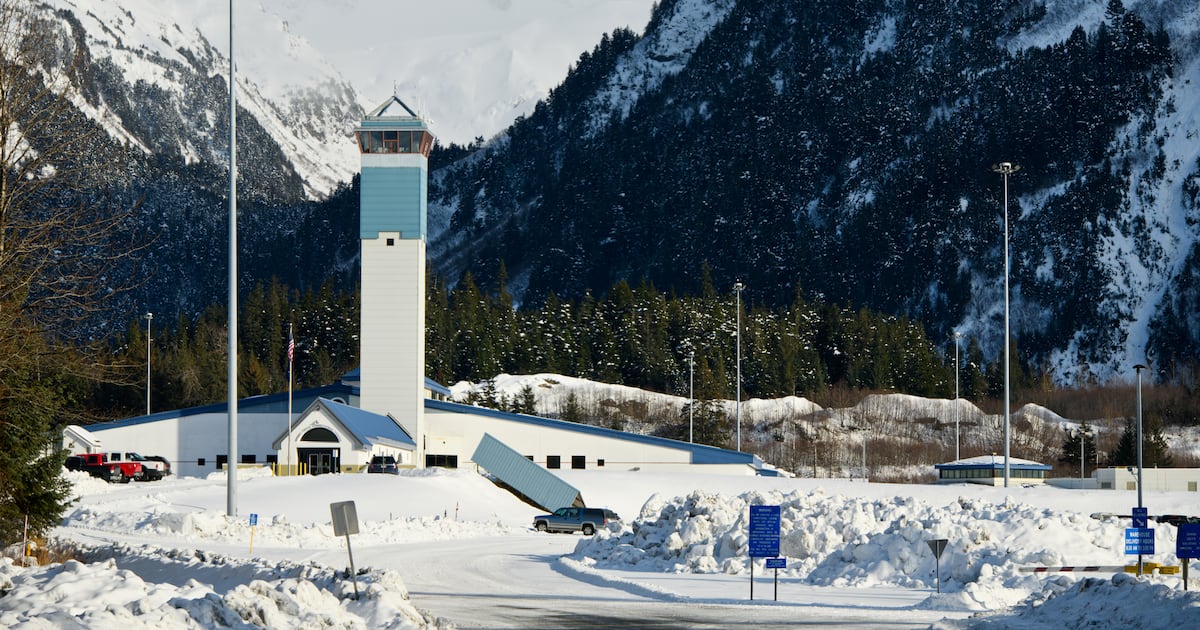
Spring Creek Correctional Center in Seward on Feb. 26, 2020. (Marc Lester / ADN)
The Alaska Department of Corrections is facing heightened scrutiny from lawmakers after its budgets have repeatedly exceeded the Legislature’s approved spending plans.
Though the number of inmates has remained largely stable since 2019, state spending on the Department of Corrections is up more than 54%, far outpacing inflation. The budget has grown every year since Gov. Mike Dunleavy has taken office, commanding an increasing share of annual state spending. This year’s budget request exceeds $500 million for the first time.
The skyrocketing spending has legislators for the first time in years considering sending inmates to private prisons in the Lower 48.
The policy proposal was raised during a Senate Finance Committee hearing earlier this month, after the Dunleavy administration asked lawmakers to add $24 million to the department’s existing $428 million state appropriation.
It’s not the first time Alaska has considered sending inmates to for-profit prisons as a cost-cutting measure. For years, hundreds of Alaska inmates were sent to private prisons in Arizona and Colorado. In 2013, the state returned the last of the inmates to Alaska, after spending $240 million constructing a new facility, Goose Creek Correctional Center, in the Mat-Su.
Dunleavy again considered sending prisoners out of state in 2019, but ultimately scrapped the plan. Senate Finance Committee co-chairs Bert Stedman, R-Sitka, and Lyman Hoffman, D-Bethel, said earlier this month that the option should be on the table given the rising cost of keeping roughly 4,300 Alaskans behind bars in-state.
“We have to have a serious conversation about that topic because the current situation is, from my viewpoint, unaffordable,” Hoffman said.
‘Unrealistic and unrealized savings’
Lawmakers zeroed in on the budget for prisons and jails earlier this year after the department indicated for the third year in a row that it is on track to spend more than lawmakers originally allocated to it.
That happened despite efforts by the Senate Finance Committee members last year to force the agency to cut its spending by ordering it to close a wing in the state’s maximum-security facility.
Senate budgeters last year cut funding for the Spring Creek Correctional Center in Seward by $7.5 million, telling it to close one of three units in the prison to achieve the savings.
The department followed lawmakers’ instructions last summer and closed the wing, department leaders said, scattering the inmates that resided there in other units of Spring Creek and other facilities. However, the department was unable to save any money, said the department’s Deputy Commissioner April Wilkerson, because closing the unit — with its 247 beds — did not do away with the cost of housing the inmates that had been located in that wing.
“Those are unrealistic and unrealized savings that were expected, and to meet operational needs, we need to have those funds restored back to the budget,” Wilkerson told lawmakers this month, defending the department’s supplemental budget request.
Corrections Commissioner Jen Winkelman told lawmakers that a fight in Spring Creek last month, which involved 48 inmates, may be tied to the wing closure. The department estimates that addressing the incident, which Winkelman said involved two opposing gangs in the facility, will cost the department $200,000.
“The house closure there led to more tension,” Zane Nighswonger, director of corrections institutions, told Senate members in a hearing Tuesday. “It’s predictable that tensions are going to be higher when you have more prisoners than you could have in a certain location, cooped up.”
Now, the department is asking not only for that funding to be restored, but for additional state dollars to be added to the budget to cover the growing costs of staffing and health care.
Department officials attribute the budget growth primarily to two factors: a challenge in recruiting and retaining state employees that has driven a heavy reliance on overtime pay, and the increasing cost of providing medical care to inmates, who are getting older and sicker in a state with one of the highest health care costs in the nation.
The funding request has yielded anger and incredulity from some lawmakers, who are facing a tight revenue picture and a request from the governor to drain the majority of funds from the state’s rainy day account by the end of the coming fiscal year.
Meanwhile, other lawmakers think that the growth in the Department of Corrections budget is not in itself the problem. Rather, the problem is what they call a short-sighted effort by the Legislature to cut the department’s budget without addressing the root cause of its growing expenses.
“We can’t pretend that things are going to be OK if we just have less money. We don’t live in this fairyland world where somehow we can go through a budgetary exercise of, ‘Oh yeah, we reduced by a third, so we can just cut a third of your budget,’” said Sen. Jesse Bjorkman, a Nikiski Republican, during a State Affairs Committee hearing on Tuesday.
Bjorkman called last year’s order to close a wing in Spring Creek “a budget exercise that wasn’t the most thoroughly vetted.”
‘An impossible question’
Facing a budget request from the Department of Corrections that for the first time ever exceeds $500 million, lawmakers have been questioning department officials on possible savings.
“Where should I go and look for a $5 million cut?” Rep. Ky Holland, an Anchorage independent, asked department leaders Tuesday.
Winkelman called it “an impossible question.”
That’s because the Department of Corrections, in her words, is a “downstream agency” that must respond to policy calls by the Department of Law and other public agencies. Seemingly unrelated changes, such as an increase in the number of filled prosecutor positions, could impact jails and prisons down the line, according to Winkelman.
“We do not know what’s going to come through our back door,” she said.
The department’s budget is driven in part by its inflexible staffing formulas. Every correctional facility must be manned by a set number of officers and support staff, determined by the department based on the type of prison and inmates housed in each facility. On average, there are between four and five inmates for every correctional officer in the department. If there aren’t enough employees to meet the requirements, the department doesn’t simply slacken the staffing ratios. Rather, it demands that existing employees work overtime.
That differs from other public agencies, where insufficient staff does not lead to overtime mandates. Instead, the agencies do less — they process fewer public assistance requests, rack up criminal case backlogs or plow less snow. The Department of Corrections doesn’t have the option of overseeing fewer prisoners, officials say.
“When the individual comes to us, we don’t just get to say ‘no, we’re not going to take them,’ or ‘no, we’re not going to treat their medical needs,’” said Winkelman.
The overtime mandates led the department last year to spend over $22 million on more than 329,000 overtime hours, the equivalent of more than 158 full-time employees. Nearly 1,700 individual employees reported working at least one hour of overtime in 2025. Of them, 179 reported at least 500 hours of overtime. Two employees reported more than 2,200 overtime hours each — meaning they worked more than the equivalent of a full-time job, on top of their full-time job.
Of its more than 2,100 funded staffing positions, more than 300 are vacant. The number of filled positions went down last year compared to the year before.
Staffing accounts for two-thirds of the department’s requested budget this year. Department officials said that health care is another cost driver.
The department is asking for authority to spend more than $66 million on inmates’ physical health care next year, more than double the figure from 2018.
“We have a very unhealthy population, and medical costs are extremely high,” said Winkelman.
The Department of Corrections also is the largest mental health provider in the state, with more than three times the capacity as the Alaska Psychiatric Institute. Four-fifths of inmates have substance use disorders. Last fiscal year, the department tallied 5,926 medical appointments for inmates outside prisons and jails. It also operates an in-house dialysis unit and provides hospice care to dying inmates.
The state covers virtually all costs of health care for inmates, unlike non-incarcerated Medicaid recipients, whose health care bills are paid primarily by the federal government.
Anchorage Democratic Sen. Bill Wielechowski said that the Dunleavy administration should have put forward policy ideas addressing the ballooning costs.
“I don’t recall seeing any proposed legislation coming out in the last seven and a half years dealing with this issue. The philosophy seems to be, ‘Let’s just lock them up.’ I think the public needs to understand that there’s a huge cost to that,” he said.
Task force
Rather than propose any specific places to cut the corrections budget, Winkelman suggested to lawmakers that they form a task force “to figure out which policy changes are going to make that difference in order for us to be able to stay within our means.”
“We’re going to need some sort of a task force with other agencies, with the Legislature, with law enforcement,” said Winkelman. “The cost is going to be shifted somewhere else unless it’s fixed upstream.”
Winkelman later said that she envisioned the task force hiring a consultant to review the department’s budget. She acknowledged, with an apology, that she was asking lawmakers to spend more money to fix the problem of spending too much money.
Holland said he is concerned about the idea of relegating budget cuts to a task force. State officials should be coming up with savings without a new line item in the budget, he said.
Holland repeated a comparison that lawmakers have often made: While the corrections budget has ballooned, the state’s spending on public schools has stagnated. Both have costs that are primarily driven by staffing — in one department it is correctional officers, and in another it is teachers.
While the Department of Corrections has firm standards for the ratio between inmates and guards, the number of students per teacher in Alaska’s schools has been on the rise as state funding has plateaued.
Under Dunleavy, spending on public schools has gone up only 6%, far below the rate of inflation.
“I just hope you understand how incredibly challenging this is when we realize that something as important as education has none of the safeguards that we insist must be in place for public safety and corrections,” Holland told Winkelman.
Winkelman said that as a mom of two school-aged children, she agrees.
“I’m fighting this battle every day of how expensive (the Department of) Corrections is,” she said. “And I know it is taking from our school system.”