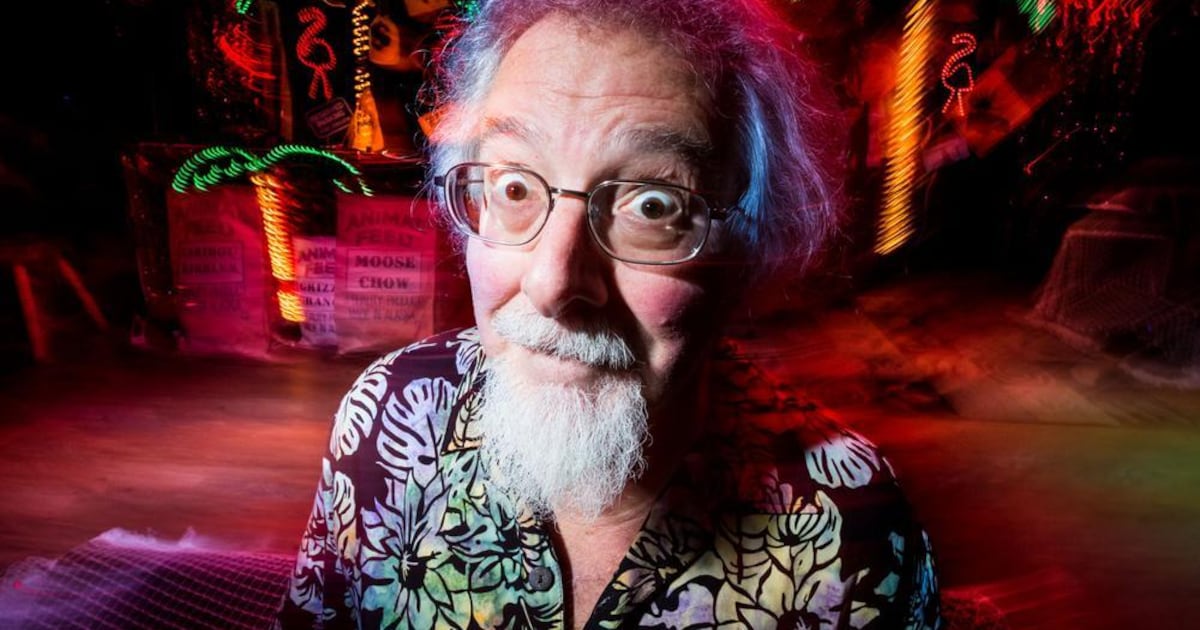
Mr. Whitekeys, pictured here on stage at the Tap Root Public House on June 10, 2014. He died last week at age 79. (Loren Holmes / ADN archive)
Mr. Whitekeys, the musician, humorist, writer and Spenard icon, died last week at age 79.
Whitekeys, whose given name was Douglas Haggar, operated the legendary Fly By Night Club in Anchorage and created the outlandish and satirical Whale Fat Follies revue.
Whitekeys was remembered as an artist who wasn’t afraid to deliver an unvarnished assessment or a righteous strike on authority.
“I loved him because he was an honest man, and he was a Renaissance man,” Anchorage historian David Reamer said. “He knew the history, he knew the lore of his area, his neighborhood, his Spenard. He knew that crime was the inescapable aspect, and he could lean into that accurately.”
Mr. Whitekeys waves to the crowd during Anchorage’s Fourth of July Parade along the Delaney Park Strip in 2022. (Marc Lester / ADN archive)
Whitekeys’ act was often equal parts cheese and sleaze.
He performed goofy songs like “Don’t Let Me Go Alone to Costco” and parodies like “There’s No Nuggets Like Moose Nuggets.” But he also embraced the seediness of Spenard in the early era of the Fly By Night Club, which he opened in 1980.
“Sleaze was one of his most used words,” Reamer said. “Unavoidable, while still loving Spenard. And that love was also there in every single thing he did.”
Kurt Riemann, who operates Surreal Studios in Anchorage, first met Whitekeys in the 1970s. By the 1980s, the two had become friends and Riemann and Whitekeys eventually worked together on a number of records.
The Fly By Night crew in 1988 included “Sourdough” Mike McDonald, Douglas “Satchmo” Everton, Jessie Barksdale, Jill Bess and Mr. Whitekeys clowning around before a performance of The Whale Fat Follies. (Anchorage Daily News archive 1988)
Musically, Whitekeys fit in the Fly By Night Club’s “Spam, Booze, Rhythm & Blues” motto. His lampooning style could cover anything from cover models for the 1980s-spawned AlaskaMen magazine to local politicians.
“It was darkly sarcastic, and he could get away with some stuff in the club that was just short of really cursing,” Riemann said. “But he could say things and just absolutely, you know, drive a point home on whatever topic he wanted.”
While he was often the main attraction, Whitekeys also brought some notable musicians to the Fly By Night Club. Riemann remembers seeing New Orleans legend Dr. John and Clarence “Gatemouth” Brown at the club.
Mr. Whitekeys plays a polka on his accordion. (Fran Durner / ADN archive)
A boogie-woogie piano player, Whitekeys often performed with his band The Fabulous Spamtones.
Eventually the Hormel Foods corporation caught wind of the name and threatened to intervene. Whitekeys responded in his trademark sardonic humor, offering to gift the line “Hormel is full of baloney” to the company for promotional purposes.
“It’s a fabulous line and it’s all yours,” he wrote.
Riemann said his back-and-forth exchanges with the company’s attorneys were eventually framed and hung in the club.
A letter from Mr. Whitekeys responding to the Hormel Foods Corporation, which didn’t appreciate his use of the Spam moniker in his band’s name.
Around that time, photographer Jimmie Froehlich and writer/photographer Tom Sadowski were producing infamous black and white postcards of Alaska. Froelich described them as a revolt against the showy colorful norm and said Whitekeys similarly loved to poke holes in Alaska convention.
“He made people laugh at Alaska, and people in Alaska take themselves very seriously,” Froelich said. “And for him to do that was kind of daring and some people didn’t like it.”
Whitekeys developed Whale Fat Follies and launched it in 1986. According to a Daily News story from 2019, it started as “a six-week experiment” to get some butts in the seats in the summer.
Cameron Morrison, left, plays Rep. Don Young, with Bridget Sullivan as Sarah Palin during a 2014 rehearsal for Mr. Whitekeys’ Whale Fat Follies. (Loren Holmes / ADN archive)
The show would run into September, capitalizing on Alaska’s tourism season and featured live music, gags, slideshows and plenty of fairly juvenile humor. It spawned other revues like Christmas in Spenard and Springtime in Spenard.
Alaska artist and musician Ray Troll met Whitekeys in the 1980s, and the two connected quickly as kindred spirits filled with creativity and dark humor.
“His satire and sarcasm could be pretty strong, but you know, never had a sense of cruelty or you know animosity about it,” Troll said. “It was just hilarious stuff. But you know, it also made you feel weirdly proud of being a dumb Alaskan.”
Whitekeys was always good for a quip. He established Fly By Night’s famous slogan: “Going out of business regularly in the same location for over thirty years.”
Mr. Whitekeys poses for a photo in downtown Anchorage on June 11, 2019. (Loren Holmes / ADN archive)
He also established the Chilkoot Charlie’s motto: “We cheat the other guy and pass the savings on to you.”
That biting sense of humor was a constant. And while he was certainly cynical, Whitekeys was almost universally hailed as being upbeat and infectious.
“He was always just such a source of energy and fun and just wacky and over-the-top showmanship,” Troll said. “He made cheesy look cool, or sleazy seem cool. He was always reveling in just the pure cheesy sleaziness of things.”
Spam was also a recurring character in the Whitekeys act. He served it at the club and it was a constant companion. He even had part of his website devoted to Spam photos from around the world.
“Spen,” a mixed-media sculpture at Spenard Road and Benson Boulevard by John Coyne, was installed in 2019. (Photo by David Reamer)
Whitekeys’ Spam obsession lives on in his neighborhood. “Spen,” a mixed-media sculpture at Spenard Road and Benson Boulevard by John Coyne, was installed in 2019. The piece resembles a Spam container, labeled with the Spenard name, with a raven perched on top.
The Fly By Night Club closed its doors in fall 2006, but Whitekeys continued his musical and creative ambitions.
He also became more deeply rooted in other interests. He became president of the Anchorage Audubon Society and was deeply involved in the local birding community starting in the 1990s. He was also interested in fish and snorkeled during trips to Hawaii.
Mr. Whitekeys, president of Anchorage Audubon, leads an early morning bird walk at Campbell Tract Thursday, May 10, 2018. (Loren Holmes / ADN)
He was also a bit of a media maven. He wrote music reviews for the Anchorage Daily News in the 1970s, writing about appearances in the state by Fleetwood Mac and Kiss.
He also wrote a monthly column for Alaska Magazine, appeared on KTUU and was a published author.
Fellow Spenard icon Duke Russell had become good friends with Whitekeys in more recent years. In a social media post, Russell wrote that Whitekeys’ “creativity and humor woven into our collective consciousness,” adding he “helped us create our identity of what it means to live in this crazy unique place we live.”
Mr. Whitekeys’ review of a Kiss concert in the Anchorage Daily News.
Whitekeys’ popularity and memory were visible online in the past week. Friends and collaborators posted remembrances that drew hundreds of enthusiastic responses.
A post on the Alaska History Facebook page elicited more than 300 comments and nearly 350 shares.
The Whale Fat Follies Facebook page in a post asked anyone interested in donating in Whitekeys’ memory to consider organizations he supported. That included “Audubon Society, Food Bank of Alaska, and Great Land Trust. Or he would love it if you helped his Spenard neighbor Duke Russell in his Herculean efforts to feed Anchorage’s homeless,” the post said.
It ended with the mantra that Whitekeys recited at the close of every show.
“Live a life filled with peace, love, and Spam; do something to make the word a better place; and be sure to tip your waitress.”
Mr. Whitekeys and his wife, Judith, during a visit to Sitka in 2024. (Photo by Jimmie Froelich)