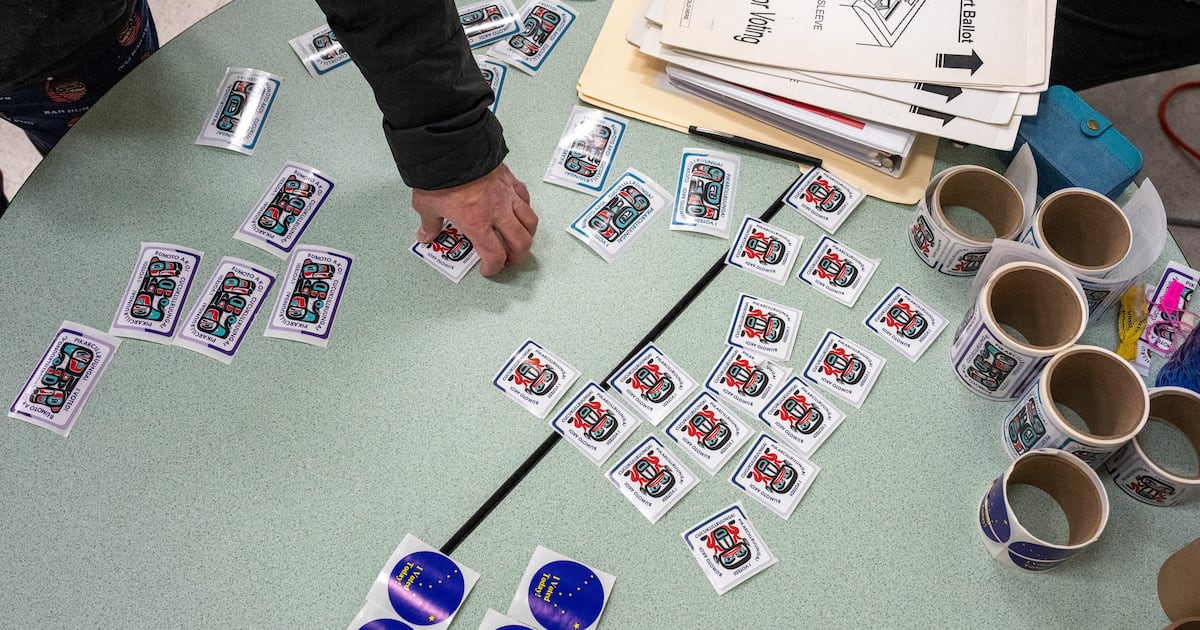
A voter picks out a sticker after voting at Trailside Elementary School on Election Day, Nov. 5, 2024 in South Anchorage. (Loren Holmes / ADN archive)
JUNEAU — Contests for five of the open seats in the Alaska Legislature are attracting some of the largest campaign fundraising hauls among the 50 legislative races in this year’s election.
In districts spanning from the Aleutians to the Interior, candidates from across the political spectrum pulled in tens of thousands of dollars in political donations during the most recent five-month campaign finance reporting period, according to campaign filings that were due Monday.
Among the top fundraisers for the few open seats this year were former Rep. Cliff Groh, an Anchorage Democrat seeking to return to the statehouse after he narrowly lost to a Republican challenger two years ago, and Joy Beth Cottle, a Fairbanks independent who first challenged Republican Rep. Frank Tomaszewski in 2024. This time, Cottle is facing off with Tomaszewski’s wife, Harmony Tomaszewski, another top fundraiser in the field.
Other races that drew top spending were well-funded challenges to incumbent lawmakers. That includes a matchup between one-term independent Rep. Ky Holland and former Department of Natural Resources Commissioner John Boyle to represent House District 9, stretching from Glen Alps on the Anchorage Hillside south to Girdwood and Whittier. That race alone brought in more than $50,000 in fundraising since the reporting period began in February.
Rep. Ky Holland of Anchorage speaks during a floor session at the Alaska State Capitol in Juneau on Monday, May 18, 2026. (Bill Roth / ADN)
In Alaska Senate races, the contest to represent District O — which encompasses the Matanuska-Susitna communities of Big Lake and Sutton plus a swath of the Interior north of Denali National Park and Preserve — topped the fundraising charts with a Republican and a Democrat challenging incumbent Sen. George Rauscher, R-Sutton. The field brought in more than $70,000 in contributions since February, with Talkeetna-based Republican challenger Ryan Sheldon drawing more than half of that total.
Several of this year’s races will potentially determine the balance of power in the Legislature, where a bipartisan coalition currently holds a slim 21-member majority in the House of Representatives.
In the Aug. 18 primary, voters will pick one candidate in each race that appears on the ballot. The top four candidates in each race who receive the most votes during the primary will then advance to the Nov. 3 ranked choice general election.
The August primary ballot will feature 50 legislative races and a total of 132 candidates. Six of the legislative races are uncontested. Nine of them have no incumbent, leaving the seat open.
This is the third statewide regular election cycle since Alaska’s former campaign contribution limits were eliminated by a federal appeals court as being too restrictive. Lawmakers narrowly passed a bill this year to preempt a ballot measure that seeks to reinstate limits on contributions to Alaska political candidates, but Gov. Mike Dunleavy vetoed it earlier this month, paving the way for the measure to appear before voters on the August primary ballot.
Collectively, candidates running for the Alaska Legislature raised over $1 million in the past five months and have nearly $1.5 million in reserve heading into the August primary and the November general election.
Ten House candidates pulled in more than $20,000 in contributions in the reporting period spanning early February to mid-July, far outpacing the average of roughly $9,000 in fundraising for all legislative candidates across both chambers.
In the Senate, three candidates cleared the $20,000 fundraising mark during the same time period.
Campaign finance filings also show independent expenditure groups, Alaska’s version of political action committees, began early financial moves to boost mostly legislators who have expressed interest in caucusing with a bipartisan majority.
The Alaska House Democratic Campaign Committee has given $50,000 since the election cycle began last summer. The amount included two $10,000 campaign checks in June from the House Democratic Campaign Committee to independents: Holland and Kathy Simpler, who is running against fellow Kodiak resident Sheldon Prout, a Republican. That’s in addition to another $8,000 Simpler took in from the committee in 2025.
The House seat sought by Simpler and Prout is open as Kodiak’s two current legislators — both Republicans — are in the midst of a potential reshuffle, with Rep. Louise Stutes running for Senate after the retirement of Senate President Gary Stevens.
The Alaska Democratic Party itself also gave another $45,000 to Democratic candidates across the state.
Also boosting mostly bipartisan caucus-affiliated legislators and candidates was the Alaska Laborers Local 341 Union PAC, with $35,000 in contributions. The union itself gave another $21,000. In both its PAC and individual donations, the union donated to more than a dozen campaigns mostly affiliated with members of the current majority caucuses, along with contributions to a few minority caucus legislators including Rep. Elexie Moore, R-Wasilla, Rep. Will Stapp, R-Fairbanks, and House Minority Whip Justin Ruffridge, R-Soldotna.
Along with support from the Alaska Laborers Local 341, Simpler also got a leg up from the Putting Alaskans First Committee, a top left-leaning group that is funded by unions and backs candidates who join bipartisan majorities. Putting Alaskans First chipped in more than $15,000 to support Simpler this summer, with a mix of cash spending and debts for social media ads and mailers supporting the candidate.
This cycle’s top individual campaign contributor so far is Anchorage resident Justin Weaver, who has given more than $70,000 in 56 donations since the election cycle began, with donations to 16 Democrats, independents and some moderate Republicans. He was also a top individual campaign donor in Alaska during the 2024 election cycle, where he spent more than $122,000 giving to campaigns.
Big spending on open seats
Multiple seats without an incumbent are attracting some of the highest levels of campaign fundraising so far this election cycle.
Cliff Groh, an Anchorage Democrat, has raised nearly $56,000 since February in his bid to reclaim the seat for House District 18, which includes Government Hill, part of Muldoon, Joint Base Elmendorf-Richardson and downtown. That’s added to about $57,000 he already had in his campaign account, leaving him with more than $80,000 in cash on hand even after spending more than $27,000 on his race this reporting period. He was the top fundraiser of all the legislative candidates in the field over the past five months.
Rep. Cliff Groh, D-Anchorage, listens to discussion before the vote. The Alaska Legislature met in a joint session at the Alaska State Capitol in Juneau on March 18, 2024, to consider overriding Gov. Mike Dunleavy’s veto of an education funding bill. Lawmakers were one vote short of overriding the veto. (Marc Lester / ADN)
The seat is open with Republican Rep. David Nelson, who defeated Groh by 23 votes in 2024, not seeking reelection.
Republican candidate Dan Sager, a member of the Anchorage Housing, Homeless and Neighborhood Development Commission and former Alaska Republican Party chairman for District 18, trails Groh in fundraising. Sager has raised just under $8,000 since the start of the race.
In Fairbanks, the race between independent candidate Joy Beth Cottle and Republican Harmony Tomaszewski drew big fundraising on both sides.
Cottle and Tomaszewski are among the top fundraisers in this year’s legislative races, together bringing in more than $75,000 in the most recent reporting period. Cottle has raised nearly $47,000 since February on top of the more than $5,000 she had on hand from previous fundraising, while Tomaszewski raised more than $30,000 during the same time period.
The race to replace Rep. Andy Josephson, a Democrat representing the Anchorage the neighborhoods of Taku/Campbell and part of Midtown who is not running for another term, has also attracted large contributions to one candidate. Lisa Keller — a former staffer to Josephson and independent Rep. Alyse Galvin — brought in roughly $35,000 this reporting period. This added to the nearly $30,000 she had in cash on hand from fundraising earlier in the election cycle.
Since February, she has spent more than $35,000 on her campaign, the most of any legislative candidate across all races. Keller’s spending and fundraising far outpaces her opponent, former Anchorage Assembly member and fellow Democrat Felix Rivera. He reported only raising $30 and spending the same amount to cover his candidate filing fee.
Simpler, who is running as an independent in Kodiak for the open seat vacated by Rep. Stutes’ run for Senate, was another top fundraiser. She has raised more than $28,000 since February, on top of the nearly $18,000 she already had on hand from fundraising earlier in the election cycle.
Her Republican opponent, Prout, trailed behind with roughly $11,000 raised in the most recent reporting period, on top of the nearly $5,000 in cash he had on hand.
Seven candidates are running to represent House District 37, which stretches across parts of Southwest Alaska and the Aleutians. The race has drawn the largest field in this year’s legislative contests. The seat is open after House Speaker Bryce Edgmon, an independent from Dillingham, announced he would run for the Senate.
Mark Smith, a former Aleknagik mayor and city council member, has far outpaced his opponents in fundraising, largely by self-funding his bid for the Legislature. Campaign filing reports show he brought in more than $27,000 in the most recent reporting period. Smith, the former owner of rural Alaska fuel logistics company Vitus Energy, has personally contributed more than $22,000 to his campaign.
Mark Smith, a candidate for House District 37. (Photo provided by the candidate)
Evelynn Trefon, a Democrat, has raised just under $8,000 while Dennis Robinson, also a Democrat, has raised about $1,670. Peter Angasan, an independent, has raised $130. Independent candidates Kimberly Johnson and Cade Woods, along with Brenda Wilson, a Republican, have not reported raising campaign funds.
Expensive challenges to incumbent lawmakers
Several incumbent legislators are also facing well-funded challenges from Republicans and an independent.
In House District 9, which includes the Anchorage Hillside, Girdwood and Whittier, Republican candidate Boyle, the former commissioner of the Alaska Department of Natural Resources, is challenging one-term independent Rep. Holland. Holland won the seat with 54.4% of the vote in a race against Republican Lucy Bauer two years ago after the retirement of Rep. Laddie Shaw, also a Republican, left an open seat.
John Boyle, former commissioner of the Alaska Department of Natural Resources, filed to run for the Alaska House at the Division of Elections office in Anchorage on June 1, 2026. (Marc Lester / ADN)
Holland’s win in one of Alaska’s wealthiest districts two years ago was instrumental to a bipartisan majority taking control of the House. Two years later, Boyle, who was a Dunleavy appointee, is challenging Holland in an attempt to flip the seat back to Republican control.
Since February, Holland has raised about $26,000 while Boyle has raised just over $25,000. Holland, however, has a larger overall campaign balance, with about $37,000 already in his campaign account from previous fundraising. Neither candidate has started heavy campaign spending, with both burning less than $3,500 since February.
Two other Republican incumbents are also facing challengers with significant cash on hand.
Brent Johnson, an independent and former Kenai Peninsula Borough Assembly president, has raised more than $40,000 in his bid to unseat Homer Republican Rep. Sarah Vance, who has served four terms in the House. He previously challenged Vance in 2024, finishing second in a three-way race with 43.5% of the vote.
Johnson raised about $42,000 during the latest reporting period, putting him third in overall fundraising among all legislative contests for this reporting period. Vance trailed behind in fundraising since February, raising roughly $11,600. However, she had more than $30,000 in cash on hand from previous fundraising. She also spent less than Johnson this period, leaving her with roughly $10,000 more in her campaign account heading into the rest of the election season.
Two Republican candidates are also challenging Sen. George Rauscher for the seat to represent Senate District O, a sprawling district that stretches from Valdez through Mat-Su to the Interior, including the communities of Big Lake, Talkeetna and Healy. Both Rauscher, who was appointed to the seat by Dunleavy from the House of Representatives in November of last year, and his Talkeetna-based challenger Ryan Sheldon were among the top fundraisers statewide during the most recent fundraising period.
Sheldon, whose family owns the Sheldon Chalet and Mountain House in Denali National Park, was the top fundraiser of all the Senate candidates, with $38,000 raised since February. He was the only Senate candidate to bring in more than $30,000. He bested Rauscher’s fundraising during the most recent reporting period by more than $20,000, but Rauscher started the period with another roughly $11,000 in the bank from earlier fundraising.
Sen. George Rauscher, R-Sutton, receives a flower before entering the Senate Chamber. The Alaska Legislature began its session at the Alaska State Capitol in Juneau on Tuesday, January 20, 2026. (Marc Lester / ADN)
Both spent heavily in recent months, with Sheldon’s expenditures topping $20,000 and Rauscher spending another roughly $15,000.
Peter Bauer, a Democrat, raised roughly $14,000 during the most recent reporting period as well. This came on top of the roughly $14,000 in cash on hand he had from previous fundraising.