What’s expected to be some of the most disturbing evidence in the trial of Lindsay Clancy, the woman charged with murdering her children, won’t be made public.
Judge William Sullivan said Friday that autopsy photos and audio of the 911 call the children’s father made the night he found them will be impounded for the court’s viewing only.
Opening statements are scheduled to get underway on Monday at Plymouth Superior Court in what is expected to be a highly emotional and lengthy trial.
Clancy is accused of strangling her children, 5-year-old Cora, 3-year-old Dawson and 8-month-old Callan, at their Duxbury home in 2023 and then cutting her neck and wrists and jumping from a second story window in an attempt to kill herself. Her defense argues that she was struggling with improperly treated postpartum depression.
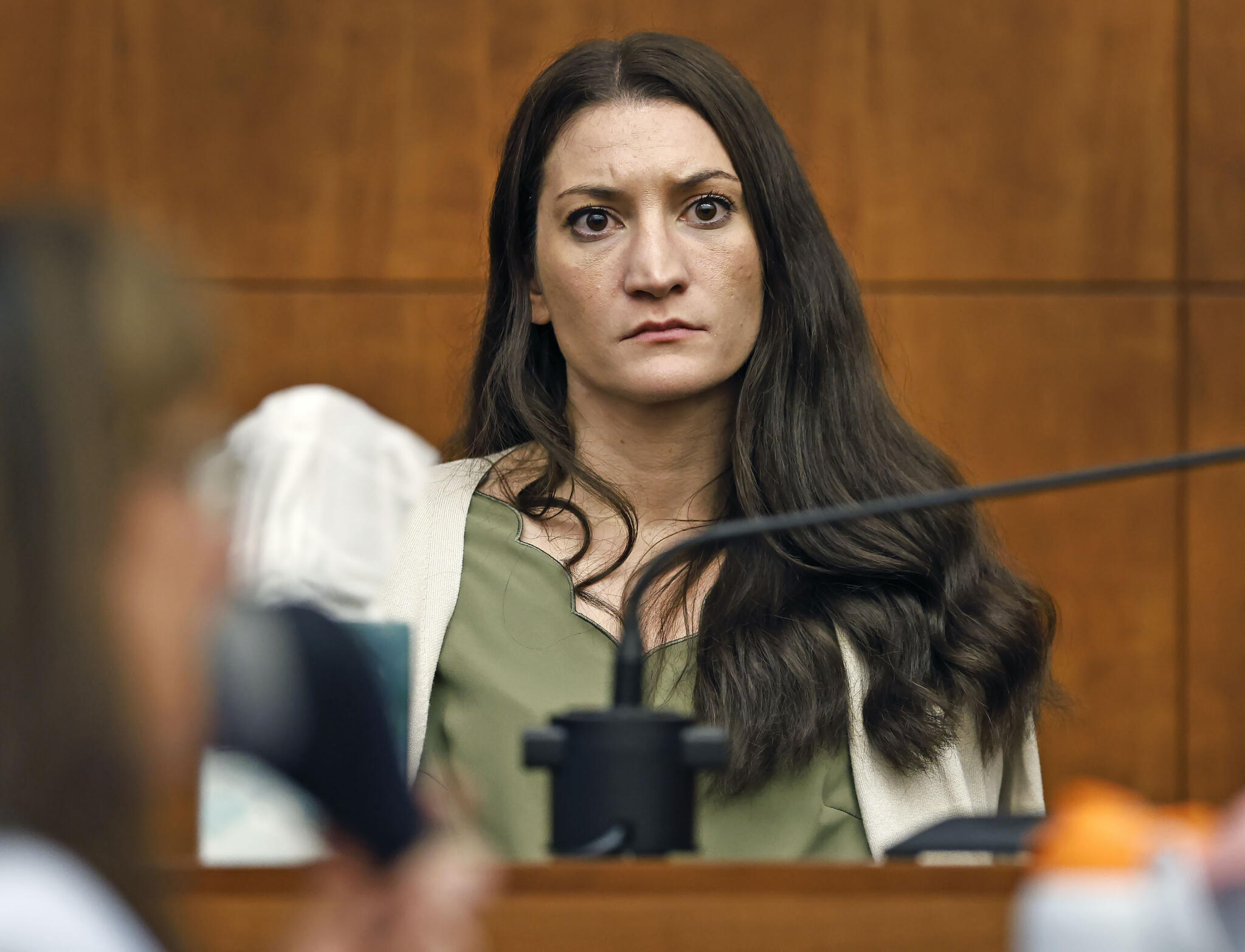
Now paralyzed from the waist down, Clancy sat in the witness box this week as potential jurors were questioned by both prosecutors and the defense. She reviewed each juror questionnaire. Dozens of jurors asked to be excused, with some becoming emotional. A tissue box sat nearby.
Clancy attended each day of jury selection in a wheelchair accompanied by two nurses from Tewksbury Hospital, where she is being held. She appeared to wipe away tears during Thursday’s court proceedings.
After the 12 jurors plus six alternates were chosen, prosecutors and the defense sparred over motions about what evidence will be presented — foreshadowing what will likely be a contentious trial that’s expected to last at least six weeks.
One motion was a request from defense attorney Kevin Reddington, which asked to limit the number of first responders called to testify. Police officers, fire officials and paramedics from Duxbury and surrounding towns are listed as potential witnesses to testify about what was found at the Clancy’s home the night of the killings.
Defense attorney Kevin Reddington argues a motion about expert witnesses. (Pool photo: Greg Derr/The Patriot Ledger)
Reddington said there is no dispute about what happened and argued it would be redundant to have multiple people recount the gruesome details of finding Clancy injured outside her home and her lifeless children in the basement.
“I think it’s reprehensible the way the government is trying this case,” Reddington said. “What I can’t fathom is the district attorney’s intent to put a circus in front of this jury that’s calculated to just inflame the passions of the jury.”
But assistant district attorney Jennifer Sprague shot back and said it is typical in a murder trial for witnesses to describe a crime scene. She said more witnesses are required because there were so many victims — the three children, an injured Lindsay Clancy and her husband.
“It is not the commonwealth putting on a circus or a parade,” Sprague said. “Now if defense would like us to reduce some of these witnesses, that would mean not talking about one of the children. So if he would like to tell me which of these children don’t matter…”
The judge cut her off and said he would not act on the request to limit witness testimony. Instead, Sullivan said he would determine during trial when to limit descriptions that are “needlessly cumulative.”
The judge also reviewed a request from Clancy’s ex-husband, Patrick Clancy, who is expected to be the first witness to testify. He asked the judge to limit public access to some evidence, including photos of his deceased children, items of their clothing and the 911 call he made when he arrived home and found his wife outside and his three children in the basement.
“The father of three deceased child victims (as well as their grandparents, relatives, and all those who knew the children) will be spared the emotional trauma that will be caused by the widespread public display and dissemination of graphic and sensational trial exhibits related to the children,” the motion reads.
Superior Court Judge William Sullivan. (Pool photo: Greg Derr/The Patriot Ledger)
Sullivan ruled Friday that he will allow some of the evidence to be impounded, including the 911 call and autopsy photos of the children.
Clancy’s defense is asking the jury to find her not criminally responsible for the murders, using what is commonly known as the insanity defense. Defense attorney Reddington has said at the time of the killings Clancy was being treated for severe postpartum depression and was prescribed 13 different medications over the course of four months.
Legal experts say the so-called insanity defense is rarely successful. But they say there are many unique aspects to this case including that Patrick Clancy has said he forgives his ex-wife, Lindsay Clancy’s documented attempts to get help, and descriptions from friends and colleagues that she was a loving mother and well-regarded labor and delivery nurse at Massachusetts General Hospital.
Many say it might be tough to prove that Clancy acted impulsively — overcome by postpartum psychosis.
“At the end of the day, they want this to be a very clear-cut case, right?” said legal consultant and Cambridge attorney Margo Lindauer. “That this person did in fact kill her children, but she was not of her right mind, and therefore, you jurors cannot find her guilty of first-degree murder.”
Lindsay Clancy confers with her lawyer Kevin Reddington during jury selection in Plymouth Superior Court on July 22. (Pool photo: Greg Derr/The Patriot Ledger)
The prosecution has argued Clancy planned to kill her children and faked her attempted suicide. The district attorney claims Clancy deliberately sent her husband out to get takeout to a restaurant that was far enough away for her to commit the crimes. They have said that she grew disillusioned with motherhood and searched for the phrase “ways to kill” right before the murders.
Even if Clancy is found not criminally responsible, she would not be released. Instead she would be held at a state facility with periodic reviews as to whether she could be returned safely to the community.
Both Clancy and her ex-husband have filed separate civil suits against her healthcare providers claiming that she had been seeking treatment for months, received both inpatient and outpatient psychiatric care and expressed concerns that the treatment was not effective.
Resources: You can reach the National Suicide Prevention Lifeline at 988 and the Samaritans Statewide Hotline (call or text) at 1-877-870-HOPE (4673). Call2Talk can be accessed by calling Massachusetts 211 or 508-532-2255 (or text c2t to 741741).