Snohomish County Superior Court Judge George F.B. Appel denied a motion for a temporary restraining order on the Washington Interscholastic Activities Association (WIAA) that would allow an ineligible Archbishop Murphy football player to resume playing this season, according to court documents obtained by The Herald.
The player’s parents filed the motion on Oct. 27, one day after WIAA Executive Director Mick Hoffman denied the player’s eligibility for the 2026-27 school year. Judge Appel denied the injunction on Oct. 28.
The WIAA decision on Oct. 26 solely addressed the player’s eligibility, and was separate from the WIAA Executive Board’s decision to uphold the Wesco Conference’s and WIAA District 1 Board’s rulings that Archbishop Murphy football would have to forfeit games due to a violation of WIAA Handbook 18.12.5, which was ultimately confirmed on Oct. 30.
WIAA Handbook 18.12.5 states, in part, “A high school student who attends, participated or was eligible to participate for a school, and subsequently transfers to another school will be eligible for sub-varsity only in all sports played during the previous calendar year for one calendar year from the date of enrollment at the new school.”
Court records show the player transferred to Archbishop Murphy from Woodinville High School — where he played football — midway through his ninth-grade year in January 2026, and he subsequently played in Archbishop Murphy football’s first four games this season as a sophomore.
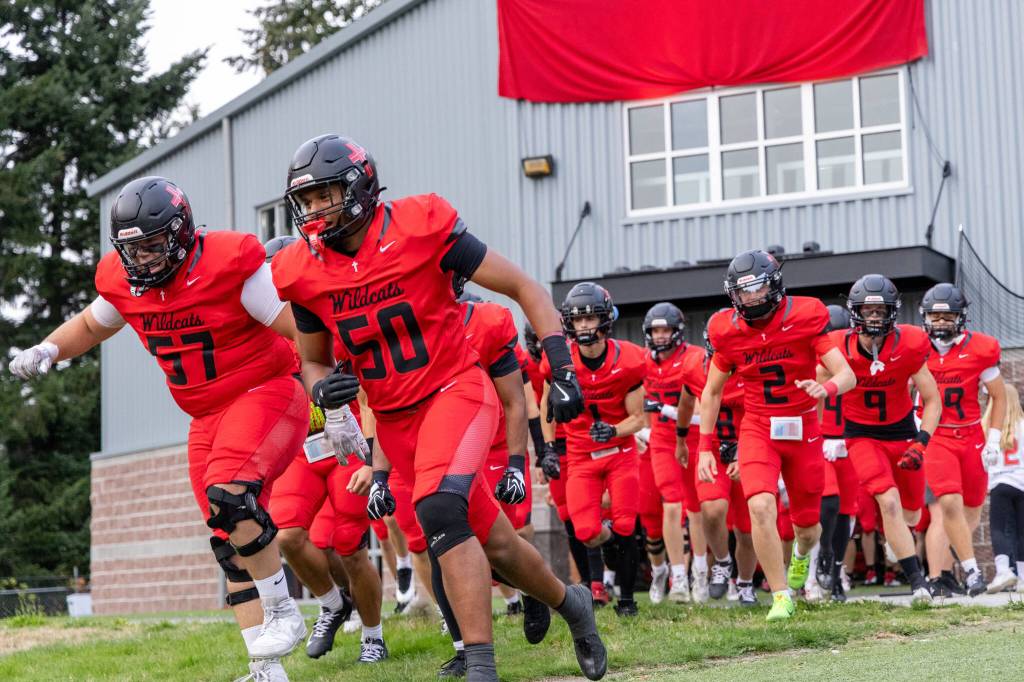
After the WIAA confirmed the player’s ineligible status, the Wildcats had to forfeit those games, but still qualified for the postseason with a 4-4 league record.
The player’s family’s motion asked the Court to temporarily restrain the WIAA from “enforcing its October 26, 2026 decision or directing Archbishop Murphy High School (“AMHS”) to bar (the player) from varsity football and to suspend the forfeiture of the games (the player) played in for the entire AMHS football team. The Court should temporarily declare (the player) eligible to participate at AMHS while this appeal is pending.”
The family took the WIAA’s decision to the Superior Court under Washington State Legislature RCW 28A.645.010-30, which gives any person(s) aggrieved by such decisions the opportunity to appeal.
The motion argued that the WIAA decision was “arbitrary” and “capricious,” that the rule in question is impossible for the school to enforce as currently written, and that the player provided necessary evidence of hardship, which allows WIAA Rules to be waived if approved under Rule 18.27.1.
Judge Appel’s denial cited that “the WIAA decision denying (the player) varsity eligibility in football for the 2026-27 school year and declining to waive the Residence/Transfer rules was not arbitrary and capricious.”
Archbishop Murphy could not immediately be reached for comment. The school’s most recent statement regarding the WIAA Executive Board’s decision to uphold the forfeitures reads: “Our responsibility has always been, and will continue to be, to put students first.
“Archbishop Murphy High School is deeply disappointed and will continue to appeal the Washington Interscholastic Activities Association (WIAA) Executive Board’s decision to uphold the eligibility determination and resulting football forfeitures following the school’s appeal on October 29, 2026. While we respect the WIAA’s role in governing interscholastic athletics, we strongly disagree with this outcome.
“The forfeitures imposed through WESCO and the WIAA affect an entire football program, including student-athletes who had no involvement in the circumstances under review. These young people have dedicated countless hours to their team, their school, and one another. They deserve to have their hard work and opportunities protected, not taken away as a consequence of a disputed eligibility determination.”
Court records provide more background information into the arguments.
Eligibility Questions Arise; WIAA Advises School to Allow Player to Play Through Investigation
The motion details the procedural history of the case, which states that a complaint was filed in Wesco after Archbishop Murphy’s first game against Bellingham on Sept. 3, challenging the player’s varsity eligibility “based on his participation on a non-school/non-WIAA 7-on-7 football team when he was in eighth grade.”
On Sept. 30, Wesco found the player ineligible under WIAA Rule 18.12.5, and the District 1 Eligibility Committee later upheld that ruling.
The motion states that Archbishop Murphy consulted with the WIAA when the complaint was filed in early September in order to determine whether or not to hold the player out, and the WIAA told the school not to, “as long as they (the school) are making the decision that he is eligible under the rules.”
Believing the player was eligible under the rules, Archbishop Murphy allowed him to play through the first four games of the season before Wesco found him ineligible on Sept. 30. The Wildcats went 3-1 in that span, and ultimately had to forfeit those three wins due to the ineligible player’s participation.
The school maintains its belief that the player should have been — and should still be — eligible, and that they let him continue playing following the advice of the WIAA. The family and school each appealed through the WIAA’s state appeal process, which ultimately led to the Executive Board’s decision to uphold the ineligibility status through the 2026-27 school year.
Jeff Lowell, the WIAA Assistant Executive Director – Compliance & Member Engagement, submitted a declaration in support of the WIAA’s response to the motion for a temporary restraining order, which included copies of the WIAA Handbook pages detailing the Mission, Core, Principles and Purpose of the WIAA as well as Section 18 and 19 pertaining to the case.
Lowell sat down with The Herald at the WIAA’s office in Renton on Monday, prior to when The Herald obtained the court documents. The WIAA declined to comment on the court cases until it receives clarity that all legal proceedings are complete.
“I’m a big ‘process’ guy. I would say I think our process is pretty sound,” Lowell said on Monday. “I think that there’s always a way to potentially look at the language that’s included in the Handbook, just ‘is it as clear as we want it to be?’ And sometimes I have to check myself because while I may think it’s very clear, somebody else might not.
“… I would say, just overall, I don’t think the idea of changing (the) process would be something I would be looking for. I think our process is pretty sound.”
The 7-on-7 Program and Disputes Over Archbishop Murphy Assistant Coach’s Alleged Involvement
The court records confirm the aforementioned 7-on-7 football program to be “Wipe Me Down Boyz,” which The Herald first reported on Oct. 24.
The motion identifies Archbishop Murphy assistant coach Tala Tevaga as the current coach whose alleged involvement sparked the eligibility concerns, but the school and Tevaga himself asserted that he attended Wipe Me Down Boyz games purely as a spectator and caretaker for his younger brother, who played for the team alongside the ineligible player.
Evidence submitted by the family’s legal counsel details the roster and coaching staff, which does not list Tevaga as a coach. The roster lists current Archbishop Murphy assistant coach Drew Bonds as one of the Wipe Me Down Boyz coaches at the time, but Bonds is not listed as an Archbishop Murphy assistant coach prior to the 2026 season.
Further evidence shows a letter from Wipe Me Down Boyz Director/Co-Founder Frank Murdock and an email from Co-Founder/Owner Ryan Clary sent via an email address attached to Executive Assistant Kaylee Clary, each stating that Tevaga was not a coach for the program.
The motion goes on to state that despite the evidence denying Tevaga coached with the 7-on-7 team, the WIAA relied on photographs and video that “showed Tevaga interacting with (the player) and other players in a ‘coaching manner,’ including a video in which (the player) referred to him as ‘Coach.’” The WIAA concluded that the evidence “created an appearance of ‘affiliation’ with the team.”
The motion argued that the WIAA did not identify a formal coaching assignment, and instead “inferred current involvement,” which Archbishop Murphy believes is too open-ended to enforce because the rules do not specify what interactions count as affiliation.
The motion cited RCW 28A.600.200(2)(a), which states “any rules and policies adopted and applied by the voluntary nonprofit entity that governs student participation in any interschool activity shall be written.”
The motion reads: “A school has to apply the standard before it can tell a family whether a transfer will trigger a varsity ban. A school needs objective facts it can check, such as an assigned coaching role or defined team responsibility.”
Believing the WIAA replaced the specific standard of holding a coaching role with an “open-ended inquiry” into the coach’s connection as a family member, friend or spectator, the school claims there is “no threshold for when that connection becomes affiliation and no way for a school to know in advance what conduct will disqualify a student.”
Judge Appel addressed the topic in his injunction denial, indicating that the WIAA’s conclusion that Rule 18.12.5.1 applies is supported by the player’s participation with Wipe Me Down Boyz prior to his enrollment at Archbishop Murphy. Rule 18.12.5.1 includes participation on a non-school athletic team in the requirement for transfers to play only sub-varsity for the calendar year after transferring.
Appel also cited the photo and video evidence documenting Tevaga engaging with players, as well as Tevaga’s “acknowledgment that he interacted with players,” and the video where the ineligible player refers to Tevaga as a coach.
“Plaintiffs’ contrary evidence was before the WIAA and considered, and where there is room for two opinions, the WIAA’s determination is not arbitrary or capricious,” the injunction denial reads, in part, at the end of Point 22.
Lowell, who previously served on the WIAA Executive Board for District 2 and worked as the Chair of the Executive Board’s Handbook Subcommittee, called the Handbook a “great document and a great foundation” for what the WIAA does.
Lowell stated that if Archbishop Murphy feels the rules need to be clarified, an amendment process can be pursued.
“There is a very formal process for that to be done, through the amendment process,” Lowell said. “And if Archbishop Murphy, if other member schools want to end up looking at the rule, they can certainly do so. It would end up working through them. Formally, if they wanted to, it would go through the amendment process.”
Transfer to Archbishop Murphy, Claims of Mental Hardship
The reason WIAA Handbook 18.12.5 applies in this case is because the player started ninth grade at Woodinville High School in the fall of 2025 before transferring to Archbishop Murphy in January 2026.
The motion details that a broken collarbone the player suffered during a football game in October 2025 led to mental health struggles. The family did not immediately seek assistance out of respect for the player’s request to keep his difficulties private, according to the motion.
However, prior to the player’s transfer, the family contacted Sydney Fee, who is described in court records as someone “who had known the family for years and had spent two decades working with adolescents in education, athletics, and school administration.”
The family asked Fee for advice due to their worry for the player, and asked Fee to keep the conversation private. According to the motion, Fee suggested counseling, but the player “was not ready to speak with a counselor at the time.”
The family ultimately concluded the player needed a more supportive school environment, and that the concern about his declining mental health prompted a more urgent change. That decision led to the player’s transfer to Archbishop Murphy in the middle of the school year.
The motion details that the family left its Woodinville home in January 2026 and moved into a Snohomish home it had purchased in March 2026 — staying at a rental in between — in order to “comply with the WIAA’s bona fide residence requirements.”
“The family was responding to (the player’s) mental health, not pursuing an athletic advantage,” the motion reads. It also includes that the District 1 committee’s written findings recognized the player’s disposition had changed drastically after he entered Woodinville, and the move to Archbishop Murphy “seems to have worked.”
Determining Hardship
Under WIAA Handbook 18.27.1, the District Eligibility Committee and Executive Director hold the authority to make exceptions to student eligibility regulations based on “hardship conditions.”
Hardship exists “only when some unique circumstances concerning the student’s physical or emotional status exist,” and not the “result of acts or actions by the student or family unit.”
The rule specifies that there must be no reason to believe that the transfer decision was for athletic purposes, and that the circumstances must be “totally different” from those that exist for “the majority or even a small minority of students.”
Additionally, the burden of providing evidence lies with the student. The alleged hardship and the student’s inability to meet the specific eligibility rule(s) must have a “direct, causal relationship” between them.
The WIAA determined the player’s depression did not rise to the level of a hardship, and the motion details that Executive Director Mick Hoffman found it relevant that the family had not spoken with Woodinville staff or a mental-health professional, as well as not providing documentation substantiating “severe and abnormal medical problems.”
The motion counters that Hoffman’s assessment is not accurate due to the family’s consultation with Fee, and that the family took swift action by moving out of the environment causing the player’s depression in the middle of the school year.
Judge Appel’s injunction denial sides with the WIAA and its conclusion under Rule 18.27.1 that the player did not establish a hardship since the family did not speak with anyone at Woodinville High School or with a mental-health professional.
“The October 26, 2026 decision applies a generally applicable eligibility rule and denies a discretionary hardship waiver,” Point 24 of the injunction denial reads. “Plaintiffs have not shown that it constitutes a penalty under RCW 28A.600.200 or that it is otherwise contrary to law.”
What’s Next
Archbishop Murphy football will start its postseason run with a home game against Hockinson on Friday. The Wildcats are informally the No. 5 seed in the 2A State Week 10 games, but teams will be officially reseeded for the 16-team bracket beginning next weekend.
The player remains ineligible for the rest of the season. Tevaga and the coaching staff remain eligible to continue coaching as of publication.
“No decision has been made by any board related to any coach,” Lowell told The Herald on Monday, indicating that’s all he could say about the subject.
Herald writer Ian Davis-Leonard contributed to this report.