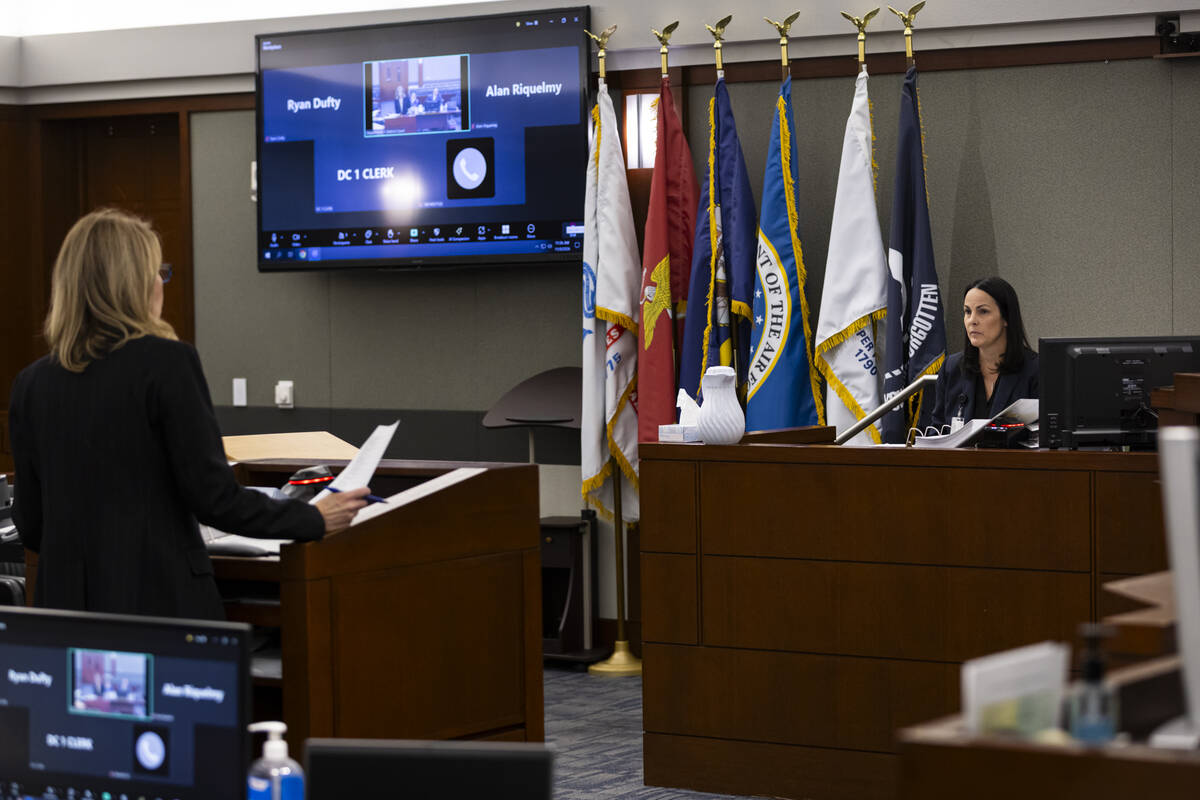
A judge will weigh a Las Vegas Review-Journal request to find that Clark County willfully violated state public records law when it withheld information related to the award of contracts that benefited the wife of a public works official.
If District Judge Bita Yeager rules in favor of the news organization, it may be the first finding that a governmental entity willfully violated the Nevada Public Records Act, according to Review-Journal Chief Legal Officer Ben Lipman.
Such a ruling would require Yeager to order a civil penalty against the county. Attorneys have until Dec. 7 to provide briefing before the judge makes her decision.
The judge previously found that the county violated the law by refusing to turn over records related to the firing of Jimmy Floyd, the former head of the county’s construction management division.
Reporting by the Review-Journal examined how Rock Solid Project Solutions, a firm owned by Floyd’s wife, Raquel, received a portion of a $10 million contract to manage the 215 and Summerlin Parkway construction project.
The couple have since divorced.
Yeager heard hourslong testimony from Review-Journal and county witnesses Monday about the news organization’s records requests and correspondence leading up to the lawsuit, which was filed in March.
The county tried and failed to delay the hearing but won a pause from the Nevada Supreme Court on the disclosure of some information.
RJ investigating potential public corruption
Colleen McCarty, an attorney for the news organization, said the county withheld the names of people who evaluated county contracts, did not timely and properly respond to requests, failed to search for records and failed to identify what records were being withheld, among other violations.
Elliot Anderson, a lawyer representing the county, said the county communicated extensively with the Review-Journal and acted in “good faith.”
Lipman testified that the Review-Journal was working in the public interest.
“We were trying to determine whether there was any public corruption going on when we had a situation in which a person overseeing a county division … was providing contracts and money to his wife’s or his family’s firm,” he told the judge.
He corresponded with County Counsel Lisa Logsdon, who claimed some information could be withheld because it was related to personnel issues, he said.
During an October 2025 call, Logsdon indicated that she hadn’t investigated which records existed, so she couldn’t tell Lipman, he said.
At that point, it had been months since the Review-Journal had filed its initial records request.
“My reaction was shock,” Lipman said. “I think I said to her something along the lines of, and maybe literally, ‘Are you telling me you haven’t even looked for what records are out there?’”
Logsdon agreed to provide a list of withheld records, Lipman said. She provided some information, repeatedly extended deadlines and eventually became nonresponsive, he said.
Logsdon took the stand, too, and seemed to remember the prior call differently.
“I don’t know if he asked if I had reviewed them, but whether I gathered them,” she said. “So I am not the gatherer of the records of the county.”
She did not provide clear answers about whether she had examined the documents at issue by the time of the call.
County proposed ‘guessing game’
Mary Hynes, the investigative reporter who has extensively covered the scandal involving the Floyds, testified that she looked into claims Floyd showed preferential treatment to his wife’s company.
She wanted evaluations of Rock Solid, investigative reports and information about the actions the county took as a result of investigations, among other records, she said.
The county provided some records, but refused to release others, leading to the lawsuit. Yeager previously ordered the county to turn over records.
The county withheld the names of evaluators, Hynes said, but offered to provide confirmation if she provided the correct name.
“I went ahead and played the guessing game,” she said.
Hynes said county spokesperson Jennifer Cooper confirmed she was correct about some of the names, but that she did not receive unredacted evaluations until after the news organization sued.
Eventually, Hynes said, the county told her she would receive no additional records. The county did not specify which records it was withholding, she said.
Cooper testified that the county tried to be helpful and suggested that providing names based on Hynes’ guesses was a compromise that supported transparency.
She also speculated about the consequences of revealing evaluator names, saying that evaluators could be solicited and that she heard some people don’t want to be on evaluation panels now.
Yeager sustained an objection from McCarty to speculation by Cooper.
Contact Noble Brigham at nbrigham@reviewjournal.com.