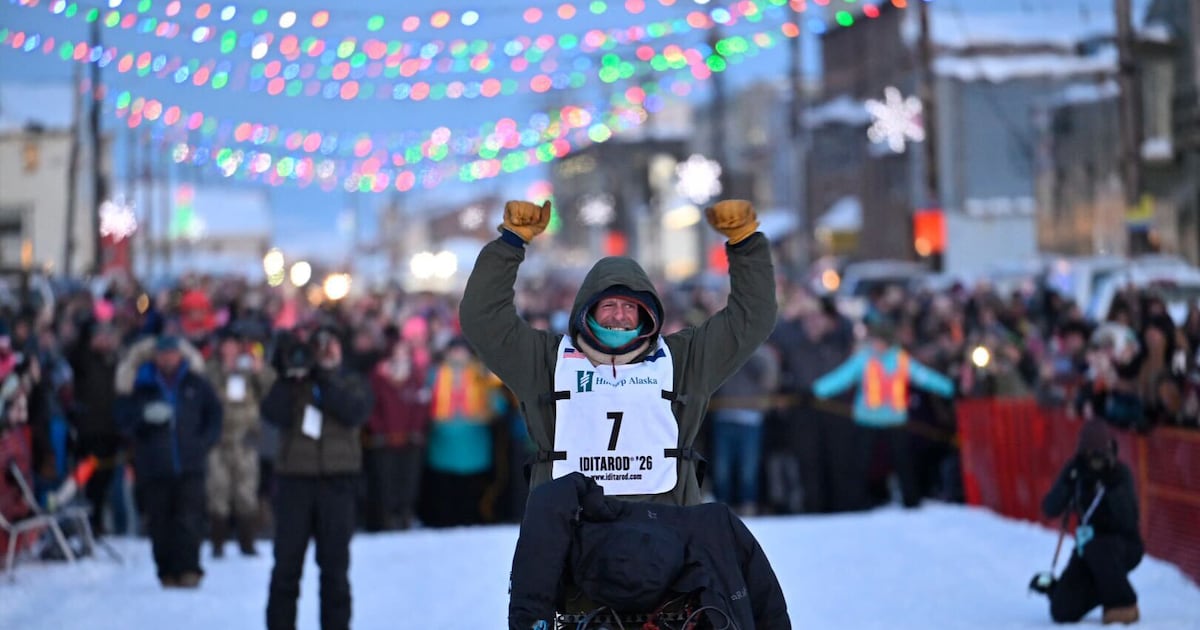
Jessie Holmes arrives in Nome on Tuesday night, March 17, 2026, in first place, earning his second straight win in the Iditarod Trail Sled Dog Race. (Marc Lester / ADN)
NOME — Jessie Holmes on Tuesday night pulled off a feat few long-distance mushers have accomplished, repeating as the champion of the thousand-mile Iditarod Trail Sled Dog Race.
As twilight settled on Nome, Holmes crossed under the burled arch at 9:32 p.m. after 9 days, 7 hours, 32 minutes and 51 seconds. He raised both arms as his team pulled down Front Street to the cheers of a few hundred mushing fans gathered near the finish chute.
His 12-dog team was led by 3-year-old Zeus and 8-year-old Polar. Once he completed the mandatory paperwork, Holmes passed out gigantic ribeye steaks to his sled dogs.
“It’s a blessing to be out here. I was just so full of gratitude and gratefulness being welcomed into all these communities, and being out in all this beautiful country with the most amazing dog team I’ve ever seen,” he said.
For winning, he was presented with an oversized check for $80,000. When asked whether he would try to repeat again next year, when the race returns to its southern route, Holmes said: “That’s what we’re going to be shooting for. And we’re going to be shooting to break that southern route record.”
Jessie Holmes arrives in Nome on Tuesday night, March 17, 2026, in first place, earning his second straight win in the Iditarod Trail Sled Dog Race. (Marc Lester / ADN)
The 44-year-old Holmes is originally from Alabama and moved to Alaska in 2004, running dogs along a trap line in a remote part of the Interior. He eventually relocated to Nenana and was mentored by longtime musher Bill Cotter. More recently, he moved to a piece of land along the Brushkana River off of the Denali Highway, where he homesteads in relative solitude with his kennel of several dozen sled dogs.
Along the way, he starred in the reality TV program “Life Below Zero,” which profiled Alaskans living rugged lives in remote parts of the state. After his victory last year, Holmes said that the money and financial stability afforded to him by the show allowed him to fund his early mushing career, but that he’d stepped away to dedicate himself more fully to training.
Holmes ran his first Iditarod in 2018, finishing in seventh place his rookie year. He’s entered and finished every Iditarod since, finishing the majority of them in the top 10.
While several mushers have won more Iditarods, just five others aside from Holmes have notched back-to-back first-place finishes: Rick Swenson (1981-1982), Susan Butcher (1986-1988), Doug Swingley (1999-2001), Lance Mackey (2007-2010) and Dallas Seavey (2014-2016).
Of them, only Holmes, Butcher and Mackey have accomplished the even rarer feat of winning their second title the year after their first.
Reflecting on their legacies Tuesday night, Holmes said, “We’re just going to keep chasing those footsteps and trying to push ourselves every day to be better.”
Veteran musher Aaron Burmeister encountered Holmes a decade ago when Holmes moved to the Nenana area and took over a dog lot that was previously owned by 1976 Iditarod champion Jerry Riley.
Burmeister said he and a number of other Nenana mushers — including Riley, 1983 Iditarod champ Rick Mackey and Cotter — offered Holmes guidance in those early years.
Burmeister described Holmes as “a sponge” who was “very motivated, very high-energy and very focused on what he wanted to do and he had the right attitude.”
But Holmes was also very stubborn, which led to some light-hearted moments among the group of veteran mushers.
“We all really took a liking to him and loved having him around because of his high energy, his attitude,” Burmeister said Tuesday in Nome as Holmes was mushing from White Mountain. “But we all would joke and tease him because of his stubbornness and he’d go out and make the same mistakes over and over until it sunk in. He certainly earned what he did.”
Dogs in Jessie Holmes’s team rest in Ruby on March 13, 2026. (Marc Lester / ADN)
Holmes developed a world-class kennel before moving his operation to the Denali Highway.
Burmeister said that was to remove distractions and put his sole focus on his dog team.
“That shows his commitment to improving as a dog musher,” Burmeister said. “It’s not easy. … You’re isolated, but that put him completely, 100% in tune with his dog team.”
Holmes took an early lead in this year’s race, emerging at the front of the pack as leaders crossed the Alaska Range. With a couple of brief exceptions, he stayed in the front, collecting several awards and prizes along the way for arriving first to checkpoints in McGrath, Ruby, Cripple, Kaltag, Unalakleet and White Mountain.
He earned his lead by improvising, taking strategic gambles that worked in his favor. He also opted to take his mandatory rests earlier in the competition than he’s done in recent years.
Jessie Holmes leaves Ruby on the Yukon River as the Iditarod frontrunner on March 13, 2026. (Marc Lester / ADN)
By the time he reached the Norton Sound coast for the last third of the race, Holmes had several hours of lead over the chase pack, even as he took longer-than-usual rests at checkpoints. Throughout, Holmes has said, his dogs have eaten voraciously, and he’s stopped every hour-and-a-half during runs to feed them high-fat snacks like beaver meat.
On Tuesday night, Holmes said he was happy that he was able to “put my dogs first and foremost, and I took lots of rest, and I stuck to my strategy and the way I do things. And you know, do you want to do great things? You got to be an original.”
He said that what makes him so emotional about what he and his team have accomplished is how hard they worked.
“All the hardships and adversity of this race are nothing compared to what we put in 365 days a year to be able to be here and to be able to make it through those things, you know, and the work ethic that they put into this and the heart and soul that they put into this,” Holmes said.
Burmeister said this year’s win is a prime example of Holmes’ evolution as a musher.
“He’s had a really commanding race,” Burmeister said. “How often does the champion get to take five to six hours rest at every checkpoint coming up the coast and three hours in Elim and keep going? It’s unheard of.”
“I’m really proud of Jesse,” Burmeister said. “He’s done a lot and he’s worked very hard for this, and he’s been very focused and well-deserving.”
Jessie Holmes tends to his team after parking in Ruby on March 13, 2026. (Marc Lester / ADN)
The chase pack and scratches
Seward musher Travis Beals left White Mountain about 3 1/2 hours after Holmes, and was on track to finish in second place.
As Holmes prepared to depart White Mountain late Tuesday morning, three teams bore down on the checkpoint to begin their mandatory rests. Jeff Deeter was the first of the triad, followed in short order by Paige Drobny and Wade Marrs. The three were all running within 4 miles of one another along portions of the route in from Elim and Golovin.
Farther back on the trail, the field saw three more scratches, bringing the total to four as of Tuesday night.
The Iditarod Trail Committee said that rookie musher Jody Potts-Joseph scratched late Tuesday morning, citing the well-being of her team. She was at the Tripod Flats Cabin along the portage trail out of Kaltag when she contacted race officials to end her run.
“ITC personnel are assisting her with the safe transport of her 10-dog team to Unalakleet via snow machine,” the Iditarod Trail Committee wrote in a statement.
Veteran musher Mille Porsild scratched after a 4-year-old female dog on her team died on the way to Elim, marking the sole dog death reported in this year’s race as of Tuesday.
Veteran musher Grayson Bruton scratched at Unalakleet on Tuesday evening. Bruton, from Tok, had 10 dogs in harness, according to race officials. In a statement, the Iditarod said Bruton scratched in the best interest of his team.
Rookie Jaye Foucher was the first musher to scratch, describing difficult conditions and strong winds along the trail before pulling out of competition at Rainy Pass.
An evolving competition
This year ushered in changes to the storied race — most notably, an Expedition Class with mushers who weren’t actually racing.
The Iditarod began with three inaugural expedition mushers whose participation launched what organizers hope will become a new, steady source of revenue and a driver of Iditarod fan base expansion.
Norwegian billionaire businessman Kjell Inge Røkke and Canadian investor Steve Curtis both made significant financial contributions as part of their Expedition Class participation. Joining them was 2020 Iditarod champion Thomas Waerner, who ran alongside Røkke for much of the route.
Ultimately, Røkke was the only expedition musher to arrive in Nome, wrapping up his run Monday after Waerner stopped in Unalakleet due to dog health concerns and Curtis ended in McGrath. As noncompetitive expedition mushers, the trio followed a different set of rules from those observed by competitive mushers: They could swap dogs, rely on outside help and avoid taking the mandatory rest breaks that competitive mushers must take.
Iditarod CEO Rob Urbach has described the potential for future Expedition Classes to include, as examples, ultra-wealthy individuals and celebrities who would love to experience the trail but either won’t be competitive or can’t commit to a mushing lifestyle.
Other changes this year include the addition of sponsor Vivazen, an energy drink company; expanded features for the Iditarod’s Insider subscription service; and a new partnership with the Wildbirch Hotel, the race’s new downtown Anchorage headquarters located a block from where sled dog teams take off for the ceremonial start each year.
The developments come as race officials have described mounting costs and other challenges associated with operating the Iditarod each year.
Daily News photojournalist Marc Lester contributed.
• • •
This is a developing story. Check back for updates.