The main lobby of the New Hampshire Lottery Commission’s headquarters in Concord has undeniably good energy. People who hit the jackpot on a scratch ticket or Megabucks stroll in to claim their prizes. There are big checks and big smiles.
The other guy in this building with good reason to smile is Charlie McIntyre, the state lottery’s executive director. The numbers alone explain his upbeat mood.
“When I started here, my first year, our return was $62 million. This year it’ll be $250 million,” he says.
There was a time, not long ago, when legalized gambling divided New Hampshire lawmakers. It was a perennial campaign issue, and the State House saw pitched fights over casinos and Keno and slot machines. That all seems sort of quaint today. New Hampshire has fully embraced gambling, with a proliferation of new options, including sports betting, increasingly expensive scratch tickets, and a dozen casinos statewide — with more in the works.
Meanwhile, gaming receipts account for a larger share of state government revenues than ever before. But that embrace has come with a cost — and some risk. Gambling revenues can be less predictable than some other sources of state money. And as the number of wagering options has risen, so has the number of people seeking help for gambling addiction.
Still, state lawmakers show little inclination to slow the trend towards more gambling, in more places, anytime soon.
“We’ve certainly grown,” said McIntyre. “Whether we desired it was not really a discussion. It was: ‘You’re doing it.’ ”
Coming up aces
Two changes in recent years are fueling gambling’s growth in New Hampshire.
The first is regulatory: New Hampshire lawmakers have approved a range of expansions — such as slot-style electronic gaming machines — and increased the hours casinos can operate. The cap on how much a gambler can wager per hand on blackjack and other games of chance have been removed.
There’s now round-the-clock online gambling options, and gas stations sell $30 scratch tickets. Pubs across the state offer Keno.
But maybe the bigger change is cultural: Gambling, especially sports gambling, has exploded nationally. Sports leagues have embraced it, sports TV chyrons now carry odds, and some fans keep one eye on the game and the other on their Draft Kings app.
Every gambler who places a wager on the Celtics knows there’s a chance they may lose.
What they may not realize, though, is that those losses are a kind of voluntary tax that benefits the state government.
“People opt into gambling,” says Phil Sletten with the New Hampshire Fiscal Policy Institute, a think tank that studies state revenue trends. “People decide to buy a lottery ticket or bet on a sports game. It’s different than a tax revenue source.”
But the gains the state is making from lottery, casinos and sports wagering means a loss for gamblers. And those losses, for some people, can be devastating. In the past five years, calls to the New Hampshire Council on Problem Gambling’s helpline have more than doubled, to more than 570 calls in 2025.
“Most of our calls are coming in from folks who are looking for support from problem gambling behaviors at a physical casino or online via sports gambling platforms.”
Dr. Angela Bergen, who oversees the NH Council on Problem Gambling
Dr. Angela Bergen, who leads the non-profit helpline, says while the group doesn’t have long-term data on the types of people seeking help, more recent callers appear to be skewing younger and more male. In the past, there was a higher percentage of people struggling with lottery or scratch ticket addiction.
“But more recently it’s shifted to where most of our calls are coming in from folks who are looking for support from problem gambling behaviors at a physical casino or online via sports gambling platforms,” says Bergen.
Electronic gaming machines inside of Lilac Club Casino.
The evolution of casinos in NH
Games of chance have been legal in New Hampshire for decades, but they were originally limited to small-scale “Monte Carlo” nights in shabby function halls. There were tight restrictions on hours of operation and the types of games available, along with strict betting limits. The Legislature’s lifting of many of those rules in 2006, plus the legalization of slot-style electronic games in more recent years, has transformed the sector. A flood of outside investment has created modern, inviting spaces across the state.
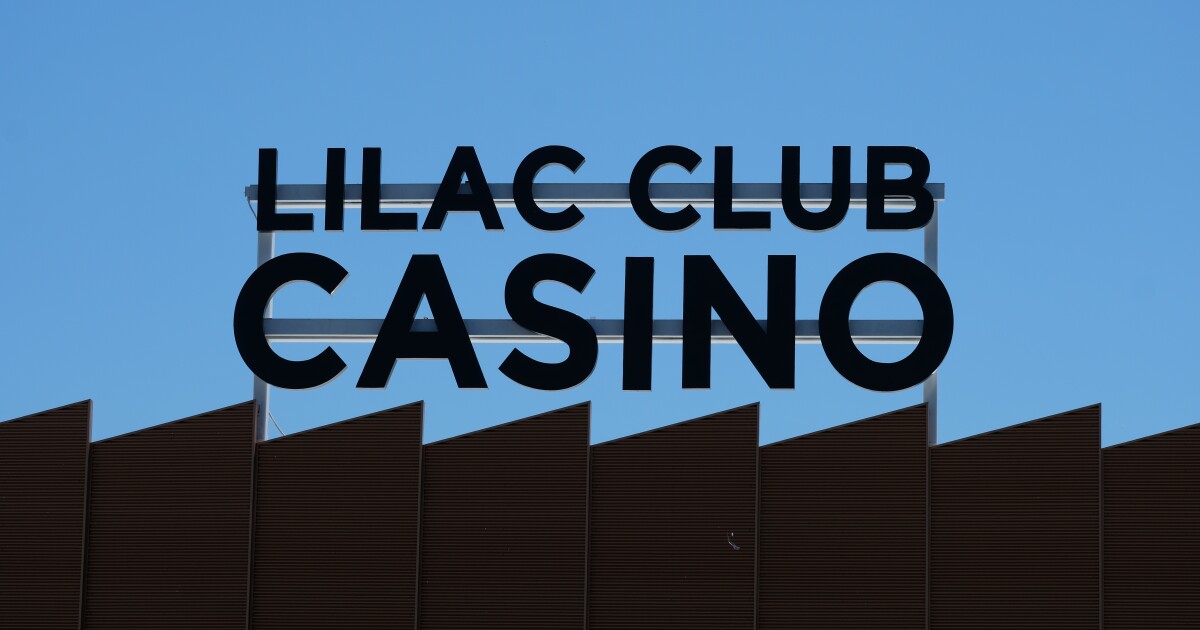
The Lilac Club Casino in Rochester is one of them.
Even at 11 a.m. on a recent weekday, there’s a steady stream of action at the Lilac Club. Eric Barbaro, the facility’s chief operating officer, ducks into the only quiet space he can find: the poker room, which hadn’t launched any games yet.
The club has 230 electronic games — picture very high-tech slot machines — plus old-school roulette and craps. There’s also a bingo room, a completely walled off smoking section, and a massive bar for watching a game.
The whole place feels modern and well-designed, right down to the restrooms.
“You’ll find you don’t have to be a great gamer to have a great food and beverage experience,” says Barbaro. “And if you’re a great gamer, you’re going to love the product that we’ve put out on the floor for you.”
Eric Barbaro, chief operating officer for Granite State Gaming & Hospitality, says a weekend craps game will draw in gamblers from across the region.
The ownership group of Lilac Club — Granite State Gaming & Hospitality — also manages a casino in Hampton, and recently announced its plans to open a third location in Littleton.
“The company is experiencing some great growth,” Barbaro says.
That can be a boost for the local economy in a place like Rochester, but it’s also a win for local non-profits: New Hampshire law requires these facilities to split their proceeds with a rotating group of local charities. In the past 18 months, Lilac Club Casino has awarded around $4 million to non-profits, according to Barbaro.
(NHPR has received gaming proceeds from a different casino.)
Still, for all the growth in gambling revenue, there are risks. Phil Sletten, with the New Hampshire Fiscal Policy Institute, says while the state treasury has certainly benefited from the rise in gaming proceeds, it can also paper over shortfalls in other key revenue sources — like state liquor sales — which have been slumping in recent years.
The current boom times may seem like easy money for everyone with a stake in the action, but Charlie McIntyre, the lottery’s executive director, knows that luck can turn quickly.
The recent surge to $5-per-gallon gas, for instance, will hurt lotto and scratch sales, because fewer people will stop at gas stations, he says.
And then there are the other big, unpredictable swings. A single sporting event can make or break a monthly budget.
“The first year we had sports betting, Tom Brady was in the Super Bowl with the Buccaneers,” says McIntyre. “And they covered [the spread] and won. And we got killed. We literally lost, as a state, $3 million.”
McIntyre may still carry some of those scars from 2021, but the New Hampshire Lottery, overall, has made it up since then.
Remember: The house always wins.