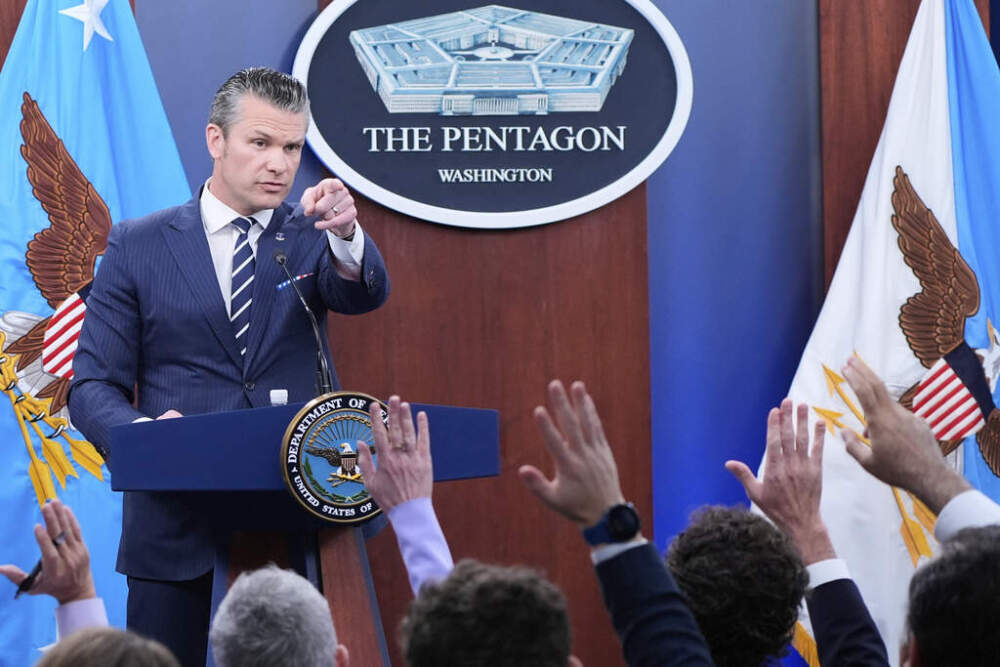
Military rules of engagement exist to specify ‘who’ and ‘what’ can be attacked. But Defense Secretary Pete Hegseth says the U.S. is fighting Iran without “stupid” rules of engagement. So, what rules are American forces following?
Guests
Daniel Maurer, associate professor of law at Ohio Northern University. Retired Lieutenant Colonel and Judge Advocate General (JAG).
Mark Nevitt, associate professor of law at Emory University. Retired Navy Commander with 20 years of active-duty service, including 13 yeas as a Judge Advocate General (JAG).
The version of our broadcast available at the top of this page and via podcast apps is a condensed version of the full show. You can listen to the full, unedited broadcast here:
Transcript
Part I
MEGHNA CHAKRABARTI: On February 15th, India hosted the 2026 International Fleet Review. It’s a nearly two-week military training event on the water. 74 countries took part in the event, involving 18 foreign warships. The naval exercises were coordinated and peaceful.
Participating ships were not armed. That included the Iranian frigate, the IRIS Dena. IRIS, standing for the Islamic Republic of Iran. Ship, Dena.
After the training, the Dena headed home to Iran, but never made it.
PETE HEGSETH: An American submarine sunk an Iranian warship that thought it was safe in international waters.
Instead, it was sunk by a torpedo. Quiet death. The first sinking of an enemy ship by a torpedo since World War II.
CHAKRABARTI: That is U.S. Defense Secretary Pete Hegseth, announcing the sinking of the Dena on March 4th. Five days after the U.S. and Israel began its war against Iran, an American submarine., the USS Charlotte fired an MK 48 torpedo at the Dena.
A large explosion and rapid flooding quickly sank the frigate within three minutes of the torpedo’s impact. Here’s Chairman of the Joint Chiefs of Staff General Dan Caine at that same March 4th press briefing.
DAN CAINE: I want to remind everybody that this is an incredible demonstration of America’s global reach. To hunt, find, and kill an out of area deployer is something that only the United States can do at this type of scale.
CHAKRABARTI: The Sri Lankan and Indian Navy’s launched search and rescue operations immediately. 32 survivors of the Dena were rescued. 87 died, 61 are still missing. The United States did not send a single vessel to assist with rescue operations. Iran’s foreign minister described the attack as, quote: An atrocity at sea. Stressing that the ship was part of a training session and was unarmed.
So is it an atrocity? Is it a war crime? Or is it a legal naval engagement? What are the rules of engagement in a war where the U.S.’ own leadership has called the entire concept of rules of engagement, “stupid and woke.” Let’s start with Mark Nevitt. He’s an associate professor of law at Emory University.
He’s also a retired Navy commander with 20 years of active-duty service. For 13 of those years, he was a Judge Advocate General, or JAG, which is a uniformed military lawyer for the other seven of those years. He was a Navy pilot, which included a deployment to Iraq in 2003. Commander Nevitt, welcome to On Point.
MARK NEVITT: Great to be with you Meghna.
CHAKRABARTI: Would you prefer a commander or professor?
NEVITT: Mark is fine. Whatever works for you.
CHAKRABARTI: Okay, fair enough. So we’re going to spend some time kind of deconstructing this torpedoing of the Dena. Can you first of all, describe to me when a decision is made to attack a naval vessel, as we saw on March 4th, how does that decision get made?
Who makes it, how does it come down the chain of command in the Navy?
NEVITT: So there’s sort of two different ways a decision would be made. I think in this case, this was probably a pre-planned attack. Again, I don’t have a security clearance these days. But that would be held at a pretty high level through the Chairman of Joint Chiefs of staff, General Caine and Secretary Hegseth.
Who have information and intelligence about the Iranian warship. And then they would execute, basically, orders down the chain of command down to the USS Charlotte to essentially destroy the Iranian vessel. That’s the path, I think, which happened here. Another sort of alternative path would be if a U.S. Navy ship or U.S. Navy vessel is fired upon.
And then you have what’s called self-defense rules of engagement, but I don’t think that’s what occurred here.
CHAKRABARTI: Yeah. There hasn’t been any reporting to the contrary, right? Because, that the Dena was part of these international naval exercises, and no one has said anything to the contrary.
Okay. Understood that obviously if a vessel is under attack, the local commander to the ship gets to make the decisions to defend their vessel. But in this case, again, you don’t have the security clearance to tell us exactly. But for a operation like this, is the decision made weeks in advance, days in advance, or does it really vary?
NEVITT: It varies. And so it depends on when the armed conflict started with Iran and how much pre-planning was done to influence the actual attack. Hard to say, but once we are involved in an armed conflict with Iran, which the United States certainly is right now, despite some commentary to the contrary that we’re not at war, we are in an armed conflict with Iran. And then the U.S. Navy Intelligence has, is the best intelligence in the world. And this is a U.S. … Iranian surface ship. And I’m pretty sure that the United States Navy have been tracking this. And had good positions and good location of this Iranian vessel for quite some time.
Then it’s just a matter of administering and issuing the orders to attack the vessel.
CHAKRABARTI: Yeah, it wasn’t hiding also, as far as we can tell, because it was involved in these joint naval exercises. So let’s talk about. So we’ll come back to the morality question a little later in this show, but the strict rules of engagement during wartime on the water.
I was reading that first of all, there’s the question of, okay, where was the Iranian ship located? Was it in enemy waters? Was it in Allied Waters? Was it in neutral non-belligerent waters? Because the United States is involved in a war with Iran, does it matter where the Dena was located at all?
NEVITT: Ultimately it doesn’t. The Dena was struck in international waters, not in the territorial sea or neutral waters. Returning from a multinational naval exercise, which I think gives maybe some of your listeners a little bit of uneasiness there because there was an exercise that Iran was participating in and then returning to Iran.
It was struck, but in the law of naval warfare, there’s no sort of zone of naval operations that says engagements may not occur outside like the Persian Gulf or something along those lines. So enemy warships are subject to attack really anywhere beyond the territorial sea of another nation or neutral waters.
And that’s been a longstanding rule dating back to even the Falklands when an Argentine cruiser was struck well outside Britain’s declared exclusion zone.
CHAKRABARTI: This is the Belgrano you’re referring to?
NEVITT: Yes.
CHAKRABARTI: Yeah. And then the UK then argued that the exclusion zone was to keep the safety, to assure the safety of neutral shipping.
But that exclusion zoning in and of itself did not restrict the UK’s right to conduct naval exercises against Argentina, which it was at war with at the time. Okay. But in a case like this with the U.S. and Iran, where would any neutral waters be on planet earth?
NEVITT: Certainly, a territorial sea of a neutral coastal state could be one of those.
So 12 nautical miles out. But most waters are international waters. And my understanding, and you have the best information that I do, this was 20 nautical miles off the southern coast of Sri Lanka. So it was in fact in international waters. Okay. S
CHAKRABARTI: o then, so this location essentially doesn’t matter as we’ve established.
Then what about the fact of the attack, because I understand that the ships can be targeted just about anywhere. Is there a naval rule of engagement that says at first if a submarine is going to attack an enemy ship, then it has to give some kind of warning? Because we have no evidence that the USS Charlotte was under threat or that it was responding to an attack from the Dena.
So is there any, are there any rules regarding having to give an enemy ship fair warning or opportunity to surrender?
NEVITT: No. And this is the shift, Meghna, from sort of peace time rules of engagement, which is most of the rules of engagement that we’re under. But we’re now in an extraordinary circumstance where we’re in an armed conflict with Iran.
And so the Dena being an Iranian warship is essentially a valid military objective and target subject to a certain analysis. The fact that it was unarmed really is not relevant. Warships are by themselves lawful military objectives by their nature. There’s no requirement once you’re in an armed conflict under the rules of engagement to give the warship a warning.
I’ve heard mixed reporting whether or not there was a warning given by the Charlotte. I can’t really assess that, but that’s certainly not required under the ROE. The fact that it’s a submarine, it’s stealth, and the Dena didn’t see it. That’s also not irrelevant under the laws of naval warfare.
One thing that is important before you strike the vessel is this idea of proportionality. So the attack, so in other words, you can’t just attack a vessel and have indiscriminate civilian harm, but this was in international waters with, I understand, no civilian vessels or objects nearby. So this proportionality threshold where you’re balancing basically the military objective.
Compared to the civilian harm inflicted, that was met. So I do believe this was a valid military objective. And that was lawful.
CHAKRABARTI: And by the way I think you’re referring to, there’s some reporting coming out of the Indian press that an Iranian sailor aboard the Dena might have called his family at least once or twice saying that they had been issued a warning by the USS Charlotte before the boat was actually, the frigate was actually torpedoed. But again, we’ve seen reports either way. Okay. So what about the final thing, which I think is something that most observers, they point to as perhaps the most appalling. That it was Sri Lankan and Indian Naval Forces that launched that search and rescue operation and the U.S. did not.
Isn’t there some kind of obligation vis-a-vis, I don’t know, the Geneva conventions for even an attacking Navy to try to rescue sailors of an enemy vessel.
NEVITT: Right, Meghna. So the first two questions to me are easier to answer. The third question, is there a duty to rescue the shipwreck survivors? Appears to be compliant with international law, but we still, I would still want to know more. It’s a harder question. You are exactly right. The Geneva conventions do apply, specifically the second Geneva conventions, which speak to shipwreck survivors.
Both Iran and the United States are parties to that convention, which was signed after the second World War, and that requires that after each engagement, such as the sinking of the Dena, the parties take all possible measures to search for and collect the shipwreck, the wounded, and the sick.
However, the obligation is not absolute. It’s conditioned on military exigency. And that’s particularly challenging for submarines, which are already small and secretive.
Part II
CHAKRABARTI: Last night I spent some time digging into certain parts of the Geneva Convention, specifically around rescue, search and rescue obligations. And as you were saying, it does say that the attacking ship does have an obligation to launch some kind of search and rescue effort, but specifically regarding submarines, as you were saying before the break, there are, let’s say, caveats included, right?
Because submarines don’t have a lot of space, they typically perform evasive maneuvers obviously subsurface after an attack. So in those cases, the Geneva Conventions say you have to either opt to deploy some of your own search and rescue materials like rafts, et cetera, the commander of the sub can notify his or her own Navy to provide assistance. Or I think I also see here that it says in good faith assessment, if the subcommander sees that other Navy’s are providing assistance, then that may be okay as well.
NEVITT: There’s some caveats baked into this general duty to aid shipwreck survivors, which you want to do, right?
This is, they’re out of combat, their considered order combat, they no longer are, quote-unquote, in the fight, so the ethics and morality of war suggest you want to help out these people. But it’s also during war time, I think it’s what the Geneva Conventions and its commentary are getting at.
Submarines is really challenging because there’s so much space on board that’s limited and transmitting any kind of communication from the submarine to a search and rescue effort could essentially, showcase the submarine position. And so they really value maintaining communication silence until they’re outside of that engagement area.
What’s interesting to me is that the Indo-Pacific Commander, which is essentially the commander of this operation, they issued a statement saying that the U.S. forces planned for and Sri Lanka provided lifesaving support. A vague statement, but it suggested there was some sort of communication between the United States military command structure and Sri Lanka and that might be enough to satisfy … certainly, the spirit of the Geneva Convention, but there’s nothing for me that I’ve heard about any kind of specific actions that the Charlotte took.
And that’s why on this third question, this duty to rescue, I just want to know a little bit more about what steps were taking and what exactly were the military exigencies before I gave more of a definitive answer.
CHAKRABARTI: Yeah, no, fair. And by the way, for folks who are interested, the particular sections, at least that jumped out at me of the Geneva Conventions, the 2017 version, the commentary that Mark was talking about, Articles 18 and 21 seemed particularly relevant to this situation.
Now, Mark. We’re talking this hour overall about the rules of engagement in this war that the United States has started with Iran, specifically because Secretary of Defense Pete Hegseth has spoken frequently about his distaste for the entire concept of rules of engagement. And I actually wanted to start out with the example of the Dena.
Because legally speaking, almost every naval legal expert that’s written about this has said what you said, that it’s not an illegal action that the Charlotte took, but what it does show us is how, I don’t know, broad the options are for naval commanders in a war setting, that may be broader than, I don’t know, what civilians find moral or acceptable.
Is that a fair way of putting it?
NEVITT: It is fear. Because again, once you, it’s a toggle switch, Meghna. Once you switch from basically peacetime rules of engagement where just the standing rules of engagement apply, where it’s just inherent right to self-defense, where essentially you have to be facing a hostile act or an eminent hostile threat to wartime rules of engagement, where you can actually, once you have positive identification of military objects, such as a warship, you can attack without essentially being attacked first. So it’s much more permissive than the peacetime rules of engagement. And right now, we’re in wartime rules of engagement.
CHAKRABARTI: Yeah, so understanding that complexity and that nuance is really my goal for this hour. Because there has been so much going on in just the past, less than two weeks, regarding the U.S. and Israel’s engagements in Iran, that I think a lot of people have a ton of questions of whether or not, not only is this a lawful war, but is the United States following international rules of war.
So first of all, let’s just go and listen to the Secretary of Defense himself. This is from March 2nd where Pete Hegseth at a Pentagon briefing basically calls the rules of engagement, quote, stupid.
HEGSETH: Unlike so many of our traditional allies who wring their hands and clutch their pearls, hemming and hawing about the use of force, America, regardless of what international institutions say, is unleashing the most lethal and precise air power campaign in history.
B-2s, fighters, drones, missiles, and of course, classified effects, all on our terms with maximum authorities. No stupid rules of engagement. No nation building quagmire, no democracy building exercise. No politically correct wars.
CHAKRABARTI: That was March 2nd. Here’s the Secretary of Defense again on March 4th.
HEGSETH: We’re playing for keeps. Our war fighters have maximum authorities granted personally by the president and yours truly. Our rules of engagement are bold, precise, and designed to unleash American power, not shackle it.
CHAKRABARTI: Okay, so that’s the Secretary of Defense on March 4th. I’d like to bring Daniel Maurer into the conversation now.
He’s an associate professor of law at Ohio Northern University. He’s also retired lieutenant colonel, served for 22 years. First as a combat engineer officer with deployments to Iraq in 2003 where he was fighting the counterinsurgency, a counterinsurgency with rules of engagement. He deployed again to Iraq in 2010 as a Judge Advocate General Daniel Maurer, welcome to On Point.
DANIEL MAURER: Hi Meghna. Thanks for having me.
CHAKRABARTI: Let’s get some basic definitions out on the table. Is there a difference between rules of engagement and rules of war?
MAURER: Technically, yes. For your listeners, it’s important to understand that the rules of engagement come in the form of an order from a commander, and it’s usually very high-ranking commander, and they filter down through the chain of command, ultimately to the war fighter.
But those rules of engagement are based on three things. First thing, they’re based on is national policy. For example, in a counterinsurgency campaign, where the intent is to quote-unquote, win the hearts and minds of the host nation population so that they work for you, not against you. The rules of engagement should be tighter, they should be narrow, they should be more restrictive, which means you’re less likely to use excessive force, which means you’re more likely to protect civilians.
But in a large-scale combat operation, let’s say Russia versus Ukraine. For example. Before we get to Iran. The rules of engagement are going to be necessarily more permissive. Because you’re fighting larger forces with more capability. You’re fighting tanks and aircraft carriers and jet fighters, submarines, infantry battalions and hopefully you’re fighting outside where civilians happen to be located.
So the rules are going to be necessarily more permissive. So national policy’s going to dictate how generally you’re going to fight a particular campaign. The second thing that influences rules of engagement would be the specific mission that a unit is fighting. So if a unit is in a densely urban area, for example, the rules of engagement might be more restricted than they are out in the countryside, again, to protect civilian collateral harm.
The third thing that they’re based on is the law of armed conflict, the rules of war, as you said that’s kind of like the red line that you can’t sink below, no pun intended. You can’t fall below that red line. If you violate a rule of engagement that would or create a rule of engagement that would violate a law of war, then you’re issuing an unlawful order, to be completely frank about it.
And one of the things that JAGS do, judge advocate officers do, is help draft those rules of engagement at the outset of a campaign. They help commanders and other planners think through the different objectives that they have, the different weapon systems that they have, the kinds of threats that they’re going to face in that particular area of operations.
All given national policy, given mission constraints, and given the laws of war. Again, JAGS are the legal experts on the staff. So if anyone’s going to understand what the laws of war are, it’s going to be the JAG officer.
CHAKRABARTI: So this is really important. Laws of war or laws of armed conflict, those are essentially international and emerged from the Geneva conventions at least, Daniel.
MAURER: That’s correct.
CHAKRABARTI: Okay. So that’s an important distinction. Those are global and they exist because of very dark history in terms of how have wars in the past have been fought. Whereas rules of engagement are national, so different nations can have different rules of engagement. Okay. Mark, let me bring you back in here.
Daniel said that one of the first ways that rules of engagement are formed is based on, what is the intent here? What is the policy intent of the military action that the nation is undertaking? I’m not sure that the president of the United States, in fact, I’m sure the president of the United States has not actually given a single clear goal for the military engagement in Iran.
So how can rules of engagement be formed around such lack of clarity?
NEVITT: It’s a good question. Certainly, there is a public facing what’s the end state, what’s the desired end state of this conflict with Iran? Is it regime change? Is it nuclear defanging of Iran, is it limiting their military capabilities?
It seems to be a little bit of a shifting sand. So Dan is exactly right. The ROE should flow from the national policy with the end goal of mission accomplishment, whatever that is defined to be. And that comes from the President, the Secretary of Defense. As a way of speaking from the President and the Secretary of Defense through the ROE, down to the people who are actually in combat to align the rules of engagement with their broader national objectives.
And there may be in the classified rules of engagement, a paragraph or two that’s discussing what those objectives are. We haven’t seen that, and I don’t think certainly the American people are clear on what exactly the end state and the national objective is with this war in Iran.
CHAKRABARTI: Okay, so Daniel, a little earlier we heard the secretary on March 2nd, say, quote, “no stupid rules of engagement.”
Then on March 4th, he says that our rules of engagement are bold, precise, and designed to unleash American power. Can we say with confidence that there are actual rules of engagement in the hands of commanders and even ground level or ship level members of the U.S. military right now?
MAURER: I think absolutely we can be confident that they are operating under some kind of rules of engagement. It’s, I think, absurd to assume that after decades of combat operations where these commanders grew up, as both Mark and I did, fighting in the Middle East with JAGS on staff following rules of engagement.
Understanding what the laws of war said it would be. It just, it doesn’t follow that they would be operating now without any, but I agree or at least acknowledge that the secretary’s initial comments give one pause. And they make one think if this is coming from the top, does that message that signal of disrespect the rules flow downward.
And I think that is a genuine fear. But I think the military, whether we’re talking about the Air Force or the Army, the Marines or the Navy are so well-trained and so professionalized that the risk of that happening, of the, I’m not going to follow these stupid rules of engagement down at the pilot level.
Or the ship captain level, I think is very unlikely. Is there a potential that you have an outlier somewhere that says my secretary or my president thinks that rules don’t matter and we’re just gonna unleash hell, so to speak. Therefore I’m gonna use maximum force whenever I can.
That’s obviously possible, but that’s possible in every conflict. What I think is interesting, I’m sorry, go ahead, Meghna.
CHAKRABARTI: No. Please wrap up your thought. Go ahead.
MAURER: I was going to say that hearing Secretary Hegseth talk, it does very much sound like he’s playing Call of Duty or video game in which conflict, war, is detached from politics.
Hearing Secretary Hegseth talk it does very much sound like he’s playing Call of Duty or video game in which conflict, war, is detached from politics.
Daniel Maurer
Clearly, Secretary Hegseth has not read his Clausewitz, war is a continuation of policy by other means. You cannot divorce the use of force from your political objectives. You have to have a clear end state; this is war fighting 101. And this speaks to his lack of experience and frankly, his lack of maturity.
And the way in which he has described this conflict as he has described other conflicts that the United States is in, like the boat strikes in the Caribbean, for example. Signals very much a game playing kind of atmosphere and that is telling, that’s telling about his maturity and his lack of experience.
CHAKRABARTI: By the way, we did reach out to the Pentagon to ask the military, the DOD, what the specific rules of engagement are for this war with Iran. And if they could elaborate in any way, shape, or form, the Pentagon did not respond to our request.
Okay, so I’ve been talking about rules of engagement in kind of broad terms. But Mark, more specifically, they refer to things like not just how and when force can be used, but when lethal force can be used, when even at the individual soldier or marine or sailor level, like when they can fire on another person.
How detailed do they get? How detailed were they when you served in Iraq?
NEVITT: They’re pretty, pretty detailed. And the ROE is transmitted through what’s called message format. Dan’s exactly right from essentially communication from the President or the Secretary of Defense down to that lowest tactical commander, the trigger puller or the war fighter.
And then from there, they’re often promulgated further into tactics or procedures on how you actually implement them based upon the factual scenario on the ground. So you go through scenarios, you get briefings from JAGS on when you can respond in either self-defense or how you can respond with forces that are declared hostile and how you make that determination based upon positive identification.
I’ll just say, taking a step back here, this war in Iran has really been an air war and to a certain extent, lesser extent, a naval war. Yeah. And so a lot of the complex ROE questions. Thank God, we don’t have them quite yet. That really comes into play when you have ground forces, when you’re trying to distinguish between civilian populations and enemies.
War in Iran has really been an air war and to a certain extent, lesser extent, a naval war.
Mark Nevitt
We saw that in Iraq and Afghanistan. We became very challenging at times to distinguish members of Al-Qaeda or people who were. Already designated hostile actors from the civilian population. So lot of this —
CHAKRABARTI: But Mark, let me just, forgive me, I gotta jump in here. So but when you’re doing bombing campaigns from the air, are we not still obligated as a modern military to distinguish between civilian and enemy in terms of where we drop the bombs?
Why are there no rules around that?
NEVITT: Of course, there are. No, of course. … Yes. And what I’m suggesting here is that those targets, as far as I could tell, again, I don’t have a security clearance. Those are pre-planned targets. I’m assuming the central command has a targeting cell.
Looking at all these targets ahead of time, there’s very little and a little bit of time sensitive strike where you’re basically making real time, calling an audible, doing this proportionately analysis that I mentioned before. Where you’re basically trying to, okay, what’s the military advantage we’re trying to gain from striking this target.
Compared to the expected civilian harm. And so I think that it’s a little bit more formulaic. I think right now, at least in the initial few days of the conflict, that might be changing. It gets more dynamic because you’re looking at these pre-planned targeting strikes.
Part III
CHAKRABARTI: So both of you had talked about before the break what the sort of rules of engagement typically have been as issued by the United States. And then also we’ll get more into this, but the broader laws of armed conflict that are recognized globally.
And Mark, since you mentioned that thus far, this has really been an air war that immediately brings to mind the bombing of the Girls school in Minab, in Southern Iran, where more than 165 students, girls, were killed. It’s the largest mass casualty event yet in this war. And here we have the president of the United States, President Trump on March 7th.
He was on Air Force One. And here’s some of his comments.
DONALD TRUMP: Based on what I’ve seen, that was done by Iran.
REPORTER: Is that true, Mr. Hegseth? It was Iran who did that?
HEGSETH: We’re certainly investigating.
REPORTER: Still investigating.
HEGSETH: But the only side that targets civilians is Iran.
TRUMP: We think it was done, we think it was done by Iran.
REPORTER: Can you give us an idea.
TRUMP: Because they are very inaccurate with their munitions, they have no accuracy whatsoever. It was done by Iran.
So that’s the President and Secretary Hegseth on Air Force one March 7th. Now, the same question was asked again of Defense Secretary Pete Hegseth, just this past Friday by CBS News correspondent Major Garrett in an interview for 60 Minutes.
HEGSETH: We’re still investigating and that’s where I’ll leave it today. But what I will emphasize to you and to the world is that unlike our adversaries, the Iranians, we never target civilians.
GARRETT: There was a report late in the week from two officials that it was likely U.S. involvement. Is that report false?
HEGSETH: I’ve already said we’re investigating.
GARRETT: If you could tell the American public it definitively was not us, you would tell us, wouldn’t you?
HEGSETH: I would say that it’s being investigated, which is the only answer I’m prepared to give.
CHAKRABARTI: So Major Garrett there referencing the fact that several U.S. officials speaking under conditions of anonymity have in fact told the media that it was a U.S. military operation.
And even more recent reporting is finding that it may have been a tomahawk missile, in fact, that killed all those young girls. Okay, so Daniel, let me first turn to you here. Under rules of engagement that you are familiar with from your time in Iraq, I understand that at least the most, there was a new set issued in 2005.
Would this strike have been, should it have been allowed?
MAURER: So it’s a complicated question actually. The rules of engagement, like I said before, are based on national policy, the aims of the overall campaign and the kinds of missions. By 2005, 2006, 2007 and later, we weren’t engaging the Iraqi military.
We were engaging insurgents who were interspersed often with civilian populations. It would be highly unlikely in Iraq anyway to see a tomahawk missile, or any kind of missile being fired into a densely populated area. That’s not the same as what we’re seeing in Iran.
As Mark pointed out, this is an international armed conflict where the law of armed conflict is actually more permissive because it understands that, for lack of a better phrase, bad things happen in war. That doesn’t mean it’s okay. It just understands that there will be legitimate military targets often being attacked with the aim of getting to a conclusion quickly that might put civilians, unfortunately, in harm’s way.
And so it doesn’t outlaw civilian casualties. The law of war does not outlaw civilian casualties. What it prohibits is unnecessary collateral damage. And that’s the proportionality analysis that Mark was talking about earlier. Where the commander ultimately has the call, has to make a decision based on information reasonably available to him or her at the time that the expected gain, military advantage that you get from striking a target, outweighs the expected collateral harm based on the information you have before the strike. And that’s very difficult, especially under conditions of combat. In a pre-planned target, it’s a little bit easier. You have more time, theoretically you have more time, you have more information.
You can pace yourself and you can wait. But this reminds me a little bit about, of a strike in the early Gulf War, 1991, February, I believe, in 1991, in which a bunker was hit by U.S. munitions. And the bunker happened to have several hundred women and children in it. And the bunker was assessed as a military target because it was surrounded by concertina wire.
There were military antennae around it, there were military vehicles around it. But what was not known at the time was that it was being used as a shelter also by civilians. That was not a war crime. It’s an unfortunate tragedy but it’s not a crime under the laws of war. So that’s best case is if this was a U.S. strike that led to the deaths of these children.
The best case is that it’s an unfortunate, unbelievably unfortunate tragedy. But I would agree with Secretary Hegseth is that we don’t, as a matter of law and policy, don’t target civilians. That is against the law.
CHAKRABARTI: Okay. This is making me wonder if even if right now the internationally agreed upon laws of armed conflict are satisfactory.
And Mark, here’s why I’m wondering it, because I hear both of you. Bad things happen in war because wars are bad. Okay. We will not have modern conflict that has zero civilian casualties. But on the other hand, in modern war, the percentage of civilian casualties is very high.
By some estimates, after World War II, we’re seeing like that 65% to 70% of all casualties are civilian. And I wonder if there’s something inadequate about even the current law of armed conflict when it comes to trying to minimize the deaths of innocent people. I feel like the proportionality rational in fact isn’t sufficient, Mark.
NEVITT: And that’s a fair critique of the existing rules of engagement and internationally humanitarian law, which is sometimes used synonymously with alarm conflict. And this is a human, it’s not formulaic in terms of a quantifiable objective for disproportionality analysis.
And it’s a human element when you are trying to weigh civilian harm versus the gain from a destruction of a military object. And different militaries may approach that proportionality analysis somewhat differently.
I will say that the rules of war and international humanitarian law writ large are fundamentally designed to get to peacetime as soon as possible. And in some respects, that’s why they’re somewhat permissible so that you strike the military objects to move towards peacetime. But what you’re bringing up, Meghna, is a fear criticism that maybe that needs to be more protection.
I just think that the existing rules of engagement should be designed to achieve that military objective as quickly as possible. So go to peacetime as quickly as possible.
CHAKRABARTI: One could argue, I guess this is what you’re saying, that trying to get to peace as possible means exacting a toll on civilians that’s as high as possible in order to motivate their government to get to peace.
NEVITT: No, that’s not what I’m saying. There’s a distinction between civilians and military objectives, which are a core part of rules of engagement and the law of armed conflict. Dan’s exactly correct, per se, targeting that school, which is just absolutely horrifying.
That is not something that the U.S. military would do, certainly a violation of the laws of war and Sec. Hegseth is correct in the sense that he says that he’s investigating this matter and we need to have a full, clear investigation of what exactly happened, what was the information they had, and whether or not there should be accountability for that mistake, because it appears that there’s a lot of questions that are unanswered.
CHAKRABARTI: Okay, let me turn now to some other actions that have raised questions just in the past couple of weeks. On Air Force One, again, on Saturday, reporters asked President Trump whether the United States was responsible for bombing a desalination plant in Iran, which had a terrible impact on the water supply for 30 villages.
And here’s the president’s response.
TRUMP: They’re among the most evil people ever on earth. They cut babies’ heads off, they chop women in half, what they did, take a look at October 7th, take a look at what they’ve done over the last 47 years.
So I know nothing about a desalinization plant other than to say if they’re complaining about a desalinization plant we complain about the fact that they shouldn’t be chopping babies’ heads off, okay?
CHAKRABARTI: So the president didn’t, president did not answer the question there, but later on, Captain Tim Hawkins, a spokesman for United States Central Command, Captain Hawkins said that U.S. forces were not responsible for that attack.
Again, we’ll see how knowledge about that attack develops. But Daniel, let me ask you, when people, again, external to the military, see things like water plants being bombed, the question once again is, first of all, are those lawful attacks, and if they are, maybe the laws themselves are not protective enough.
Your response to that.
MAURER: Yeah, that’s a really good point. And I would echo Mark’s observations, too. I agree wholeheartedly with him that these are very difficult questions and as a society, as a U.S., we’ve had 25 years of counterterrorist and counterinsurgency operations under our belt.
Predominantly anyway, and not large-scale combat operations where it’s one nation against another nation. We had a bout against Iraq in the initial invasion in 2003. We had a bout against the Taliban government of Afghanistan in 2001, but after that it was counterinsurgency and counterterrorism.
So what we’re seeing now is the gloves coming off, so to speak. But they’re coming off against, I don’t want to say a near peer competitor at all, but this is another formidable military, a nation state that has national resources of Navy and Air Force and Army, that does pose legitimate threats to other nations around it.
And when we do see attacks that are permitted by the laws of war on objects that look to be civilian, like desalination plants or factories, power plants, that does immediately strike people as odd and potentially very wrong. But there’s a key point here and that is some of these facilities are often used by military for military purposes.
They might be used to store ammunition. They might be used as a communications hub, they might be used as a headquarters, that would be wrongful. Using a civilian facility like that is actually unlawful under the laws of war. But it happens. And if the intelligence suggests that there is a legitimate military target that’s hiding in or around what appears to be an otherwise civilian object, it doesn’t mean it’s off limits.
It just reemphasizes that the military has to go through that proportionality analysis, which is given that it’s a civilian object, there are likely to be civilians there. You have to weigh the expected civilian property and human life damage. That you expect against the anticipated military advantage, and you have to take precautions.
So this is another principle of the law of war that we didn’t get to yet, was this idea of distinction. Which is really the primary principle that is distinguishing between civilians and combatants and civilian property and military targets. And one of the rules is taking feasible precautions. So not just the proportionality analysis, but knowing that you’re going to strike something that might have potential civilian harm.
You have to take, the commander has to take feasible precautions. That might mean striking at night when there are fewer civilians likely to be in the area, or striking a slightly different target in that area so that you minimize collateral damage or using a certain kind of weapon system that won’t have as much explosive fragmentation.
Those sorts of decisions are normal within the planning process to ensure that we’re meeting the proportionality of tests. But those are precautions that commanders should take. And when the secretary says essentially gloves are off and no stupid rules of engagement. To me, that sounds like a signal that fewer feasible precautions need to be taken.
And that to me demonstrates, or at least explains why there was a strike in the middle of the day in a densely urban populated area where there’s a school nearby. When, you know, that maybe should have been struck later in the day, later in the afternoon, in the evening, at night.
CHAKRABARTI: Yeah. You know what we keep coming back to is I hear in both of your descriptions, the establishment of a set of beliefs and rules within our professionalized, sophisticated technically excellent United States military, in terms of following both rules of engagement set nationally and the laws of armed conflict internationally. But that’s coming up against the attitudes that the current leadership of the Pentagon and even the White House have about no stupid rules of engagement.
That tension is real and we’re going to see how that plays out over time. But we just have a minute left. Less than that. I just want to ask you both a quick question before we have to wrap up, and that is, all of this conversation is happening within the context here in the United States, that this war was never authorized by Congress.
Would you call the current action that the U.S. military is taking under the leadership of President Trump and Secretary Hegseth legal, Mark, is this a legal war?
NEVITT: So first there’s just two different dimensions to that briefly. Maybe that’s in our next conversation.
CHAKRABARTI: Yeah, because you only have a few seconds.
Sorry.
NEVITT: Under international law that doesn’t strike me that threshold’s been made. There’s no UN Security Council resolution justifying or authorizing this war. United States, the evidence requirement to respond in self-defense, I don’t think that’s been made publicly to satisfy the self-defense requirement under international law.
And Dan can maybe speak to the domestic law, but certainly Congress hasn’t declared a war and Congress has been missing an action on a lot of this.
The first draft of this transcript was created by Descript, an AI transcription tool. An On Point producer then thoroughly reviewed, corrected, and reformatted the transcript before publication. The use of this AI tool creates the capacity to provide these transcripts.