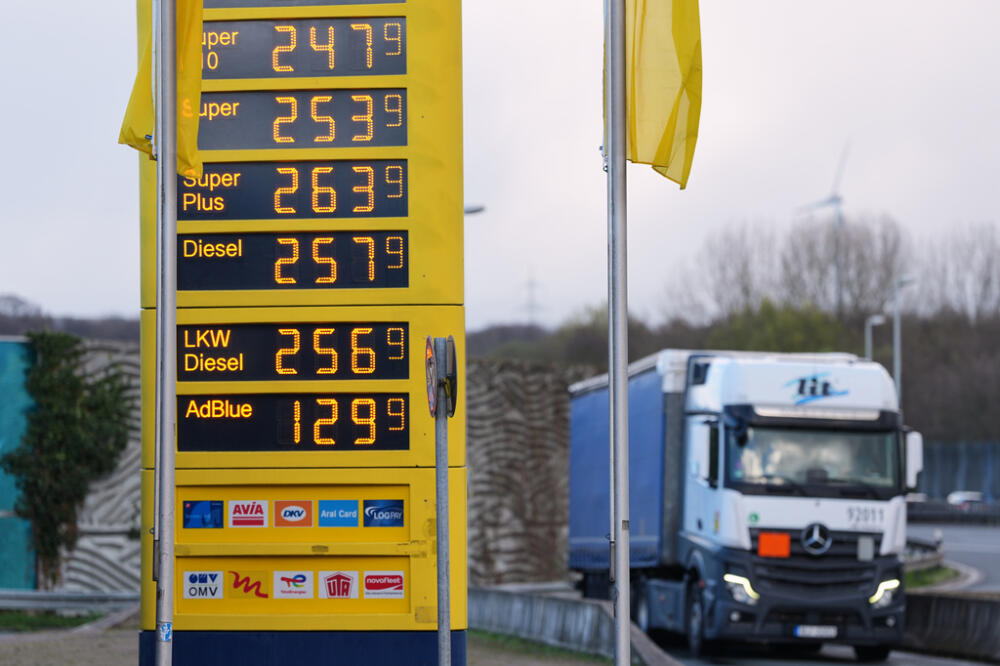
Europe and Asia are facing fuel shortages. The U.S. is in a fuel deficit. Some experts say the Iran War has caused the largest energy security threat in history. And it’s about to get worse.
Guests
Jan Rosenow, energy program leader and professor of energy and climate policy with the Energy Change Institute at Oxford University.
Daniel Spiro, professor at the Department of Economics at Uppsala University.
Jim Burkhard, vice president and head of research for oil markets, energy and mobility at S&P.
The version of our broadcast available at the top of this page and via podcast apps is a condensed version of the full show. You can listen to the full, unedited broadcast here:
Transcript
Part I
MEGHNA CHAKRABARTI: Fatih Birol is head of the International Energy Agency, and just a month ago, he made a dire prediction.
FATIH BIROL: We are facing the biggest energy security threat in the history.
CHAKRABARTI: And he said it again just three days ago. Birol says that the U.S. and Israel’s war with Iran has greatly depleted commercial oil inventories around the world.
There are still reserves at the moment, but Birol says they will only last, quote, “Several weeks. We should be aware of the fact that it is declining rapidly.” End quote. He isn’t the only one. Earlier this month, Chevron’s CEO Mike Wirth said the world is starting to see some of the consequences of those dwindling oil reserves.
MIKE WIRTH: We’re starting to see risks of supply outages in some of these economies. In Europe, you’re seeing flights canceled and schedules reoptimized because jet fuel is getting very tight in Europe. And we’ve seen a number of economies in Asia that have instituted policies to reduce demand because they’re concerned about running out of supply.
Supply outages, you heard him say that, meaning regular fuel supplies just aren’t there. Commodities expert Jeff Currie is currently with ABX Markets, and he’s also former global head of commodities research at Goldman Sachs, and he laid out some clear definitions on Bloomberg News.
JEFF CURRIE: A deficit versus a shortage. We have a deficit today, meaning that demand is above supply and we’re drawing inventories. It’s not a shortage yet. So to answer your question, you have the shortages in places like Asia. And it’s not that bad yet. Because you’re not completely at tank bottoms. But in places like Europe and the United States, you’re in a deficit, and you don’t hit the shortages until you hit tank bottoms.
And then there’s Jason Bordoff, director of the Center on Global Energy Policy at Columbia University, and he says that the effects of the depletions are coming to the U.S.
JASON BORDOFF: If you keep the Strait of Hormuz closed, I don’t know if it’s two weeks, three weeks, or six weeks, but we are headed to much higher oil prices. Because eventually if you have 15 million barrels a day of supply off the market, prices have to rise high enough to destroy 15 million barrels a day of global demand.
CHAKRABARTI: So a worldwide energy supply deficit could lead to recession. Adam Posen, president of the Peterson Institute for International Economics, recently spoke with The Atlantic’s David Frum, and Posen told Frum that even higher inflation is coming, and it’s coming to the U.S.
ADAM POSEN: We’re very close to another bout of global inflation.
I think actually in some ways that’s a place where the U.S. is gonna be worse off than a lot of the other high-income economies because we didn’t quell inflation enough over the last few years since COVID. But I also think that the recession is very imminent in what’s called the Global South and in certain parts of the middle income economies.
Swinging back to the U.S., commodities expert Jeff Currie added:
CURRIE: It’s going to be sometime the month of May that you’re going to end up with Europe hitting tank bottoms, and in the U.S. it’s somewhere in that July 4th time period, if not sooner. By the way, the inventories number coming out of the U.S., the ones we got last night, the ones last week, I’ve never seen anything like that before.
The analogy I think is like in that movie Jaws when the mayor declares, “The beaches are open,” and you can see the fin swimming around, around there, and the fin are these inventory numbers.
CHAKRABARTI: So today we’re going to get a deeper understanding of why so many energy experts and analysts have been saying almost in unison that an historic global energy shock may be just a few weeks away, and what follows could be that inflation spike, and for some nations, recession.
So let’s start in Europe. Jan Rosenow is leader of the energy program and professor of energy and climate policy at the Energy Change Institute at the University of Oxford in England, where he joins us. Professor Rosenow, welcome to On Point.
JAN ROSENOW: Hello. Thanks for having me.
CHAKRABARTI: First, give us the picture there from Europe.
You heard some American analysts saying that Europe is either already feeling or on the brink of experiencing supply outages.
ROSENOW: There are no outages yet, but it’s definitely very tight, and there’s certainly talk about potential shortages of jet fuels in the summer, for example.
Europe is in a very different situation to the U.S. We import about 88% of the natural gas that we use in Europe in the EU, and we also import about 95% of the oil. And after the invasion of Ukraine by Russia, increasingly, that gas demand is being satisfied by importing liquefied natural gas, LNG, and some of that also, of course, goes through the Strait of Hormuz.
So Europe is deeply exposed, and that’s why we’re really feeling the shock waves of this crisis ripple through the European economy.
CHAKRABARTI: And so give me some concrete examples of how the people in Europe are feeling those shock waves now.
ROSENOW: Let’s look at heating oil, which is one of the fuels people use to keep warm.
And in March, we’ve seen heating oil prices triple overnight almost. That is one example. Or when you look at the cost of electricity in markets that depend heavily on gas-fired power stations, we’ve seen gas prices rise by 70, 80%, at some point almost double what they used to be, and that filters right through into higher electricity prices.
A lot of this will only be felt by consumers, though, in the coming months as these price effects work their way through the supply chain and that will take some time. But yeah, inflation is definitely going to rise, and it’s going to hit everybody, whether we like it or not.
Inflation is definitely going to rise, and it’s going to hit everybody, whether we like it or not.
Jan Rosenow
CHAKRABARTI: Professor Rosenow, let me just reiterate some of the numbers you said, because they are quite eye-opening, and I want to be sure I heard you correctly.
So in some places in Europe, the price of heating oil has basically tripled, yes?
ROSENOW: That is correct.
CHAKRABARTI: Okay. And then you talked about gas, specifically for industries that you have to use a lot of energy. Gas prices increasing 70% to 80%, almost doubled. So that is for, almost in the production tier of the European economy.
And so then, it seems like the only natural outcome is a cascading of higher prices through the rest of European, Europe’s both industrial and consumer economies.
ROSENOW: That’s absolutely right. And it’s not just energy. The other important aspect to this is that also things like fertilizer are, of course, based on fossil fuels, and that filters through the cost of food production.
There’s other derivatives, helium, for example, that plays a very important role in certain sectors. All of those will be more expensive. So it’s not just energy, but it’s all the derivatives from the petrochemical industry that we’re using all across the economy, and that’s why this has such fundamental impacts on the cost of living in Europe right now.
CHAKRABARTI: The fundamental cost of living in Europe. Okay. Obviously in the media, especially here in the United States, in speaking about Europe, the headlines have all been about jet fuel shortages that could be on the way. It seems as if, yes, while that is significant, especially during the summer holidays, that it’s merely one of many ways in which, as you said, the cost of living for Europeans is going to change dramatically.
Now let me go back to one thing you said about its LNG restrictions on gas that’s coming through the Strait of Hormuz that is especially hitting Europe hard. What were Europe’s storage capacities like prior to, say, these past two weeks? There wasn’t enough in storage, but what technically is enough, Professor?
ROSENOW: They weren’t great to begin with. That’s the part of the problem. We’ve just come out of the winter, and that’s when gas demand is high because of heating and buildings, and that means there’s less resilience in the system. For gas, it’s different. For oil, there are mandatory emergency supplies that countries need to withhold from the market and can then release in an emergency situation.
And then we’ve seen that happening, haven’t we, a few weeks back when the International Energy Agency released those oil reserves, but for gas, nothing like that exists. So it’s a lot tighter. And in research that we just published yesterday, we find that with any other supply-side disruption, you have any other geopolitical tension happens, then prices in Europe could really go through the roof because the market is extremely tight right now, and any other shortages could really worsen the situation quite dramatically.
CHAKRABARTI: And how does this then play into Europe’s dependence already, or at least partial dependence on, say, energy from Russia, given the Ukraine war?
ROSENOW: They certainly now talk about allowing at least some Russian energy back into Europe, Russian diesel, for example.
But also, potentially LNG, that comes out of Russia. So that is definitely part of the discussion. But I think the United States currently benefit probably the most from the lack of LNG from the Gulf region and the absence of pipeline gas from Russia, so we’re expecting a significant expansion of LNG from the U.S. in the coming years in Europe.
We’re expecting a significant expansion of LNG from the U.S. in the coming years in Europe.
Jan Rosenow
CHAKRABARTI: Okay. Professor Rosenow, it seems as if Europe, actually the entire world, but we’re focusing on Europe for the moment, is realizing the same thing that the U.S., the American people, I should be specific, are realizing, and that is so much of our energy stability has relied on the presumption of relatively frictionless passage of ships through the Strait of Hormuz.
No matter what happens between the U.S., Israel, and Iran, I don’t think anyone’s necessarily saying that it’s going to go back to what it was prior to the start of the Iran war. With that in mind, this seems to be a moment where Europe has to have very strongly considered, consider what a new normal will be if those energy supplies will always be considered more vulnerable or just de facto more expensive.
ROSENOW: Absolutely. And to make it really simple, it’s a fork in the road, Europe could go more towards what the U.S. is doing right now and become more of a petrol state, that’s what some people are arguing, or go in the direction of China, which is an electoral state.
The difficulty is that Europe doesn’t really have vast oil and gas resources in the same way that the U.S. does. So there isn’t really all that much choice. So there’s really only a choice between continuous reliance on imported fossil fuels from overseas or transitioning away from them. There isn’t really very much in between.
Europe doesn’t really have vast oil and gas resources in the same way that the U.S. does.
Jan Rosenow
CHAKRABARTI: Just, we have just a few seconds left, professor. Are any European nations concerned about recession now?
ROSENOW: 100%. This is the number one issue. Politicians, but also the population worried about the economy, European industry, jobs the cost of living. That is front and center right now all over Europe.
So it’s the number one issue.
Part II
CHAKRABARTI: Jim Burkhard joins us now. He’s vice president and head of research for oil markets, energy and mobility at S&P Global Energy, and he joins us from Washington.
Jim, welcome to On Point.
JIM BURKHARD: Thanks, Meghna.
CHAKRABARTI: Okay, so first of all just sticking with what I said a second ago, have you seen anything like this in your lifetime where it seems like everyone, everywhere all at once is saying it’s about to get markedly worse?
BURKHARD: It’s extraordinary, and the consensus within the industry, I’ve never seen it, that type of consensus.
And that’s because sometimes it’s dangerous to say this, but we have never seen this before. There’s never been a disruption of the magnitude that we have today.
There’s never been a disruption of the magnitude that we have today.
Jim Burkhard
CHAKRABARTI: Yeah, a little later in the show we’re going to talk about what is specifically different and the consequences of that between this energy squeeze, to put it mildly, and say the ones that we saw in the 1970s.
But I did promise listeners that we want to talk about Asia and then also the Global South more broadly because the last time we did an energy shock show, which wasn’t that long ago, when the Strait of Hormuz was first closed, even then Asia seemed to be hit almost immediately and particularly hard.
What’s happening there now, Jim?
BURKHARD: Yeah, the epicenter is of course Asia and the Middle East. And that’s because half of Asia’s crude oil imports came from the Middle East, and suddenly they’re gone. Now, the impact isn’t the same across all the countries. If you go to Northeast Asia, look at Japan, South Korea, China, they have very large emergency reserves, so that has helped cushion the impact so far for them.
Half of Asia’s crude oil imports came from the Middle East, and suddenly they’re gone.
Jim Burkhard
But if you look at Southeast Asia, Indonesia, Vietnam, Thailand, India, they had very little reserves, and they’ve had to really struggle, and they had to react quickly to the supply crisis beginning in March.
CHAKRABARTI: What does that look like on the ground? Because, again, when we did that first show on Hormuz, gosh, maybe it was a little more over a month ago, a guest on that show told us that, for example, in Pakistan they were closing schools for a period of a few weeks simply because they wanted to conserve energy.
So in places like Vietnam, Malaysia, as you said, what’s happening on the ground?
BURKHARD: It’s a similar thing. The work week has been shortened in some cases. The subsidies on fuel prices have been diminished, or they’re rationing scarce fuel supplies that are still subsidized. Government workers are encouraged to work from home.
Prime Minister Modi of India encouraged his fellow citizens not to travel abroad, to try and consume less. So it’s really impacted the day-to-day living for people going to work, going to school. They’re urged to stay home and move around less.
CHAKRABARTI: Wow. Okay. So tell me a little bit more. The reliance on oil and energy from the Middle East, that 50% crude oil is one thing.
But what I hear in the chorus of experts sounding the alarm now is that it’s storage levels that are dropping. You heard the phrase tank bottom before. Did Asia have, I guess it sounds like they didn’t have adequate storage levels historically.
BURKHARD: It, again, it depends on the countries.
China has over a billion barrels of crude oil inventories. That’s the biggest in the world by far. Japan has over six months, at least at the beginning of the crisis, had over six months of crude oil reserves. But it’s the other countries that don’t have those types of reserves, particularly in Southeast Asia, South Asia, East Africa, those are the ones that are bearing the brunt of the crisis right now.
CHAKRABARTI: Do you know why they didn’t have adequate reserves?
BURKHARD: It costs money. So if you’re going to store a billion barrels like China, that is a lot of money. And are you really going to need it? You don’t know. It’s an expensive insurance policy. But those countries that have it are very glad to have it right now.
CHAKRABARTI: Yeah. Again, so this is part of that paradigm shift, right? Because it made logical sense that beforehand with the presumption that oil and LNG could flow freely through the Strait of Hormuz, it makes sense that governments would say we need to invest more in roads and schools, and not so much in holding billions of gallons of barrels of oil.
But now, tell me a little bit more about what especially those Southeast Asian countries and African nations are doing when this could be the new normal.
BURKHARD: Some of the things they’re doing right now are trying to find secure supply. One example, Japan is helping to finance Vietnam’s crude oil purchases.
That’s another big difference. Those who can afford to pay the prices are doing okay. Those who struggle to pay the prices, they’re the ones suffering. Other example, Singapore and New Zealand just signed a deal where they will guarantee food and fuel supplies. Singapore will guarantee fuel supplies to New Zealand, and New Zealand will guarantee food supply to Singapore.
Australia’s foreign minister has been traveling around the region to China and elsewhere to try and secure supplies. So the immediate need is the immediate action is really focused on how can we get more supply now that there’s less? We need to get as much as we can. And that’s where a lot of the effort’s on, whether it’s sharing with other countries or trying to secure state-to-state deals.
CHAKRABARTI: So it sounds like these economies, especially in Southeast Asia, are on shaky ground right now, Jim.
BURKHARD: Unquestionably. The countries that were the most vulnerable that I went, that I mentioned, those are the ones that are struggling right now with this.
CHAKRABARTI: They also happen to be very important for the global economy, though.
I’m thinking about all the imports from Vietnam, from Singapore, that travel, that go all the way around the world. How is Southeast Asia’s particular dire situation now, how could that affect economies elsewhere?
BURKHARD: It can increase costs because moving stuff around, if you’re making something to Vietnam and shipping it elsewhere, first of all, does that factory have all the fuel it needs?
Does it have all the trucks to get it to port? If it does have the fuel, it’s going to be more expensive. So shipping that, the goods around the world that go to Southeast Asia, and more importantly, that come from Southeast Asia, that’s simply going to cost more.
CHAKRABARTI: Okay. So let’s move to the United States now, because we’ve talked about two major regions on planet Earth, and the question is, what could the impact here be?
So Jim, first of all, at the beginning of the show, we played some clips from other energy analysts and they said the U.S. isn’t going to have a shortage, right? That tank bottom phrase kept coming up of storage, but that we’re already in deficit. Your thoughts on that? How would you analyze that?
BURKHARD: Yeah, I think that’s the right way to think about it. When something becomes scarce, like oil today, you’re going to have higher prices, and those who can pay those higher prices, they won’t have a shortage, but if you can’t pay those higher prices, you will have a shortage. And the U.S., among all the major economies in the world right now, is very well-positioned to deal with this at the moment.
CHAKRABARTI: And can we keep pumping enough oil to manage the deficit and not have it tip over into something that becomes unsustainable?
BURKHARD: The U.S. cannot offset the loss of oil supply from the Gulf. No one can. The world cannot increase production elsewhere to offset. That’s simply impossible right now.
The U.S. cannot offset the loss of oil supply from the Gulf.
Jim Burkhard
But the U.S. is exporting a record amount of crude oil and refined products. Last week it was about 13, over 13 million barrels per day of exports. That is enormous. So the U.S. exports, the U.S. production, U.S. exports are playing an important role in addressing the crisis right now.
CHAKRABARTI: Okay so let me just bring the big G issue here to the table, and that is, of course, for the United States, gas prices.
So here’s Jason Bordoff. You heard him at the top of the show. He’s director of the Columbia Center on Global Energy Policy, and he says the United States is most definitely not immune to this global energy shock.
Gasoline prices are going to keep going up. Because it is a global market, and at some point, there’s dozens of tankers from Asia who have headed to the United States ready to load up U.S. crude if we can, and the price in the U.S. is gonna have to rise high enough to keep those barrels here and meet domestic demand.
CHAKRABARTI: Jim Burkhard, do you have a prediction or an estimate of where gas prices could be, say by, I keep hearing the 4th of July as a potentially tipping point for the U.S.
BURKHARD: In the summer, the oil industry, we call the summer the driving season. Yeah. That’s when more people drive, gasoline demand goes up, and yes, the U.S. is not immune.
Now we’ve already seen prices go up quite a bit since February 28th, so the impact is here in the U.S. It’s just not quite as severe as maybe one would have anticipated given what’s happened, but it’s definitely here, and inventories can only go so far to address the issue. So we do see fundamental upward pressure on gasoline, testing higher prices, perhaps new record highs.
It would not be surprising if we see new record-high prices for gasoline in the next two months.
It would not be surprising if we see new record-high prices for gasoline in the next two months.
Jim Burkhard
CHAKRABARTI: I’ve been seeing some estimates that say very soon we could see an average national price, meaning it’s going to be higher in some places in the country, of over $5 a gallon.
BURKHARD: Yeah, that’s entirely possible.
Prices have been, again, they’re already up quite a bit. It’s probably just going to get tighter as we move further into driving season, particularly in the United States, so that fundamental pressure is going to remain there, which would push prices up higher.
CHAKRABARTI: Okay. Let me ask you about then the long tail of this.
Do you see gas companies as being very responsive to oil prices, say, if and when. We’ll talk about how that’s possible, but if they begin to go down?
BURKHARD: What companies would do in response to falling prices?
CHAKRABARTI: Yeah. Would the price of oil began to drop a little bit or the supplies became more secure, would the pump price reduce here in the United States?
BURKHARD: It would eventually. The most important determinant of the gasoline price is the global price of crude oil. So if the crude oil prices were to diminish, then yes, you would see that impact at the pump.
CHAKRABARTI: You sure about that? Because I’m seeing other industries, like we played some tape from Delta’s CEO a little while ago saying, in a different show, saying in order to maintain our profit margins since jet fuel’s become so much more expensive, we’re going to keep our ticket prices high.
What’s stopping the gas companies here in the U.S. from doing the same thing?
BURKHARD: I would say the gasoline. How many airplane companies are there in the United States? How many gasoline stations are there? It’s a different industry structure. Now, you go down the street, if a price is lower there, you’re going to go fill up at that station down the street.
So it’s a very competitive industry. And you are right in the sense that when crude oil prices fall, you don’t immediately see that impact on the gasoline price. But the price of crude oil is the single biggest component of the gasoline price. So if that falls, and again, it depends on how much.
If you’re talking a couple dollars, you’re not going to see it. If it falls $20, $30, and again, I wouldn’t expect that to happen over the next few months, but if and when prices did fall later this year, next year perhaps, eventually that would filter through to the pump price.
CHAKRABARTI: Okay, so here’s what President Trump has been saying.
This is just from Tuesday, just two days ago. He says he expects the war with Iran to end soon. There’s a lot of competing reporting about whether that is plausible at all. But here’s a thing he said about the energy market.
DONALD TRUMP: You’re going to see oil prices plummet. They’re going to come down. There’s so much oil out there.
They’re going to come plummeting down.
CHAKRABARTI: How many Pinocchio’s would you give that, Jim?
BURKHARD: Let me say this, that let’s say, just theoretically here, that the Strait of Hormuz opens up or flows begin to increase, say, in the next few weeks. That’s not a prediction, just for the sake of argument, say that happens.
There is such, there’s a series of developments that have to happen to really unlock the whole oil system. The fields, the oil fields in the Gulf, many of them have been shut or their production is very low. You just don’t flip those on overnight. It could take weeks, perhaps many months for some of those oil fields that have been shut in or highly curtailed to get back up to the level of production that they were.
This is, we’ve never seen shut-ins or cutbacks in production, forced cutbacks like we’ve seen now. So the scale of the reopening is massive, and that will take time. Many months.
CHAKRABARTI: And similarly for refineries in the region, right?
BURKHARD: Refineries as well, and we don’t yet have a really good grip on how severe the damage has been at some of the refineries.
So that is still, that’s a big uncertainty. But again, these are large industrial operations. You don’t just flip the switch and here we go. It can take weeks, months to get that back up.
CHAKRABARTI: Okay, so this goes straight to why this is different and why you said at the beginning of our conversation that really people in your industry, anyone, no one’s really ever seen anything like this.
Because for the oil shocks of the late 1970s, that wasn’t because of a physical crippling of the global energy system, right? That was just a choice to restrict supply by OPEC.
BURKHARD: Oh, the first one, the 1973 oil embargo. The mother of all oil crises. Yes, that was a political decision.
There were later ones, the Iranian Revolution, the Iran-Iraq War. Those did have a physical impact, but you’re right, the first one was a political decision.
CHAKRABARTI: Okay. And so but the scale of the, let’s say, during the Iran-Iraq War, et cetera, because oil fields were set on fire. Thank you for reminding me about that.
Is it comparable to what we’re seeing now?
BURKHARD No. Both in terms of volume or the percentage of global production. So just a quick number. If you look at the combined impact of the Iranian Revolution and the Iran-Iraq War, ’78 to 1980, we lost about, at its peak, about five, six million barrels per day.
And some of that was offset by higher production from Saudi Arabia. Today, the net loss is about 15 million barrels per day. As a share of global production, it’s higher than it was during the late ’70s. So the shock in volume terms and percentage terms, it’s never been nothing nearly as severe as this.
CHAKRABARTI: The net loss is 15 million barrels per day. Wow. What could that mean for long-term oil prices? I’m seeing some crazy estimates. Look, people right now, I feel like they feel rather safe in making very extreme estimates because this is truly undiscovered territory for us.
But I’m seeing like what could be $200 a barrel or conversely, it may never go back below $100 a barrel.
BURKHARD: It’s possible we could see both. The degree of uncertainty, it kind of goes without saying, the future’s uncertain. Yeah, it always is, but in this particular environment, it’s extreme uncertainty, if I could call it like that.
We will see pressure on prices for some time to come, simply because of the supply loss. The world has to adjust to it. And then you will have countries reacting to it. They say, “Hey, look, we need to replenish our inventories or create emergency inventories.” That will also lead to higher demand for a time.
But then you also have another reaction. It’s “Okay, let’s try and limit or restrain our use of oil,” and this is what happened in the ’70s and ’80s in Europe and the United States. That will happen as well, and one interesting part of that, I don’t know if we want to go down this road, but Chinese EVs.
That’s not going to change the world overnight, but over time it could have a big impact.
CHAKRABARTI: Oh, yeah. We did a show on Chinese EVs not that long ago, and it kinda blew my mind. It made me wish that we did import Chinese EVs into the United States. But wait, so you said restrict usage there, or you used a better term.
That to me reminds me of lines at the gas station in the 1970s. You’re not saying that could be on the horizon here in the United States?
BURKHARD: I don’t think we’ll have gasoline lines in the United States. We could have higher prices, possibly much higher prices, but not the gas lines of the ’70s, and that’s because the U.S. is by far the largest oil producer in history.
The U.S. essentially added a new Saudi Arabia to global oil supply in the last 20 years. It still blows my mind to say that.
CHAKRABARTI: But we’re still part of the global oil market, which is why those high prices could go even higher.
And when energy prices rise the way they are, the big inflation word is the next thing we think of, and so we’ll talk about that in just a moment.
Part III
CHAKRABARTI: I’d like to bring in Daniel Spiro into the conversation now. He’s a professor in the Department of Economics at Uppsala University, and he joins us from Uppsala, Sweden.
Professor Spiro, welcome to you.
DANIEL SPIRO: Thank you.
CHAKRABARTI: So first of all, tell us, do you see the possibility of even higher inflation and perhaps more significantly recession in several, or not many countries around the world?
SPIRO: Oh, yeah. Certainly. I think that this is, like many have expressed, this is the biggest, at least physical energy shock the world have faced, at least in modern times.
This is the biggest, at least physical energy shock the world have faced, at least in modern times.
Daniel Spiro
I emphasize the word physical because I would like to nuance the concerns. I am very concerned, but if we compare to the ’70s with the Suez Crisis that might have been less oil lost than now. But at that point in time, oil and energy was more important as a share of global GDP.
Today it’s much lower. Also today I think we have many ways to adapt that we didn’t have there.
CHAKRABARTI: But Professor Spiro, I’m just gonna jump in here because your line is just breaking up entirely. So can you hear me now?
Okay, we’re going to try and get Professor Spiro in Sweden back here for just a second. So Jim, let me turn to you. I’d like to basically ask that same question, but in with respect to the United States. Because energy, of course, drives the entire economy and I’m seeing people economic analysts saying there are various parts of the U.S. economy that are signaling bright red alarm signs that inflation could go even higher.
BURKHARD: Yeah, Meghna, I think that’s a distinct possibility, especially when you look at what could happen to oil prices. But I gotta say, if you just look at what’s happened so far in the United States, if you were to ask me February 27th, “Hey, Jim, this is gonna happen for the next two to three months. What would the impact be?”
It hasn’t been as severe as I would have guessed, or I think any of my colleagues would have guessed at that time. Stock markets in the U.S., South Korea, Japan hit record highs in April. That’s surprising, and it’s surprising prices aren’t higher already. So just want to make the point so far, and I don’t want to diminish the challenges that many people face, particularly in Asia and Africa.
But in terms of the impact one would’ve expected at this point, given the Strait of Hormuz has been effectively shut for going on three months now, it hasn’t been that severe yet, but we’re not out of this. We’re not out of this by any means, and that inflation pressure is there.
CHAKRABARTI: Yeah, so interesting that you turn to the market as a potential indicator, because just a couple of days ago, I was reading how Mark Zandi from Moody Analytics, he put the probability of a U.S. recession within the next year at 40%, compared to a historical average, about 15%.
And one of the reasons why, he said, “The market is just disconnected from a consumer reality right now,” because he says it’s driven a lot by, AI, investment and speculation, hyperscalers, et cetera. But if you look at anywhere else in the U.S. economy outside of what’s happening on trading floors, that you’re seeing there’s already basically a lot of upward pressure on prices and downward pressure on what people can afford.
BURKHARD: Yes, I think we see that in a number of areas. And, the gasoline prices, to give you an example, in February, the average price for regular gasoline, so this isn’t the super-premium gasoline, but the regular gasoline most of us buy, that was about $2.90 a gallon. Today it’s around $4.50 a gallon.
So let’s say you’re filling up your car with 15 gallons. That’s what I typically do, so I use that. You’re paying $24 more than you were in February right now. And if you’re a truck driver, wow, the impact is even more severe. So yeah, that has an impact, and it will have an impact, and it will build over time.
CHAKRABARTI: Yeah. What Zandi said was that he thinks that right now there’s a game of hall of mirrors going on between the Trump administration and the markets. Because he said the stock investors are looking to the president for assurance of potential government intervention if things, go upside down.”
But the president’s looking back at the stock market, and it’s very vivacious behavior right now and saying everything’s okay.” But I think we have Daniel Spiro back from Uppsala, Sweden. Professor Spiro, can you hear me?
SPIRO: I hear you. You hear me?
CHAKRABARTI: Okay, great. Apologies for the previous technical disruption there.
But you were talking about how you wanted to put some nuance on this idea of the physical disruption to the supply of oil, and you were talking about the Suez Crisis. So please go ahead and continue there.
SPIRO: Yeah, so exactly. So physically, this is certainly a very big shock, and I’m very concerned, but I think we’re in a slightly different situation compared to the ’70s.
So today, oil and energy is a smaller share of economic activity. We also have more possibilities to adapt to energy and oil shortages. For example, people can work from home. Some people have electric vehicles. There’s other energy sources, and we have storage. You know, the total economic effect is essentially when we multiply the physical effect with the ability to adapt.
We’re in a slightly different situation compared to the ’70s.
So today, oil and energy is a smaller share of economic activity. We also have more possibilities to adapt to energy and oil shortages.
Daniel Spiro
And so whether it’s going to be bigger or smaller than the ’70s is a little bit hard to say.
CHAKRABARTI: Okay. Good. I appreciate that. Because it puts some more, it’s put some logical boundaries around the comparison with past shocks. But let’s then refocus on what we know about what’s happening now. What would your analysis be on the potential for increased inflation?
Obviously, I’m here in the United States, but pick anywhere, Europe, Asia, et cetera.
SPIRO: I’m pretty sure that this is going to translate to inflation and possibly even stagflation. So the order of things that things are going to happen here is first we see a deficit like now, and then prices rise.
Then eventually when storage or the ability to use the storage falls then we get a shortage. And what happens then is that production falls, because we need energy to produce things for the economy, right? And then prices rise even more, and we’re going to produce less.
And those effects can be quite severe. Then in the next stage, what happens is that when prices rise of the things that I produce, and you need to buy the things from me, then you need to raise your prices to someone else. So then you raise your prices, and then that person raises their prices, and then I buy from them and essentially, we might go into an inflationary spiral.
CHAKRABARTI: A global inflationary spiral it sounds like given how interconnected these economies are.
SPIRO: Yes, it could be. One thing is the value chains within countries, but of course, like a country like Sweden, where I live, we are very exposed because we’re relying on exporting our things and importing a lot, so we’re very trade dependent.
So we might import inflation from other countries.
CHAKRABARTI: So I was thinking how earlier Professor Jan Rosenow at Oxford was saying that a lot of these, that Europe could reach a kind of tipping point in perhaps even the next couple of weeks. If that’s the case let’s start off within Europe.
Do you think that this negative feedback loop of inflation could lead to a significant spike very soon, Professor Spiro?
SPIRO: So the spiral, I think that spiral that I described, I think it’s going to be more delayed. So it’s probably going to happen later. Of course, all of this is very uncertain, but I would think that it happens later.
My sense, but this is a little bit of guesswork. Because the data that we’re relying on or analysis on is always lagging. So my sense is that the storage that we have for oil and gas and so on might last for a little bit longer, but it’s gradually going to decrease. So I’m not that worried that it’s going to happen within a few weeks, but eventually if the Hormuz remains closed then it will happen.
And even after the Hormuz opens, it might continue because we don’t know the physical state of the Strait. You can have like somebody else earlier mentioned, some of the production facilities and the infrastructure in the Hormuz has been damaged and so on. So this is not going to end just because the war or whatever you want to call it ends.
CHAKRABARTI: Okay. Jim, I just want to come back here to the United States. Because I’m trying to understand what are the signals that we should be paying a lot of attention to in order to understand the immediate future of the U.S. economy. And I’ve been reading that the bond market is starting to make some noise, right?
With yields spiking to places for exactly, for example, for the 30-year T-Note that it hit a level that hasn’t been seen since back in 2008.
BURKHARD: Yeah, that’s right. I was gonna mention that. The most important price in the world is the price of money, and the most visible price of money is the cost of U.S. government debt.
The most important price in the world is the price of money, and the most visible price of money is the cost of U.S. government debt.
Jim Burkhard
So yes, the government yields or the interest rate that the U.S. government needs to pay to borrow money that’s gone up over the last two months. Now, is it just because of Hormuz? There’s some other factors, but Hormuz is certainly a key part of that. So higher interest rates that the U.S. government has to pay, that certainly is a pretty visible and clear signal that there’s pressure.
CHAKRABARTI: Oh, yeah. And one of the most immediate sort of domino impacts from higher Treasury rates is that also, like everything else, goes up, too. Auto loans, mortgages. I think mortgages are now at a new high. Their 30-year fixed rates just hit their highest level since July of last year.
So let’s listen to what members of the Trump administration are saying, specifically the U.S. Energy Secretary, Chris Wright. He appeared on Meet the Press earlier this month, so in May, and he said that the war in Iran could actually eventually increase the flow of energy in the future, even if things are extremely challenging for global economies right now.
CHRIS WRIGHT: When we start to get free flow of traffic through the Straits of Hormuz, energy prices will come down. And by ending Iran’s ability to get a nuclear weapon, they are the biggest threat in the world to the flow of global energy. They’ve killed more American soldiers over the last two decades than any other power.
They’re the giant force of destabilization. They’re the largest sponsor of terrorism around the planet. So ending Iran’s nuclear program, that is massively positive for the flow of energy, meaning more energy will flow in the future, meaning lower energy prices for Americans and the rest of the world.
Long-term, this is a great move. Short-term, it’s causing some discomfort.
CHAKRABARTI: Professor Spiro, let me ask you. To me, when I hear the U.S. Energy Secretary say Iran’s nuclear program is really the reason why energy prices have been so high, it seems to me that he’s saying look at this apple over here.
The existence of the apple is the reason why the orange on your counter is slowly rotting away. It’s related, but only very tenuously, Professor. What do you think?
SPIRO: I think I agree with you. Their nuclear program might have been the reason why the U.S. and Israel attacked Iran, but I don’t think that their nuclear program has caused any major concerns for the global energy market until now.
I think he could be right, though, that in the long term, oil prices are gonna go down. And the main reason for that, I think, is gonna be that big parts of the world are gonna say, “We don’t not want to be reliant on this market, so let’s find alternatives.”
CHAKRABARTI: Ah, interesting. Jim, what do you think?
BURKHARD: Yes, if you look at what China has done, the development of their EV industry.
Here I am again talking about Chinese EVs. But that was a decision made many years ago because something like this could happen, and China was exposed. It’s vulnerable. So China has made the decision to electrify transportation to a much greater degree than anywhere else in the world among major economies.
So other countries will look to that to some degree. We will also see some countries look to increase domestic production. Could be renewables, could be coal, could be oil, could be natural gas. Indonesia, for example, is accelerating trying to attract money to expand its oil production.
So we will see both more investment in oil and gas, but also efforts to diversify into renewables, EVs, and other such things.
CHAKRABARTI: Yeah. Professor Spiro, just another question focusing on the Iran war, which is the cause of all of this. Even if the United States and Israel came to some sort of agreement with Iran regarding its nuclear program, do you see a future in which the flow of energy through the Strait of Hormuz goes back to what it was, again, I use the word relatively frictionless beforehand, to what it was before the Iran war began?
SPIRO: To me, that seems to be the sort of the really key question here. I doubt that, and I doubt it for several reasons. There is such a scenario. I don’t find it particularly likely. For one, there’s still gonna be the tensions and the conflict that has been built up now and come to surface between Iran and Saudi Arabia and the neighbors. So that’s one thing. Another thing is that what we’re seeing also in parallel is essentially OPEC breaking up. Some countries are leaving. It’s unclear whether the OPEC countries, which are essentially bombing each other now, could continue that collusion.
And that collusion has costs, right? But on the other hand, it also creates stability. So I think we’re looking for even more volatility in the oil market over the next, say, five or 10 years.
CHAKRABARTI: Jim Burkhard, we have just a few seconds left. I guess my last question is the most practical one, and I should have asked it a lot earlier, which is, for all the people listening, for Americans who are looking, we’re looking right now at the summer season, what do you think they should expect, and how would you recommend they manage it?
BURKHARD: Don’t be surprised if prices go higher, especially over the next couple of months. And it depends on how much you spend on gasoline. How important is that in your family’s budget? If it is quite important as it is for many of us, then plan to make adjustments to fit that in or travel less.
The first draft of this transcript was created by Descript, an AI transcription tool. An On Point producer then thoroughly reviewed, corrected, and reformatted the transcript before publication. The use of this AI tool creates the capacity to provide these transcripts.