Ali Vaez was involved with the 2015 negotiations that led to the Iran Nuclear Deal. He’ll explain why, even as a new deal was tantalizingly close late last month, the U.S. and Israel launched their war against Iran.
Guests
Edward Wong, Diplomatic correspondent for The New York Times.
Ali Vaez, Iran Project Director at the International Crisis Group. He led the International Crisis Group’s efforts in helping to bridge the gaps between Iran and the P5+1 that led to the landmark 2015 nuclear deal.
The version of our broadcast available at the top of this page and via podcast apps is a condensed version of the full show. You can listen to the full, unedited broadcast here:
Transcript
Part I
MEGHNA CHAKRABARTI: We asked you a little while ago about what you wanted to know regarding the U.S. and Israel’s war with Iran. Today we’re going to take on some questions you have about nuclear negotiations between the U.S. and Iran. Here’s what Laura in Portland, Oregon wanted to know.
LAURA: What I would love to have a deeper dive in, if possible, is what happened with the negotiation between the United States and Iran before America just left the table and started bombing.
CHAKRABARTI: Julie is in Boulder, Colorado. She wanted to know about the future.
JULIE: I ask if Iran can be trusted with its nuclear aspirations. Or will that make the situation in the Mid East worse?
CHAKRABARTI: This week President Trump has said that the U.S. and Iran held talks over the weekend. He claimed the talks went well, which influenced his decision to postpone strikes that he had threatened against Iranian power plants. Now, those strikes, by the way, since they would have been on civilian infrastructure, could have constituted a war crime.
Now, about the purported weekend talks, the president said that there were, quote, many points of agreement between the two countries. However, Iran has publicly rejected the idea that any significant talks are taking place. The country’s foreign ministry says there have been regional initiatives aimed at reducing tensions, but they say that Trump’s claims about progress are about reducing energy prices and to buy time for implementing Trump’s military plans.
That’s according to Iran’s state run Mizan news agency. A little later in the show we’ll return to what’s real and not real regarding any current talks between the U.S. and Iran. But that might make more sense after we learn more about what happened in the previous talks in the days leading up to the February 28th start of the war.
So for that, we’re going to begin with Edward Wong, diplomatic correspondent for the New York Times. He and his colleagues have reported extensively on the run up to the war with Iran. Edward, welcome back to On Point.
EDWARD WONG: Hi. Thanks. It’s great to be back.
CHAKRABARTI: Edward, can you just describe to me what shape or condition the talks were in literally the 24 or 48 hours before Israel and the U.S. started bombing Iran?
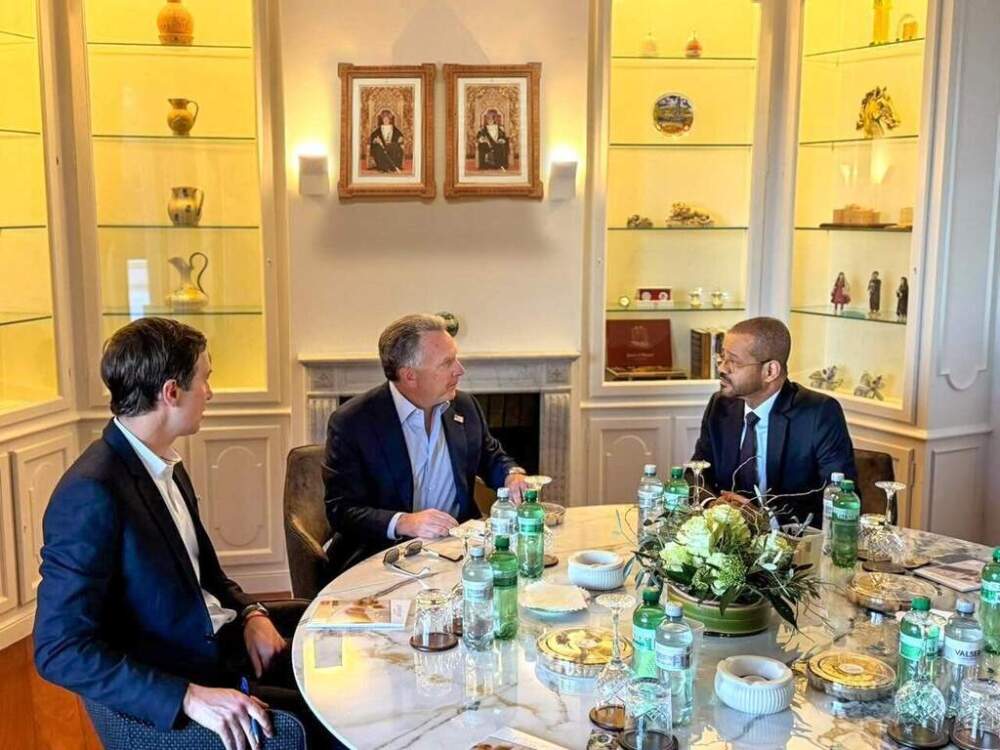
WONG: Shortly before the war started, there were diplomats meeting in Geneva, and you had in that week Steve Witkoff and Jared Kushner from the American side. Witkoff being special Envoy, Jared Kusner being the president’s son-in-law … and a businessman with interest in Middle East, but not holding any official position.
Meeting with former minister of Iran in Geneva. And those talks were centered on Iran’s nuclear program. The Americans are trying to get Iran to commit to what is known as zero enrichment, meaning that Iran wouldn’t have the right to enrich any uranium even for civilian purposes, such as medical purposes or energy purposes.
And Iran has always said that is a non-starter. Because as a sovereign nation, it should have the right to choose whether it does enrich uranium for a civilian nuclear program. And it has said all along, it has a civilian nuclear program, but does not intend to build nuclear weapons. And the ayatollah who was killed at the start of the war had issued a fatwa some years ago saying Iran cannot develop a nuclear weapon.
Of course, the Americans and the Israelis have long been suspicious of those assertions by Iran and some, and the most hawkish people within the U.S. government and within think tanks in Washington, say that Iran is likely trying to develop a nuclear weapon. So the talks centered around all of that.
CHAKRABARTI: Okay. So let’s get some more detail on that because I’ve been reading both in the New York Times and in other places, that there was some concern about whether Mr. Witkoff and Kushner actually had the technical knowledge to understand what the Tehran Nuclear or research reactor was capable of. And that there’s been reporting that Witkoff and Kushner did not actually bring a nuclear expert with them to these talks. Have you found that as well, Ed?
WONG: That’s correct. Everyone I’ve spoken to in Washington says that both men are not well versed in the technicalities of nuclear negotiations or nuclear power and that they didn’t have someone who had that wealth of knowledge with them. I mean, I would say that in part when we focus on the back and forth over the nuclear program, it’s a little bit of a red herring. Because I do think that when you look at the statements that Trump and his close aides were making in the runup to the war, that they were laying out lots of things that they need, lots of conditions they needed around to meet that had nothing to do with the nuclear program.
So I actually think that those who argue that the nuclear talks were basically just a head think in a way by Trump to buy time to get ready for an attack, that could be true. There is evidence in what Trump and Rubio and others have said leading up to the talk, to those talks that leads one to believe, oh, the talks were never going to address the things that Trump and Rubio and others really cared about, as well as Israel.
Which was one that there was this government run by fundamentalist clerics. They had made statements saying that in a way was a non-starter for the U.S. that you could never deal with the government like that and never trust them. And they also said things about Iran’s ballistic missile program and said, Iran must curb, limit or downside ballistic missile.
That was never part of the talks. So that raises a big question about whether the talks are even being done in good faith by the Americans.
CHAKRABARTI: Interesting. Okay. So in that case, I was going to ask you Edward, about there’s been a lot of reporting that Iran had actually put, a what, seven page proposal on the table, literally in the day or two before the war began.
That surprised, I don’t know if it surprised Kushner or Witkoff, but there was a British security expert who was there, who has been, it’s been reported in the Guardian that he was quite surprised by what Iran says it was offering. But if the U.S. was never really even there to achieve any kind of negotiation over Iran’s nuclear capability, then I guess what you’re saying is it wouldn’t have mattered what they offered.
WONG: That’s what some people argue. And there was that paper, that seven-page proposal was given to Witkoff and Kushner in the room when they sat down for the meeting in Geneva. And then Witkoff and Kusher and U.S. officials have said they read the paper and that some of the things in it alarmed them.
And it could be that those two men were there thinking they were on an actual diplomatic track, negotiating in good faith while back in Washington, Trump and maybe some other aides were saying, oh, the attack is imminent. And Netanyahu was thinking that as well. And Israel was communicating that to Washington.
Like they knew that they got intelligence that the top leaders, including the supreme leader were about to meet. And that Trump wanted to go ahead and do an attack that killed all those leaders. So I think that maybe the negotiators thought that they were actually negotiating a possible outcome that would avert war, but at the same time in Washington, the momentum might have been for war already.
CHAKRABARTI: I see. Okay. In your reporting, you quote Robert Malley, who helped lead nuclear negotiations with Iran in the Obama and Biden administrations, and he told you that, quote, Iran was prepared for reasons one could understand to go further than they did in 2015, and were willing to in 2021.
Which is really interesting, because then Edward, help explain to us if you can why the president said subsequently that Kushner and Witkoff came back to him and said, actually Iran is very close to a nuclear weapon. I think that the president’s statements are questionable.
I don’t think that there is any evidence that first of all, there’s no evidence and there’s nothing in U.S. Intelligence that says Iran was developing nuclear weapons. That just doesn’t exist in any intelligence assessment. There has been discussion of, Iran has enriched uranium to a high percentage.
It did that after Trump withdrew from the Obama era nuclear deal. Back in 2018, Trump withdrew from that. And then Iran starts to accelerate its enrichment. And when, the enrichment levels went beyond what you would need for something like a civilian nuclear program, most people think Iran was doing that in order to have leverage over the U.S. and Israel, get them to come back and negotiate a new agreement and to say, and to broadcast that they have this leverage.
Then last summer when the U.S. and Israel attacked Iran, the U.S. attacked nuclear sites in Iran and that highly enriched uranium was left buried at a site in Iran, like near Isfahan. And one, right now, Iran can’t get to that highly enriched uranium. And even if they could, there’s no evidence that they had, at least before, had the intention of developing nuclear weapon.
And so I think Trump’s statement, there’s a lot of questions that could be raised about Trump’s statement. It’s very unclear exactly why he was making that statement.
CHAKRABARTI: Okay. So Edward, you’ve been reporting on international diplomacy for a long time. We’ve got about a minute left to go in this first segment here.
What’s your read on the dynamics of these, I guess I have to put them in quotes now, quote-unquote, negotiations, if they were doomed to fail from the start. And if, does it make it that much less likely that either party will come to the table in the near future?
WONG: What we have so far in the last year is that there have been two instances when the Iranians were about to sit down or were sitting down for negotiations with Americans.
In both those instances, Trump then attacked Iran, Trump and Israel then attacked Iran. So I think that Iran will be very wary now of negotiations or talks. I think they might enter into them because of the state of the war right now. I mean, I think both sides realize there will at some point be some end to this war.
It’s unclear when that would come. And so Iran might enter into them, might put out feelers, but I think it would be highly unlikely at this point that Iranian officials would trust the U.S. to be negotiating in good faith and also, they might think it’s deployed by the U.S. to just buy more time to get certain military assets in place, such as the marine units that are heading from both Japan and California to the Persian Gulf.
And so they might be keeping that in mind.
Part II
CHAKRABARTI: I’d like to bring Ali Vaez into the conversation now. He joins us from Geneva, Switzerland. He’s the Iran Project Director at the International Crisis Group, and he led the International Crisis Group’s efforts in helping to bridge gaps between Iran and negotiating countries. That led to the landmark 2015 nuclear deal.
Ali Vaez, welcome to On Point.
ALI VAEZ: Great to be with you Meghna.
CHAKRABARTI: And I understand also that you are a nuclear scientist as well. Yes?
VAEZ: That’s right. Yes.
CHAKRABARTI: Okay. What I’d like to first do with you, Ali, if I may, is compare what we know about the dynamics of the February talks this year in comparison to what you facilitated back in 2015.
And I do want to focus a little bit on the knowledge that Steve Witkoff and Jared Kushner brought to the table as has been reported in places like The Guardian and the New York Times. It seems as if there’s quite a few eyewitnesses now that say that neither Kushner nor Witkoff brought any technical nuclear expertise or experts for that matter to the talks with them, and that even previously last year in June, Steve Witkoff is reported as not really having taken any real notes, literally any notes in the five sessions last year.
Also, February 6th of this year, there’s reporting that in talks in Oman, that Witkoff actually arrived with Admiral Brad Cooper, who leads the U.S. Navy in the Middle East, which was very much out of protocol. Just some examples there.
Compare that to what you witnessed in terms of how the United States operated back in the talks that led to the 2015 deal.
VAEZ: Oh, these two situations are absolutely not comparable. In the run up to the 2015 nuclear agreement, I remember that the U.S. had a technical team of several dozen people.
In addition to the fact that almost all the national DoD in the United States of which have been involved in nuclear research and nuclear weapons development for many years were involved. They were checking the numbers, they were checking the calculations. They were making projections.
And so there was an entire technical infrastructure that was involved. I think all in all it was around 400 people in the United States who were contributing to the U.S. nuclear negotiating team’s efforts to try to come up with a set of terms that were as strict as possible, both in terms of restrictions applied to Iran’s nuclear program and also monitoring done by the International Atomic Energy Agency, which in and of itself is a technical organization of the United Nations in charge of nuclear verification and accountancy.
CHAKRABARTI: Can I just ask you, if you were sitting at the table and you saw any negotiating team come in talking about nuclear capacity and they didn’t bring a technical team with them.
Would you be able to take that party seriously at all?
VAEZ: No. I would think that they’re not serious about diplomacy and they’re probably either trying to check a box or buy time for some other purposes.
CHAKRABARTI: Interesting. We had just talked to Edward Wong of the New York Times, who reported that several people, his contacts, he’s a diplomatic correspondent, are wondering if that actually is what was going on.
That the Trump administration was never serious about achieving any kind of agreement with Iran over its nuclear program. So the actual, the reality of the war right now aside. Was this a missed opportunity, Ali? Because there seems to be reporting also that Iran was willing to make offers that it hadn’t done in some time.
VAEZ: It was definitely a missed opportunity. This was a missed opportunity from the get go, from the time that President Trump decided to tear up the 2015 Nuclear agreement as one of the most, one of the strongest advocates of the JCPOA, the nuclear deal in 2015.
I wrote in 2017 when he came to office that there is space for arriving at a better kind of arrangement because the Iranians actually by that point had realized that sanctions relief was not as effective as they had imagined when they were negotiating the deal. And President Trump was unhappy with some of the measures in the nuclear deal.
And so there was space to negotiate an arrangement that would be mutually beneficial for both sides. But he decided to unilaterally renege on U.S.’ commitments which made getting back into negotiations for the remainder of his first term impossible. And then in the second term, I don’t believe that Steve Witkoff was necessarily trying to deceive the Iranians.
And diplomacy was used as a cover for military preparation. But I do believe that he went to the negotiating table and President Trump’s perception of negotiations was Iranian capitulation. They were not looking for detailed technical negotiations that would take weeks or months.
They were looking for a yes and no answer, and that’s why it didn’t work. Otherwise, the Iranians were willing to put concessions on the table that in 2013 to 2015 period, we could not have even imagined. Iran suspending uranium enrichment for a long period of time, accepting long-term restrictions.
All of those things were put on the table in 2025 and 2026. But it wasn’t good enough because the administration was seeking full capitulation from the Iranians.
CHAKRABARTI: So then they weren’t actually seeking a negotiation is what you’re describing.
VAEZ: Yes, they were seeking a surrender agreement. Which was never on the cards.
CHAKRABARTI: Okay. Ali, I would really be grateful if you could help us understand what the truth is about Iran’s current nuclear capacity, because the administration has been saying up, down, left, front, center, contradicting itself with almost every turn that it takes in talking about Iran.
So first of all, help me understand the basics, how much nuclear material, if I can put it so generally, do we know that Iran actually has.
VAEZ: So we know that Iran has around 440 kilograms of 60% enrich uranium that is based on the IEA report right before the 12 day war. We know that Iran also has several tons of enriched uranium to different levels.
20%, 5% or below. But we don’t know is where all of this material is. Prior to the attacks, we saw through satellite images that there were some trucks that had arrived at one or two of these bunkered facilities. And so there is the possibility that Iranians have moved some of this material into bunker of installations that are more immune to U.S. strikes. And but the most important of all of these stock buyers is really the 60%, because uranium enrichment is not linear. It’s much more difficult to go from raw uranium to 5% than it is to go 5% to 20% than it is to go from 20% to 60% and from 60% to 90%, which is weapons grade.
And when you enrich to 60%, you have basically done 99% of the effort that is required to reach weapons grade uranium. And that is why the fate of that 440 kilogram is more important than anything else, and it is currently unaccounted for.
CHAKRABARTI: Okay. So that 60% enriched uranium. What is the gap between having that level of enrichment or getting it up to 90% plus to actually having a nuclear weapon?
VAEZ: So it’s like having the ingredients of a cake, but you still have to bake it into a cake. You still have to manufacture a nuclear weapon, which takes about six months to a year. But Iran has other pathways potentially to nuclear weapons. The 440 kilograms are sufficient for around 10 sophisticated nuclear warheads that could fit into the cone of a missile.
But Iran can also use that stockpile for around four rudimentary sort of crude nuclear weapons similar to the device that was created at the end of the second World War and was dropped on Hiroshima. But this stockpile could also be used in what is known as dirty bombs. If some of the enriched material is mixed in with explosives it could create contamination in civilian centers.
This is the biggest risk to international peace and security I would say that we have ever had since the fall of the Soviet Union.
This is the biggest risk to international peace and security I would say that we have ever had since the fall of the Soviet Union.
Ali Vaez
CHAKRABARTI: Wow. Okay. But then what did the 2015 Iran Nuclear Agreement put in place in order to have, ideally reduce the risk of an enriched stockpile like this?
VAEZ: At the time Iran had around, sorry, maybe I shouldn’t say this, because I don’t remember the exact number. But at the time Iran agreed to send out 97% of its enriched uranium stockpile and to cap its stockpile for 15 years, that would take us to 2031 at 300 kilograms of uranium enriched to 3.67%. So that’s below 5%, which is used for civilian purposes.
And 300 kilograms, just to give you an idea, is about one fifth of the material that you need for at least one nuclear weapon. Iran had basically agreed until 2031 that it would create a lot of distance from its ability to break out, which is to quickly dash towards enriching enough uranium for a single nuclear weapon.
Those restrictions obviously came off when President Trump reneged on the 2015 nuclear deal and Iran started putting aside its own commitments and ramped up its nuclear program significantly.
CHAKRABARTI: I see. Okay. Now one more thing about the lower level of enrichment that you said there’s several tons of it that’s anywhere between 20% to 50% enriched.
Steve Witkoff has been talking about the fact that he said in the U.S. media that Iran could get that enriched up to 60% or above quite quickly. Is that true? And if so, how? Ali.
VAEZ: So Iran had almost an industrial scale enrichment program prior to the 12-day war. And it had sophisticated, advanced centrifuges that although Steve Witkoff says they’re among the best in the world, they’re not. But they were pretty effective based on Iranian standards. And it would take Iran about six days to enrich enough uranium for a single nuclear weapon using its most advanced centrifuge, which was called IR-6. Now it is possible and quite likely that Iran had stockpiled some of these centrifuges in safe areas, for a scenario in which it needs to actually dash towards nuclear weapons.
I had full monitoring over not just the fissile material in Iran, but also the equipment, as a result of the JCPOA. But again, because the U.S. reneged on that agreement, we lost the ability to have oversights over the equipment. And so I lost continuity of knowledge about where the machinery might be.
And if Iran still has those advanced centrifuges, it could still enrich enough uranium for a single nuclear weapon in the same amount of time, in six days. So just put this in perspective. In 2015, at the cost of a F-35, which is the amount of ticket, flight tickets, hotel bookings, room reservations, food that the U.S. diplomatic team invested for two and a half years to negotiate a nuclear deal.
We got restrictions on Iran’s nuclear program for 15 years. Then in 2025 we went into a war that did cost the United States, including defense of Israel, tens of billions of dollars to destroy Iran’s nuclear program. Where as the breakout time would still before or after the war was six days.
And now eight months later, the U.S. had to go back in and bomb those nuclear facilities again. And we still don’t know where the material is. And we still don’t know if all the stock buyers of centrifuges have been destroyed. And Iran might still be six days away from being able to have enough material for a single nuclear weapon.
And in the process, the U.S has spent tens of billions of dollars and a dozen service members have been killed and a lot of Iranians have been killed and injured. So you can just compare the outcome of diplomacy and the outcome of the military option. I think it’s pretty straightforward which one delivers better.
CHAKRABARTI: Indeed. And also, that the cost of the stability of the global economy as well as we’ve been seeing, and who knows how much the final price tag of the war, the military operations of the war itself is going to be. The United States government, the Pentagon’s asking for $200 billion more dollars as we speak.
But Ali, can we say for certain that that Iran was entirely forthcoming with the inspections that were going on under the JCPOA.
VAEZ: Absolutely because the IEA published 15 reports when the JCPOA was fully enforced. Those are quarterly reports that the agency publishes and informs its Board of Governors about its activities. And in all of those reports the IEA claimed that Iran was fully committed to every single measure that it had agreed to in the JCPOA. So there was no violation in terms of inspections. And I think it’s very important to also understand that Iran, although it had an industrial scale enrichment program, it didn’t have a very sophisticated nuclear program. It didn’t have Japan or like Germany. A lot of reactors and a lot of nuclear material going around. Nevertheless, at certain point, the UN inspectors were spending more time inspecting Iranian facilities then they were spending time inspecting a country like Japan.
Part III
CHAKRABARTI: Ali, I’d like to go back to that time a little bit more to understand just really internally what it is like to negotiate with Iran, to negotiate with the United States. Tell me a little bit more on who was there on the Iran side of the table and what their approach was to the 2015 negotiations.
VAEZ: The Iranian negotiations were led by foreign minister Javad Zarif at the time, who was Iran’s former ambassador to the United Nations, and had basically, by that point, spent most of his life in the United States. He was a student in the U.S. and then again, had served multiple times at the UN mission.
Of the Islamic Republic and so was very familiar with the U.S. culture. And Wendy Sherman, who was the under secretary at the State Department and was leading the U.S. negotiating team, used to say that sometimes she had to pinch herself to remember that she’s not negotiating with another American because of Zarif’s American accent.
But the way these talks basically gained momentum was that in September of 2013 the Iranian delegation with the newly elected President Rouhani and foreign minister Zarif came to New York. And for the first time since the Iranian revolution in 1979, there was a direct meeting between Secretary Kerry and Foreign Minister Zarif, and in that meeting they agreed on the end game in the negotiations, which was the basic formula of Iranian restrictions and transparency measures on Iran’s nuclear program, in return for economic incentives in the form of sanctions relief.
By that point, there was already a secret channel that had negotiated an interim agreement or the outlines of it in Oman and Muscat. And they agreed that they would try to finalize that interim agreement which would halt the most problematic elements of Iran’s nuclear program in return for some very limited sanctions relief.
And then that would buy them time and space to negotiate a more comprehensive agreement. And then they continued negotiations for almost a year and a half after that, until they reached a comprehensive agreement in July of 2015.
CHAKRABARTI: So there was authentic motivation on all sides here. That’s one of the, I feel like that’s one of the necessities in order to reach any kind of deal, in any negotiation.
VAEZ: Absolutely. It has to be win-win. If you want to impose your will on the other side, they’re either going to resist and not agree, or they are going to eventually cheat on the agreement. And this is, I think, what made the 2013 to 2015 period really quite unique because this was also, by the way, not just two countries negotiating Iran and the United States.
Other world powers, members of the Security Council were involved, including U.S. adversaries and rivals like China and Russia. So to bring all of these countries together, create consensus and work on the same draft, and completely segregate those negotiations from what was happening in the outside world was really quite marvelous and extraordinary. It’s the kind of thing that happens maybe once in a generation.
For instance, I remember that Russia invaded Crimea in the middle of negotiations. And the U.S. and Russian negotiators agreed to not focus on that contentious issue, but to continue work on an issue of common interest, which was to prevent Iran from developing nuclear weapons.
When in February of 2024, Russia invaded Ukraine, that didn’t happen. That derailed the negotiations.
CHAKRABARTI: Now segregating the negotiations from the events of the outside world, does that also mean sort of turning a deaf ear to what the, I presume objections of Israel would’ve been back then.
VAEZ: Not a deaf ear.
U.S. negotiators would brief their Israeli counterparts before and after every negotiation, and there was every effort that the Obama administration put into trying to bring Israel on board and try to listen to their concerns and meet them halfway. But Israel’s approach towards the negotiations was zero sum.
They didn’t want Iran to benefit from an agreement. They wanted maximalist terms that were just unachievable. And therefore, at certain point there was no way of bridging the gap between the U.S. and Israel.
CHAKRABARTI: That’s another way in which we’re in a completely different place now. Because at least the relationship between President Trump and Prime Minister Netanyahu is very tight. We have to factually call this not just the U.S.’ War, but the U.S. and Israel’s war. Does that really eliminate any possibility that Iran would be actually willing to enter negotiations beyond an immediate ceasefire at the moment?
VAEZ: There is already the negative experience that the Iranians have had with the Trump administration three times. Reneging on the agreement in 2018 and then bombing Iran twice in middle of negotiations last year and this year. But there is also the view that the Trump administration doesn’t have a policy of its own.
It is basically getting its cues from Israel. And Israel is not going to agree to any kind of agreement that would benefit the Islamic Republic. Even capitulation might not be fully acceptable to Israel, because it wants regime change. And I think that adds to Iranian mistrust in the utility of negotiations and in the Trump administration’s reliability as a negotiating partner.
CHAKRABARTI: Ali, let me ask you, just in the past few days we have heard President Trump say there’s talks going on between the U.S. and Iran. Of course, the Iran Foreign Ministry says, no, not really. There might be regional efforts, but nothing direct or no significant progress having been made. Who do you believe, Ali, right now?
VAEZ: It’s very hard to believe the Trump administration at this moment. I’ve had conversations myself with some of the mediators, and from what I understand, there have been efforts to try to prevent tensions from spiraling out of control. And the mediators are obviously no longer, the traditional ones that are now caught in the crossfire.
Countries like Oman and Qatar themselves have suffered from Iranian attacks and retaliation for U.S. and Israeli aggression against Iran. But countries like Turkey, Egypt, and Pakistan are playing an important role. But again, the objective is not to resolve any of these issues in a sustainable manner.
The objective is to just prevent a bigger disaster from happening. And then eventually, yes, there needs to be talks about some sort of a ceasefire, but it’s much easier said than done. The Trump administration has put objectives that it hasn’t been able to achieve in the last two years at the negotiating table, that I don’t think the Iranians would ever accept, including, again, capitulation, their nuclear program or their missile program or their regional policy.
And the Iranians are now asking for guarantees that the U.S. and Israel would never attack them again. It’s unclear what form that would take. They are asking for reparations for the damages caused by this war, which are probably in tens of billions of dollars. And they are also asking for the right to enrichment being respected.
All of these things are almost an impossible conditions on both sides. So I think none of the fundamentals have changed at this point other than maybe both sides taking a step back from the brink of an absolute scorched earth kind of approach in a region. But to get to a ceasefire or any kind of an agreement I think that’s pretty farfetched at this point.
CHAKRABARTI: Ali, if I may, I just want to go back to the 2015 agreement just for a moment, because you had said earlier that the IAEA was in fact doing its inspections as part of the agreement and that Iran was open about that. Then I’m wondering what you make of this, because just this past weekend the current IAEA director, general Rafael Grossi, was on CBS’s Face the Nation here in the United States.
He said that the IAEA had actually seen some concerning behavior from Iran following the 2015 agreement. So here’s Grossi.
GROSSI: Iran was complying with a number of things, but we started seeing new stuff. We started seeing and getting new elements that gave rise to concerns. And we were talking about them with Iran; you’ve seen me many times go to Tehran, sign declarations and see commitments on their part. And then it came a point, very important point, when I said, in view of this, I have to say that I’m no longer able. I’m no longer able to say that everything is in order.
CHAKRABARTI: Ali, what do you make of that?
VAEZ: So these are different issues.
Okay. The JCPOA put in place a set of inspection mechanisms, which as I said, would monitor every gram of fissile material in Iran from cradle to grave and every knot and bolt of equipment in Iran. And on that front, I never had concerns and Iran was committed to full implementation of the deal.
There were, however, some traces of nuclear material that the IEA was able to find as a result of the expanded authority that the JCPOA provided about Iran’s past nuclear activities pre-2003. And the IEA needed explanation about where this material came from and where it was today.
We know Iran had a nuclear weapons program prior to 2003 and the Iranians never explained to the IEA that they had weapons designs and intentions. And so this remained a problem. This is related to safeguards commitments that Iran has towards the IEA as a member the NPT that it has to basically explain an account for every gram of uranium in the country, even if it dates back from 20 years ago. So this is what Grossi is referring to, it’s about Iran’s past nuclear activities, not its commitments under the JCPOA. And of course, these could have been resolved in the same way that a lot of past nuclear related concerns were resolved when the 2015 nuclear deal was finalized.
And in fact, its sanctions relief was conditioned on Iran closing every outstanding issue with the IEA that happened in December of 2015 and sanctions relief was offered to Iran in January of 2016. But this time around, of course, because President Trump had already started undermining the agreement and then withdrew from it.
The Iranians had very little motivation to try to resolve these safeguards issues with the agency and now it’s even worse than before because we were talking about a few grams of unenriched uranium dating back to 20 years ago missing. Now we’re talking about half a ton of 60% enrich uranium missing.
CHAKRABARTI: Okay. There’s so many more questions I could ask you, Ali, but let me conclude with this. So just to recap, regarding the discussions that were going on in February before the U.S. and Israel started bombing Iran, it seems that Witkoff and Kushner, not only did they not have the technical expertise, they didn’t bring the customary technical, nuclear technical experts with them to really solidly understand what Iran was offering in just the days before the U.S. and Israel started attacking Iran. So we have that.
We also have reporting that shows that it’s possible that those talks in general were a red herring to buy time to prepare the attacks that the U.S. and Israel undertook. Both you and Ed Wong told us that Iran feels very betrayed, because this is the second time this has happened, of being attacked in the midst of negotiations.
And now we’re also at a point where given this track record, I can’t imagine any country, let alone Iran, saying we’re gonna come to the table with a possibility that we will have a ceasefire, maybe even lifting of sanctions.
But in exchange we’ll have to give up any of our nuclear aspirations, and maybe sanctions don’t even matter that much anymore. The U.S. has lifted sanctions on Iranian oil to the tune of $14 billion. So I’m just trying to go through this history again, Ali, for myself and for listeners to get to this.
Are we now more or less guaranteed that Iran will have a nuclear future, let alone potentially a nuclear weapon in the future?
VAEZ: Of course nothing is guaranteed, but I think the odds of Iran becoming a nuclear weapon state are now higher than ever before. Not only there is no credibility or utility in the eyes of the Iranians in engaging with the United States diplomatically, but they have now more motivation than ever before to develop the ultimate deterrent because their conventional … their missiles, their drones obviously didn’t stop Israel and the U.S. from attacking them.
I think the odds of Iran becoming a nuclear weapon state are now higher than ever before.
Ali Vaez
The regional proxies like Hezbollah and Lebanon or the Houthis in Yemen also didn’t deter an attack on their soil. Any Iranian leader who wants to survive and who wants to deter any future attacks would consider, given how far the Iranians have come in terms of knowledge acquired to try to cross the Rubicon and develop nuclear weapon.
There is also another phenomenon that I think it’s important to take into consideration, which is that a lot of ordinary Iranians, now having seen their country being subject to attacks and given the very high civilian toll of these strikes, would like their country to have a deterrent that is reliable.
And so even the bottom-up support for nuclear weapons has significantly increased. And the final element is that the former Supreme Leader had the religious edict, fatwa against nuclear weapons. We might choose not to believe that, but at least ideologically or religiously, there was a ban on nuclear weaponization. That fatwa died with the Supreme Leader who was killed in the opening act of this war.
And it is quite possible that his son would come up with a different nuclear doctrine for the country. So in the process of trying to resolve this problem using the military option we’ve basically turned it into a self-fulfilling prophecy.
The first draft of this transcript was created by Descript, an AI transcription tool. An On Point producer then thoroughly reviewed, corrected, and reformatted the transcript before publication. The use of this AI tool creates the capacity to provide these transcripts.