Can you feel the restaurant churn?
As the heat index surged and tourists left town, the unmistakable signs were everywhere this summer: Longtime mom-and-pops closed shop with little warning on social media, Facebook commenters offered their say-it-ain’t-so outcries, and new eateries eager to backfill vacancies started construction anew.
This season, the churn has felt like a deluge: Across Broward and Palm Beach counties, restaurants that once weathered decades of downturns have closed left and right, blaming a combination of doubled rents, higher labor wages, increased food costs and disagreements with landlords.
For 12 years, the New England-style Rack’s Fish House and Oyster Bar arguably commanded the busiest stretch of real estate in Delray Beach: Southeast Second and Atlantic avenues, the beating heart of downtown tourism.
This summer, once the tourists left, owner Gary Rack noticed that locals and regulars — the Fish House’s bread and butter — stopped coming as often for oysters, chargrilled octopus Bolognese, lobster rolls and Maryland fries tossed in Old Bay seasoning.
Rack said he knows why: Premium seafood costs more, so he raised prices. On Aug. 16, facing an expiring 15-year lease next January, the seafood shack served its final meal.
“The landlord wanted to push my rents up … at lease renewal, and those numbers didn’t work for me,” Rack told the South Florida Sun Sentinel. “I can’t just keep pricing fish higher and higher until no one wants to pay it. People’s incomes are so much lower these days, and folks are staying home.”
Amy Beth Bennett / South Florida Sun Sentinel
The doors are shut and the chairs overturned inside Rack’s Fish House and Oyster Bar in downtown Delray Beach. (Amy Beth Bennett/South Florida Sun Sentinel)
Online, the gut reactions came swiftly.
“You literally make Delray Delray,” commenter Kira Sudol posted after Rack’s shared its final goodbyes on social media. Another poster, Stacy Scotto Stabile, asked: “What? Is this a joke? Why? One of the best downtown restaurants!”
For every “Why?” on social media, South Florida hospitality experts point to one bottom line: Whether it’s sticker shock at the supermarket or sticker shock for high-end seafood, it’s getting more expensive for operators to operate and for consumers to consume, no matter where you eat.
“I’m crushed when I see my favorite restaurants closed, but I do feel strongly that summer churn is the new normal,” said John Noble Masi, an associate professor and chef teaching restaurant management at Florida International University. “Most mom-and-pop places have no room for error. They have profit margins under 10%, so when labor and rent goes up, they raise their prices, causing guests to feel resistant.”
In the following sections, we’ll break down the reasons why many fan-favorite restaurants have closed this summer and diagnose the financial pressures they faced in 2025. (Note: Not every restaurant’s reason for closing fits neatly into one category; some may have closed for multiple reasons listed below.)
CLOSED DUE TO RISING COSTS
For Rack, the demise of Rack’s Fish House and Oyster Bar this summer was a study in contrasts. As Fish House floundered, his farm-to-table eatery right next door on Atlantic Avenue, Gary Rack’s Farmhouse Kitchen, actually flourished.
That family friendly restaurant, home to burgers, fish sandwiches and cauliflower-crust pizzas, has “put up record numbers” all summer at both locations in Delray Beach and Boca Raton, Rack said. He credits the Farmhouse Kitchen’s success on a summerlong 50% off promotion for the entire menu that lured in droves of diners, which in turn helped offset the loss in profits from discounted food.
Amy Beth Bennett /South Florida Sun Sentinel
The closed Rack’s Fish House and Oyster Bar in Delray Beach is seen on Wednesday, Sept. 17, 2025. (Amy Beth Bennett/South Florida Sun Sentinel)
“We had more volume, my margins were lower, and our servers all had such great incomes from the summer, we had to hire more people,” Rack said. “You’ve got to have great value, especially on Atlantic, which has gotten super-expensive. Compare that to my Fish House, where we’d sell grouper for $34 a few years ago and had to charge $44 to maintain the same margins. That’s why people didn’t come in.”
Rack’s discount strategy isn’t a one-size-fits-all solution for every stripe of restaurant, which must sometimes raise prices as a matter of survival.
A recent James Beard Foundation report, done in collaboration with U.K. accounting firm Deloitte, found that 91% of independent restaurants raised menu prices in 2024, typically by 5% to 10%, to offset pressures from higher labor and food costs. The report found that restaurants raising prices above 15% saw declines in traffic, suggesting diners had hit their spending limits.
Meanwhile, the latest Consumer Price Index report from the U.S. Bureau of Labor Statistics showed that food-away-from-home prices jumped 3.9% over the past year, outpacing inflation in other categories.
Here are a few other South Florida eateries that blamed rising costs as their reason for closing this summer:
- McCray’s Bar & Grill in Lake Worth Beach, the much-anticipated reboot of pitmaster Derrick McCray’s family barbecue dynasty, soft-opened over the July 4 weekend and closed six weeks later on Aug. 17. “The place was a little too big and it was costly,” McCray said. “The landlord and the city were always gracious with us, but pulling it off in the summertime and not being capitalized as much as we thought, it was just a bit too much.”
- Mo’s Bagels & Deli in Hallandale Beach permanently closed on Sept. 2 after 4 1/2 years in business, owner Hussin “Mo” Mohamed confirmed with the Sun Sentinel this week. But where one bagelry closes, another rises: Mohamed, who cited slow traffic and higher food and labor costs, sold the business and restaurant equipment to South Florida-based, New York-style deli chain Roasters ’N Toasters, which soft-opened Sept. 12.
CLOSED AFTER DISAGREEMENT WITH LANDLORD
Another common culprit cited is a breakdown between restaurateur and landlord. Some examples:
- Lucille’s American Cafe in Weston closed Aug. 31 after 26 years , according to owners Beth and Paul Nunez, who cited a landlord disagreement over higher rents and upgrades to the restaurant’s aging kitchen and bathrooms.
- Undergrounds Coffeehaus in Fort Lauderdale, an indie cafe from owner Aileen Liptak that had struggled to stay afloat during the pandemic, is expected to close on Oct. 2 after nearly 19 years in business. A Facebook post said the landlord did not renew the lease.
These reasons can span disagreements over higher base rent to so-called “additional rent,” lesser-known fees tacked onto leases such as property insurance, utilities and Common Area Maintenance, or charges that tenants pay landlords to cover landscaping in common areas of shopping centers, says David Helbraun, lead partner at Coral Gables law firm Helbraun Levey.
“If they didn’t try to cap these costs in the lease upfront, they’re out of luck,” Helbraun said. “It’s yet another example of [restaurant owners] being squeezed from all sides. Beyond that, Florida’s minimum wage and insurance premiums keep going up every single year, and we all know that food costs are through the roof.”
To ensure these fees stay low, new restaurant owners should strongly consider hiring a hospitality law firm to negotiate on their behalf, Helbraun argued.
“You’re rolling the dice if you don’t,” he said. “If a landlord has a problem with you, if a fired employee decides to sue you over wages, if your employee handbook isn’t compliant with the law, you can be sued and go out of business. There’s so many ways to take it on the chin if you’re not sufficiently protected.”
CLOSED BECAUSE OF DECLINING FOOT TRAFFIC
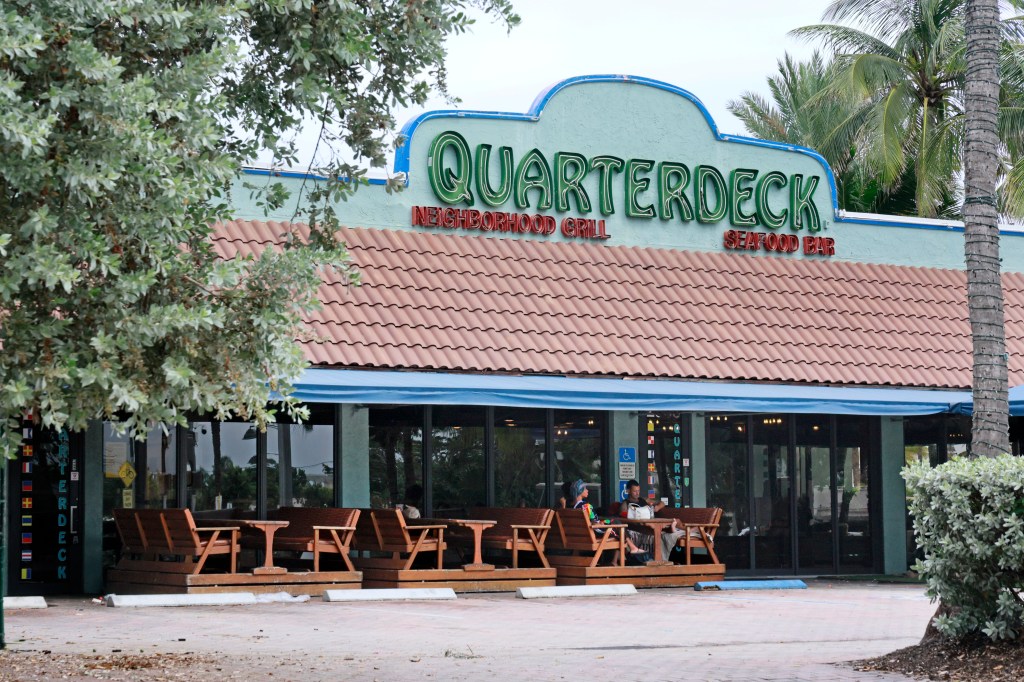
Broward-born casual chain Quarterdeck shut its Fort Lauderdale beach sports bar on Sept. 9 without warning, ending its 30-year reign as a magnet for tourists and locals on the corner of Las Olas Boulevard and State Road A1A, said Quarterdeck Restaurants partner and CEO James Flanigan.
Mike Stocker/South Florida Sun Sentinel
An aerial view of the now-closed Quarterdeck on Fort Lauderdale beach. (Mike Stocker/South Florida Sun Sentinel)
That location, which faced an expiring lease in January, had been coasting on “pretty good” business all summer, he said. The bigger problems: His flagship Quarterdeck 2 miles away on the 17th Street Causeway, which is four times bigger and includes a next-door Whiskey Neat drinking lounge, had been siphoning away customers since the pandemic. He also complains of “less places to park” at the beach, which in turn caused “less foot traffic on the beach in general and less at our restaurant.”
“I feel a little sad that it had to close, but it’s the nature of the business,” Flanigan said. “For six years, they were basically competing against each other, so we felt that we could get more business at one if the other wasn’t there.”
Other summer closings that can be attributed to a slowdown in customer visits include:
- Grandview Public Market in West Palm Beach, South Florida’s first food hall, closed on July 31 after seven years. Its Miami-based operator, City Food Hall, asked to terminate its lease earlier this summer, according to CBS12. “We’re sad to see the end of an era. The Food Hall has been the heart of the Warehouse District since it first opened,” the District posted on social media. The market is expected to be overhauled into a collection of retailers devoted to home furnishings, interior design and fitness. The closing followed an exodus of food and drink businesses that struggled to draw traffic and traction in the District after the pandemic and road construction on Elizabeth Avenue in 2023 and 2024.
- Moore Fire Grill in Coral Springs, a Southern restaurant, closed after five years in late June due to financial setbacks stemming from “unexpected business slowdowns, equipment repair bills, and unforeseen hospitalizations,” owners Dayne and Christina Moore posted on a GoFundMe page to support their next chapter.
CLOSED FOR BANKRUPTCY FILING
From Brio Italian Grille to Hooters, multiple casual chains filed for Chapter 11 bankruptcy in 2025, and some shuttered locations as a result.
Another is Planta Queen in Fort Lauderdale, the celeb-magnet vegan restaurant that closed its Las Olas Boulevard sit-down in July after three years, following closings of other Planta outposts in Miami-Dade earlier this year. In a May 12 bankruptcy filing, Planta cited decreased consumer spending, higher operational costs and debt liabilities to landlords and suppliers between $10 million and $50 million.
How do mom-and-pop restaurants avoid insolvency? The answer, if you ask FIU hospitality expert Masi, is by lifting a page from fast-casual chains.
Masi, who teaches about the intersection of technology and hospitality, said restaurants like Pollo Tropical and Chipotle Mexican Grill pivoted to self-serve kiosks and new point-of-sale systems early in the pandemic, which helped save on labor costs.
Mom-and-pop eateries that invest in certain upgrades can weather climbing costs, shifting trends and wobbly supply chains “much easier” than those that don’t, he said. He pointed to a recent classroom visit from Miami chef Adrianne Calvo, who said she uses inventory management software that feeds her automated alerts whenever food distributors hike costs on food items — and even shops for lower prices on her behalf.
“If mom-and-pops don’t use technology like this, they’re going to miss out on opportunities,” Masi said. “The rents and insurance are fixed and owners have no control over them, but they do have control over lowering expenses and shopping around. When there’s no margin for error, it’s about maximizing value.”
OTHER CLOSURES
Many restaurant owners this summer offered zero reasons before their final bows, leaving loyal patrons to speculate wildly. Some examples include:
- ABC Lobster Co. in Davie closed after 4 1/2 years on Aug. 10.
- Lucky’s Tavern in Fort Lauderdale’s Himmarshee District closed Aug. 29 after 15 years.
- Loch Bar, the upscale seafood tavern from Baltimore-based Atlas Restaurant Group, shuttered Aug. 30 after nearly seven years in Boca Raton’s Mizner Park.
- Niran’s Kitchen in Deerfield Beach, specializing in sushi and Laotian cuisine, also closed Aug. 30.
Instead of quietly disappearing into the restaurant churn, Masi said more restaurants should fight for survival with total transparency.
“I’m crushed when I see my favorite restaurants closed, but the really good places that stay open are proactive instead of reactive,” Masi said. “If eggs go up, say something on social, don’t just pass it onto customers. Be more trend-focused with TikTok accounts that appeal to Gen-Z consumers. You do this, it will be appreciated by the most loyal guests.”
Phillip Valys can be reached at pvalys@sunsentinel.com or Twitter/X @philvalys