For years, Michelle Thomas has tracked her calls to law enforcement for updates on her son’s murder case. “No answer” is scrawled next to many of the entries in her handwritten log.
Her son, Carl Sepheus Jr., was shot and killed leaving a friend’s house in 2018 not far from her home in Springfield.
“I need help with getting justice,” Thomas said. “My child’s life was taken, and it is not fair.”
Sepheus’ death is one of hundreds of unsolved homicides in Massachusetts. For every case like his, loved ones often wait in the dark — not only for justice, but even for access to basic records.
A new analysis by WBUR shows district attorneys in the state can, and often do, deny requests for case files and updates by saying investigations are still open. They have done so in cases even after years passed with no new suspects or evidence.
The radio silence has been a strikingly more common experience for families of Black or Hispanic victims, as their loved ones make up a far higher proportion of unsolved homicides in the state.
Records are kept under wraps
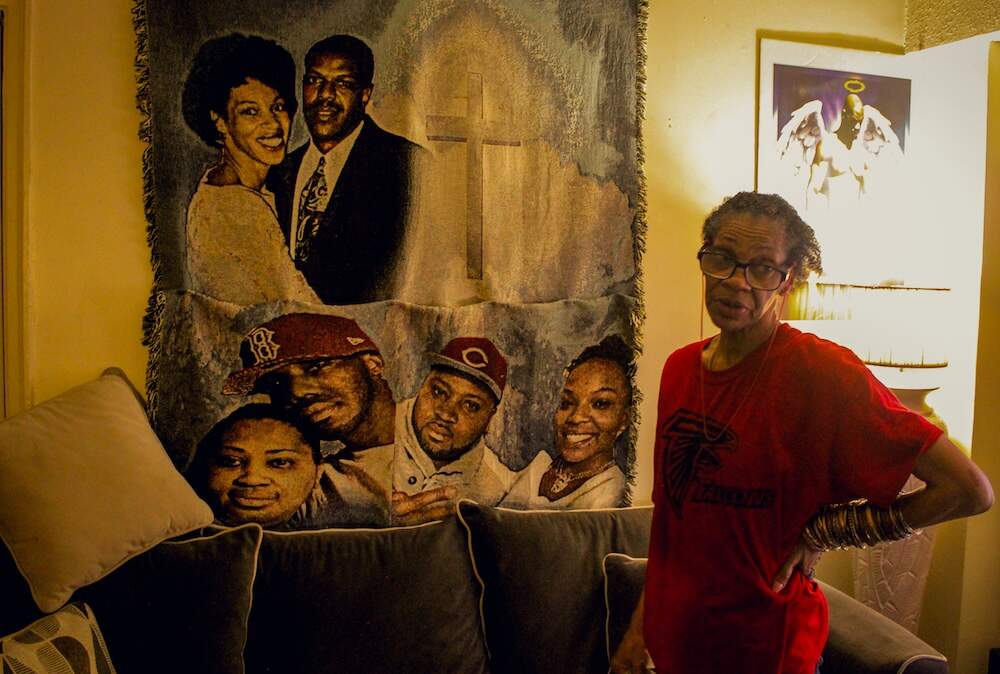
Inside Thomas’ home, a candle with her son’s picture sits on a shelf alongside awards that recognize her activism over the seven years since his death. They’re reminders of her son — and of her struggles to find out what happened to him on that September night.
She hasn’t been able to find out how many bullets pierced his body. She’s lost on where he was hit. She doesn’t even know what he was wearing.
It’s not that these details will bring him back. But still, she said she grasps for anything — any minute fact — that might help fill in the blanks around her son’s last moments.
Thomas has requested copies of her son’s autopsy report multiple times, but she said the Hampden County district attorney’s office said it wouldn’t release it because his murder remains an open investigation.
Thomas records each time she contacts the detective in her son’s case. (Julia Goujiamanis for WBUR)
“His death certificate just says gunshot wound,” Thomas said. “They told me I probably wouldn’t be able to get an autopsy only because the case was unsolved.”
When a Massachusetts district attorney says a homicide case is still open, the office does not have to release details about any progress, or lack of it — even to the victim’s family. That’s because the state’s public records law includes an exemption for ongoing criminal investigations.
John Verner, an assistant district attorney in Suffolk County who heads up the unsolved homicide unit, said he works with many families who, like Thomas, are grief-stricken and desperate for answers.
They often press him on what’s new in an investigation, what he’s learned, Verner said.
“And I say, the hardest part of my job is to sit here and look at you in the eye and tell you, ‘I can’t tell you,’ ” he said.
Releasing information too soon, Verner said, can put the investigation at risk. It could potentially derail a promising lead or make it difficult for investigators to gauge the validity of witness statements. It’s witnesses, Verner said, who solve cases.
“If we tell families we don’t give up … and we’re always hoping something happens, and we’re always working on something,” Verner said, “how can you do that, and then on the other hand, release evidence or facts which could jeopardize an investigation?”
When WBUR sought public records on Sepheus’ murder from the Hampden DA’s office, an official said there hasn’t been a new document filed in the case in six years. The office did confirm a detective with the Springfield police department and an assistant district attorney from the unresolved case unit are still assigned to the investigation.
Thomas with the folder of information she keeps on her son’s case.(Julia Goujiamanis for WBUR)
It can be tough for a family to believe a case is still “active and ongoing” when there’s no progress for years. In Massachusetts, there’s no legal definition of an open or closed case. Instead, each district attorney sets their own standard.
Mike Glennon, a former assistant district attorney in Suffolk County, spent 10 years investigating homicides in Greater Boston. He agrees with Verner that disclosing records too soon can compromise future leads. But he also thinks there’s a time when sharing information — like an autopsy report — is important for families and the public.
“At some point, the community’s interest in understanding what’s been done outweighs the investigative necessity of keeping that file closed, especially for the families and survivors of these terrible events,” Glennon said. “You run into this distrust that occurs when nobody from the law enforcement side will tell you even what they’ve done.”
What the numbers show
Sepheus’ murder is one of nearly 400 in Massachusetts that occurred between 2014 and 2024 and remain unsolved. That’s roughly 20% of all murders in the state during that period.
To dig deeper into the unsolved cases, WBUR and Boston University investigative reporting students obtained death certificate information from the state medical examiner’s office and the names of victims from every district attorney. There is currently no central repository for this data.
The records offer glimpses of grim stories: a 22-year-old woman shot in the head in 2020 in a car in Pittsfield. An 18-year-old high schooler shot multiple times in Lawrence in 2017. A 42-year-old construction worker, stabbed to death in Boston in 2014.
Of all the murders in the state, the racial breakdown is roughly equal among Black, Hispanic and white victims, at about 30% each. But when it comes to unsolved homicides, there’s a big disparity: In those cases, 85% involve Black and Hispanic victims, while just 7.5% involve white victims.
“You run into this distrust that occurs when nobody from the law enforcement side will tell you even what they’ve done.”
Mike Glennon, former assistant district attorney
Glennon, the former assistant DA, said the numbers don’t necessarily mean law enforcement prioritizes certain cases over others. But he acknowledged the discrepancy and said it’s “no question” authorities face challenges in homicide cases in part because historically marginalized communities feel police and prosecutors cannot be trusted.
It’s “because of what we know of the justice system, and how people of different racial and ethnic backgrounds are treated in the justice system,” he said. “The distrust of minority communities and communities of color of law enforcement is gonna be another one of those factors.”
Families push for change
Family and friends of homicide victims gathered in November at the State House. Many wore lapel buttons with pictures of lost sons and daughters, brothers and sisters. They were there to support a bill that would create a statewide database of unsolved homicides, as well as a new department under the Massachusetts attorney general, where families could petition the AG’s office to review an investigation after three years.
Natasha Carrington was in the crowd that day with a shimmering necklace that spelled out the name of her son, Darrion, who was killed in 2008. She also wore a pendant with a photo of him dressed up for prom.
“He loved life, and he kept me on my toes,” Carrington said in a later interview. “He grew up loving basketball. He wanted to be a police officer in the beginning, but then he wanted to become a professional basketball player.”
Carrington said it wasn’t until 10 years after her son’s murder that she found support through the Louis D. Brown Peace Institute, a Boston nonprofit that helps people affected by violence and trauma. She said the group was the first to tell her about what’s called a victim witness advocate.
Under the state’s “Victim Bill of Rights,” each DA’s office is supposed to provide an advocate to guide surviving family members through the investigative process.
Carrington said she never heard from one.
“There was never a conversation, ‘Ms. Carrington, these are the next steps. This is how the investigation is going to go,’ ” she said. “Victim witness advocate, those words were never spoken to me.”
The largest number of unsolved cases in the state between 2014 and 2024 — more than half the total — are in the state’s most densely populated county, Suffolk.
Glennon, the former Suffolk County assistant DA, said without more accountability, details around unsolved homicides will remain largely out of public view.
“The investigative privilege can act as a shield, and that’s not what its intention is,” he said. “So having some way to allow some oversight at some point in the process is absolutely necessary and in the community’s interest.”
In the meantime, Thomas said she’ll keep calling investigators for answers about her son’s death.
“As long as I have breath, I’m not going to let my son’s murder go unsolved if I can help it. I’m not,” she said. “I want legal justice.”
Julia Deal, Mariam Ibrahimi, Rayea Jain, Angeliki Michalou, Laila Musleh, Abigail Pritchard and Aditi Thube of Boston University’s investigative reporting course also contributed to this story. Dooling is an associate professor at Boston University.