When law enforcement officials broke down the door of a South Burlington home March 11, they were looking for a Mexican man named Deyvi Daniel Corona-Sanchez. He wasn’t there.
In fact, he might never have been.
What followed that raid, as well as the detention of two men in an unrelated traffic stop, was nine days of habeas corpus petitions, courtroom hearings and increasingly pointed judicial rebukes of the government’s conduct. One by one, four of the five people swept up in the U.S. Immigration and Customs Enforcement operations walked free — every one of them, in fact, who made it before a Vermont federal judge.
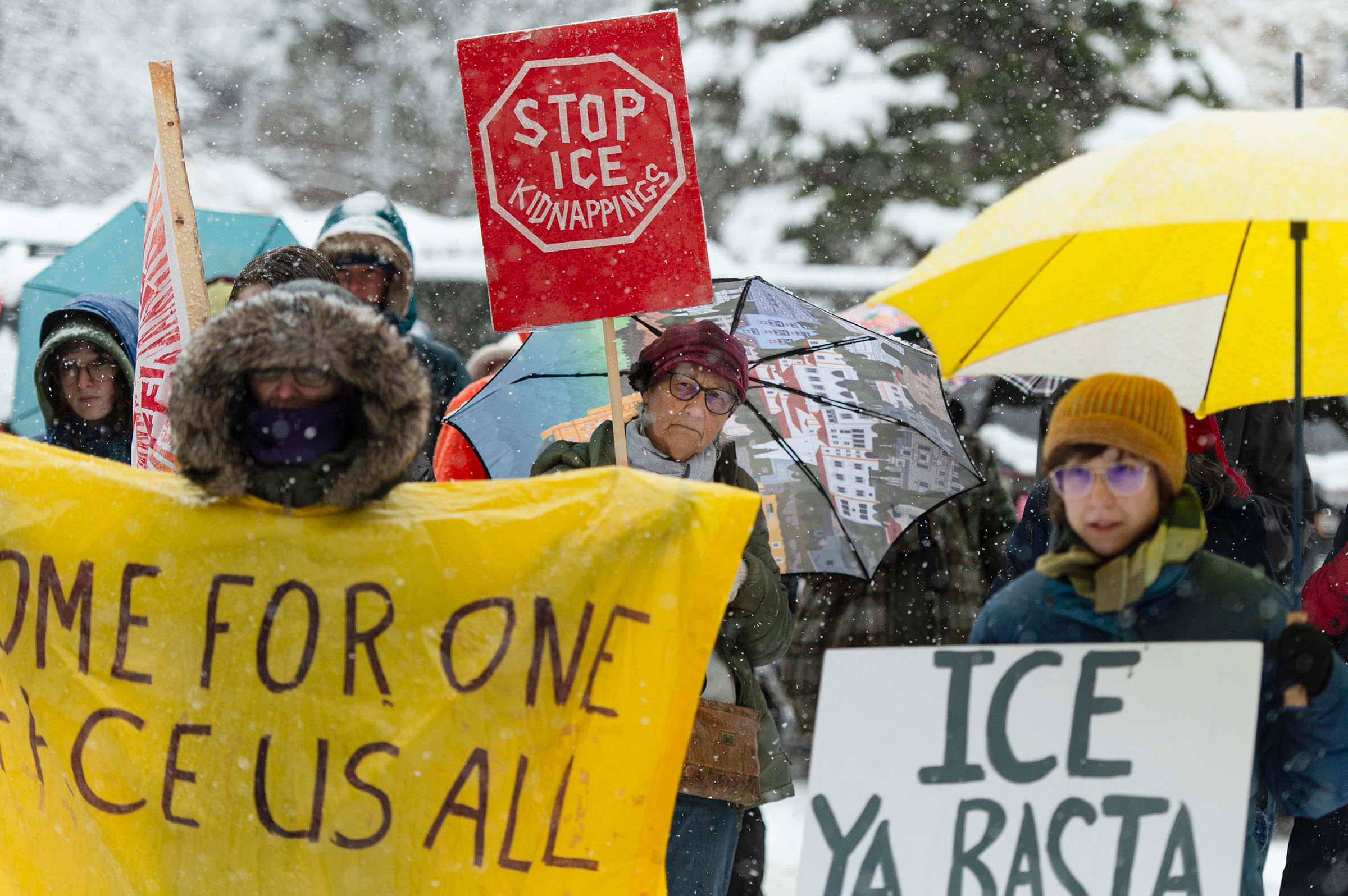
The last of the detainees freed, Daysi Camila Patin Patin, 20, emerged from the Burlington federal courthouse into a wet snow and a crowd of cheering supporters on March 20. She had been picked up in the Dorset Street raid along with her sister, Jisella Johana Patin Patin, 31.
The third person detained in the raid, Cristian Humberto Jerez Andrade, 31, had been released the day before.
“Without the support of all of you, none of this would have been possible,” he told another crowd of supporters through an interpreter when he was freed. “I wouldn’t be here with you today.”
But even as supporters celebrated, organizer Will Lambek with the immigrant rights group Migrant Justice was already signaling the group’s next move. He said he wants to hold state and local law enforcement agencies involved in the raid accountable.
Last week, the story got worse for the government.
Colton Riley, the ICE deportation officer whose attempt to pull over a car started the chain of events that led to the March 11 raid, filed a court document stating that he now “no longer believes” the person he was seeking, Corona-Sanchez, was even in the vehicle. The car’s flight through South Burlington ended in crashes, a foot chase and eventually hours of standoff at the Dorset Street home. The identification of a suspect that set the raid in motion, ICE now concedes, was wrong.
Meanwhile, the man who was the operation’s actual target, Corona-Sanchez, remains at large.
In the Dorset Street raid, ICE had come to South Burlington for one person and left with three, none of them the man they were looking for, none of them named on the warrant and all of them, by week’s end, freed by federal judges who found their detentions potentially constitutionally indefensible.
One of the two men detained in the unrelated traffic stop that week in Burlington, Jaime Eliceo Castro Guaman, 40, was also freed under the same judicial reasoning.
The score in court so far, after a week of federal judges systematically dismantling the government’s cases: detainees 4, government 0.
A fifth man, age 24, detained alongside Castro Guaman, remains in custody. Officials have not released his name. VtDigger was unable to determine what legal proceedings, if any, he has faced.
Across those court hearings, a pattern emerged that immigration attorneys say is more troubling than any single detention. Government lawyers repeatedly invoked alleged criminal records — warrants, past charges, convictions — without producing documents to back them up, according to court proceedings VtDigger covered.
Judges pushed back. Defense attorneys pushed back harder. And one federal judge warned that he was prepared to convene a “major trial” examining whether ICE’s tactics in Vermont violated the U.S. Constitution.
That trial didn’t happen because Jerez Andrade was released in an immigration court hearing. But the question it would have answered hasn’t gone away.
If federal officials falsify information or mislead a judge to get a warrant or conduct searches of people not named in the warrant, it could be grounds for a constitutional violation, according to David Rudovsky, a law professor at the University of Pennsylvania.
“The pattern is terrible,” he said, adding that there are questions in these cases that the courts have not yet dealt with.
Although the lower courts have generally been good about immediately releasing people unlawfully detained by ICE, Rudovsky said, the Supreme Court hasn’t really weighed in on issues such as whether authorities need a warrant to detain people. And with new leadership at the Department of Homeland Security, the future of President Trump’s crackdown on immigration looks uncertain.
“So some of it is just unresolved, and some of it is in play because the government’s really been embarrassed by what’s going on,” Rudovsky said. “How much this Trump regime will change, it’s very hard to say.”
Mistaken identity
To understand how Vermont ended up here, it helps to start with the piece of paper federal officers used to justify forcing their way into 337 Dorset St. on March 11.
That document was a criminal search warrant signed by federal Magistrate Judge Kevin Doyle — and it named one person: Corona-Sanchez, 24, wanted on a charge of reentering the United States after having been deported.
That warrant authorized federal officials to enter the home and make the arrest, according to court filings and a press release from the U.S. attorney’s office for the District of Vermont.
Riley, the deportation officer, was 50 yards away when he made the call that unraveled everything. He saw two men get into a Toyota Camry that he later said was registered to Corona-Sanchez, checked a prior immigration-related photo and decided the driver was his guy.
Riley hit his lights and siren. The Camry fled, crashing into other vehicles. Two men ran into the Dorset Street home. It led to hours of standoff involving hundreds of protesters and some 60 law enforcement officers that ended with a door battered down and three people inside the house arrested.
Riley now says the man behind the wheel was someone else.
The admission contradicts a March 16 news release from the Department of Homeland Security in which Deputy Assistant Secretary Lauren Bis stated that Corona-Sanchez “weaponized his vehicle and rammed our ICE law enforcement officers” and “fled on foot into a nearby residence.”
ICE and Homeland Security officials did not respond to specific questions despite multiple requests by VtDigger over the last week via phone and email.
What ICE did not have, even with a judicially signed warrant, was any legal basis to detain the three people they found later inside the home, said defense lawyers for the detainees. None of them was Corona-Sanchez. None of them was named on the warrant. And that distinction, attorneys argued in court, is precisely where the constitutional violations begin.
“From our perspective, Johana would not be detained but for an unlawfully executed search warrant,” said Kristen Connors, the Burlington attorney who represented Johana Patin Patin.
Connors argued that her client’s detention without a bond hearing was unlawful and a violation of her due process rights under the Fourth and Fifth amendments to the U.S. Constitution.
Judge Geoffrey Crawford, who ordered Johana Patin Patin’s immediate release, called her petition essentially uncontestable. Judge Christina Reiss, in ordering the release of Johana Patin Patin’s sister, similarly said that Camila Patin Patin’s warrantless arrest may have been unlawful, according to court proceedings.
Judge William K. Sessions III went furthest.
Sessions said Jerez Andrade’s petition raised fundamental claims about whether the raid violated his constitutional right to due process and protection from unlawful search and seizure. Had an immigration court not ultimately released Jerez Andrade, Sessions warned, he would have brought the case back to Burlington for what he called a “major” trial on the ICE operation.
Although immigration officials can enter a house with a search warrant, they cannot lawfully search people the way they did on Dorset Street, said Nathan Virag, a lawyer with the Association of Africans Living in Vermont. He represented Jerez Andrade and Camila Patin Patin in court. Another of his clients is Jerez Andrade’s 18-year-old nephew, who was also in the house.
“They assaulted my U.S. citizen client and went through his pockets,” Virag said, referring to the nephew. “Unless the guy was hiding in the pocket, they should have never been searching him.”
In Johana Patin Patin’s case, the judge said her Fifth Amendment due process rights had been violated because her name wasn’t on the warrant, and ICE made no effort to make an individualized assessment that she was “a danger to the community or a flight risk,” said Connors.
“Basically, if she is to be detained, the government has to go through a particular process and make an individualized determination that she should be detained,” Connors said.
Whether or not the government publicly admits to errors in the case, Virag said lawyers are exploring avenues for accountability and assessing liability.
The case is an example of the government pushing the constitutional limit, Virag said.
“From the onset, the warrant was questionable … based on them articulating facts that were literally false.”
‘No evidence substantiating the details’
The identification failure was not the only thing that troubled judges. There was something else — a quieter but in some ways more alarming pattern.
In at least two of the four hearings, government lawyers cited alleged criminal histories to argue that detainees should remain in custody. In the Jerez Andrade case, the government’s lawyer referenced a domestic abuse conviction in another state, outstanding warrants and an alleged stalking incident, yet provided the court with no documentation of any of it, according to testimony at the hearing.
“There is no evidence substantiating the details of the alleged past crimes,” Virag told the court at Jerez Andrade’s hearing. He added that it was the government’s responsibility to verify that information if it sought to justify detention.
The same pattern emerged in the case of Castro Guaman, who was detained the day before the Dorset Street raid. The government cited potential warrants and produced none.
What makes this more than a procedural footnote is context.
The same tactic of government lawyers invoking unverifiable criminal history and producing no documentation surfaced in two different cases, from two different enforcement operations, before the same court, in the same week.
That’s a new one for Virag. “It’s very extreme,” he said.
Sessions, for his part, was unsparing about Castro Guaman’s situation.
“Other than a mistake by ICE, he would not have been detained,” the judge said. “This is a person who was just living his daily life.”
A spokesperson for the U.S. attorney’s office for the District of Vermont declined to comment.
Hopes for a reckoning
Outside the courthouse, as the newly freed Camila Patin Patin smiled into a crowd of supporters, Migrant Justice’s Lambek was already looking past the moment.
“The struggle for accountability now begins,” he promised the crowd.
Migrant Justice, which mobilized more than 200 supporters to the Dorset Street standoff and maintained a near-daily presence outside the Burlington courthouse throughout the hearings, is now explicitly pivoting from emergency response to something harder and slower: making someone answer for what happened.
There are no sure-fire avenues for achieving accountability, though. Federal civil suits against ICE officers are notoriously difficult. The Supreme Court has sharply narrowed the so-called Bivens doctrine, which allowed federal agents to be sued for constitutional violations.
The path got even narrower last week. The U.S. Supreme Court ruled 6-3 that a Vermont State Police sergeant is immune from an excessive-force lawsuit stemming from a 2015 Statehouse protest. The court said the law did not clearly establish the trooper’s conduct as a Fourth Amendment violation. Jared Carter, a law professor at Vermont Law and Graduate School, said the ruling has made challenges to officers’ qualified immunity from civil lawsuits significantly harder. He also said the decision is directly relevant to calls for accountability over police conduct during the South Burlington standoff.
Lambek said he believes all avenues must be pursued, including internal affairs investigations, hearings at the Vermont Criminal Justice Council, litigation and oversight by elected officials at the local and state levels.
Whether or not litigation materializes, the legislative front is already active. Vermont lawmakers convened a joint hearing of the House and Senate judiciary committees recently, grilling state and local police about their role in the raid.
State police Col. Matthew Birmingham told lawmakers that troopers came to the scene only to maintain public safety, not to assist ICE. South Burlington Police Chief William Breault told the committees he had “no option” but to call for backup.
As law enforcement officials testified that their officers acted professionally and denied allegations of misconduct, dozens of observers in the room scoffed and laughed.
The judiciary committees are holding a joint hearing for the public, scheduled for Tuesday from 5-7 p.m., on the recent ICE operations. Although the public hearing is full, the committees are still accepting written testimony via email.
A community digs in
At least 25 detainee cases have been logged in Vermont this year, according to U.S. District Court records. As the Trump administration’s immigration crackdown continues, lawyers and advocates are ramping up efforts to defend detainees’ rights in court, fund their legal costs and coordinate rapid response teams to provide on-the-ground protection.
For the time being, the four people detained by ICE and released in federal court are working their way through the immigration court process. The constitutionality questions remain unanswered. Lambek promised accountability. Virag promised to fight, too. And in the Northwest State Correctional Facility in St. Albans, Vt., a fifth man — Castro Guaman’s coworker, detained with him in the traffic stop and not brought before a Vermont federal judge — is still waiting.
Disclosure: Jared Carter has provided pro bono legal assistance to VTDigger in an unrelated public records case.
This story was republished with permission from VtDigger, which offers its reporting at no cost to local news organizations through its Community News Sharing Project. To learn more, visit vtdigger.org/community-news-sharing-project.