This story appears as part of a collaboration to strengthen investigative journalism in Maine between the BDN and The Maine Monitor. Read more about the partnership.
A federal immigration enforcement surge appears to have ended in Maine, but the legal response to agents’ tactics may just be beginning.
On Friday, law firm Johnson, Webbert & Beard filed a notice of claim under the Federal Tort Claims Act against the U.S. Department of Homeland Security and U.S. Immigration and Customs Enforcement, requesting $7.5 million in damages on behalf of a man who was threatened for observing ICE activity.
The legal filing, which is a required step before bringing a lawsuit, alleges that federal agents violated the constitutional rights of Bob Peck of South Portland by saying they would pull him out of his car and arrest him if he continued to drive behind and watch enforcement vehicles on the road last week.
Peck is a U.S. citizen, the filing states, who was “exercising his First Amendment right to observe ICE agents.” It argues that agents stopped him without reasonable suspicion, which was an “unconstitutional seizure in violation of the Fourth Amendment.”
“The primary thing we’re trying to do is to stop it from happening again,” said David Webbert, Peck’s attorney. “We also don’t want history to get rewritten. One of the reasons to bring this case is to document that this did happen.”
The government will have six months to respond to the claim by either paying the requested damages, offering a counter amount or denying the claim, Webbert said. If Peck receives no response or a denial, the case could escalate to court.
The filing appears to be the first legal step of its kind taken in Maine in response to the tactics immigration authorities used against observers over the last 10 days. A growing number of people have said they were intimidated or threatened by masked agents in tactical gear for attempting to film or watch them.
In addition to reviewing more than a dozen videos posted to social media or other news websites, The Maine Monitor spoke with five people who documented immigration enforcement and then had agents drive to their homes, or film their faces or license plates; one agent told a woman she was now in an internal database and considered a “domestic terrorist.”
The Bangor Daily News reported how an agent fired paintball-like projectiles at the cars of people observing them in a parking lot.
Peck, 67, captured on video the interaction that spurred his notice of claim. On Jan. 22, Peck heard whistles and car horns alerting people to ICE activity at a Mexican restaurant near his home.
He saw an unmarked SUV leave the scene and drove after it, doing so because “he wanted to be a good neighbor and document any instances when the ICE agents violated anyone’s rights,” according to the legal claim.
He lost track of that vehicle, and then went to the ICE facility in Scarborough, where he began following another SUV, being “careful to stay a safe and respectful distance,” according to the claim. This vehicle then pulled over on a side street. Peck stopped and began filming.
Two masked officers approached Peck’s car, and one asked if Peck was following them, to which he answered yes. The agent told Peck that he was impeding law enforcement and said he would be arrested if he continued.
“I am following you. I’m not impeding you,” Peck replied. “I’m observing you.”
“It is impeding,” the other agent responded. “If you keep doing it, we’ll pull you back out and arrest you.”
Lawyer David Webbert filed a notice of claim on Friday against the U.S. Department of Homeland Security on behalf of his client, Bob Peck, of South Portland, who was told he would be arrested for following and observing immigration agents in Maine. Credit: Kristian Moravec / The Maine Monitor
The agent cited a federal statute that makes it a crime to forcibly assault, resist, oppose, impede, intimidate or interfere with law enforcement. Peck’s lawyer, Webbert, said the key word is “forcibly” and argued that following agents in a car does not qualify.
The “tactics of a supercharged secret police force” have left Peck unable to drive his car without fear of a violent and sudden arrest, the claim states. “I felt at that point that I was extremely close to physical danger,” Peck said in an interview Friday evening.
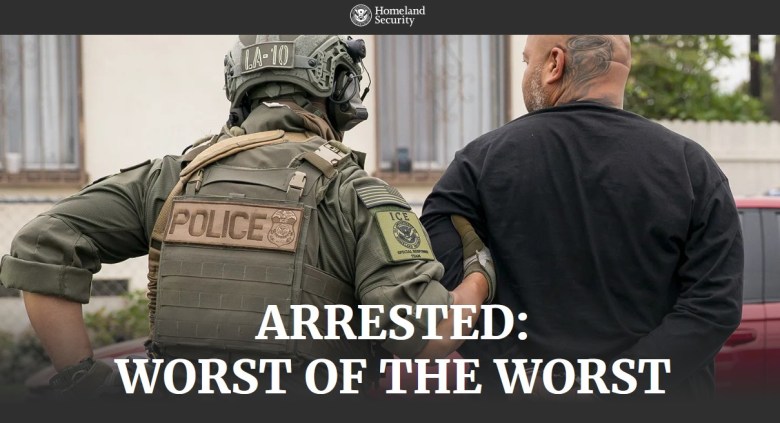
The legal filing comes after Sen. Susan Collins, a Republican, claimed on Thursday that a sweeping immigration enforcement effort in Maine had ended. The same day, ICE said it had made 206 arrests between Jan. 20 and Jan. 24, as part of an operation to go after the “worst of the worst.”
News reports, however, have shown agents detained a number of people without criminal records who were approved to work.
Alongside photos of arrests and detainees, the ICE press release included an image of a bystander in a bright hat, blowing a whistle and holding up her phone. It noted that agents carried out their work “despite the organized efforts from activist groups, radical politicians and protestors to thwart our activities.”
This matches the agency’s rhetoric in Minneapolis where the Department of Homeland Security has pushed back against community opposition and classified protestors as threats. During the recent surge in Maine, several bystanders who captured enforcement activity on video said they were threatened by authorities for doing so.
In one incident in South Portland last Friday, an agent pulled out a phone to document a bystander who was filming him before warning her that she would be put on some type of internal list. The Maine resident, who agreed to be identified only by her first name, Colleen, out of fear of retaliation, had also been out earlier that morning to film three agents pulling a screaming woman out of a car.
“We have a nice little database,” a masked agent can be seen telling her in a video that has since been shared widely on social media. “And now you’re considered a domestic terrorist.”
She said she felt shocked. “But, you know, I stood my ground,” Colleen told The Monitor. “I was not going to be intimidated.”
Her encounter came one day before U.S. Border Patrol agents shot and killed 37-year-old Alex Pretti in Minneapolis after he appeared to be filming them and then attempted to help a nearby civilian who had been pepper-sprayed. Pretti was the second U.S. citizen killed this year by federal agents as tensions over the Trump administration’s immigration crackdown have escalated.
The Department of Homeland Security did not respond to a list of questions from The Monitor about its enforcement tactics in Maine. In a statement to CNN earlier this week, spokesperson Tricia McLaughlin said, “There is NO database of ‘domestic terrorists’ run by DHS.” However the agency monitors and investigates threats to officers, she said, and obstructing law enforcement is a crime.
Earlier this month, a memo obtained by CNN asked federal agents in Minneapolis to “capture all images, license plates, identifications, and general information on hotels, agitators, protestors, etc., so we can capture it all in one consolidated form.”
Trump’s border czar Tom Homan told Fox News that the administration was planning to “create a database where those people that are arrested for interference, impeding, and assault, we’re going to make them famous.”
ICE is using facial recognition technology and other surveillance tools in Minneapolis to identify undocumented immigrants and to track American citizens who have demonstrated against immigration enforcement in the city, three current and former Department of Homeland Security officials told The New York Times.
Lawyers have said agents’ tactics are infringing on detainees’ and observers’ civil liberties. The Maine attorney general’s office and the American Civil Liberties Union of Maine both launched ways for people to report misconduct by immigration officers this week, setting up the federal government for potential litigation.
“[E]vidence of constitutionally-deficient, excessive, and intimidating enforcement tactics is quickly emerging in our own state,” the attorney general’s office said in a statement on Monday in which it shared an email address that people can write to with documentation of violations of the Maine and U.S. constitutions, as well as Maine laws such as the Maine Civil Rights Act.
The attorney general’s office received 15 credible reports within four days, it said Thursday.
The ACLU of Maine created a form for people to report if they have been harassed, intimidated, detained or subjected to use of force by federal immigration enforcement officers. The civil liberties group said it “is investigating unlawful conduct towards ICE observers.”
‘We know you live right here’
Many Maine communities were gripped by fear as agents, often masked, began making widespread detentions last week. Some agents shattered windows as they pulled people from cars, which were left running in the road.
Schools saw attendance drop. Volunteers set up systems to deliver groceries. Some churches began online services and offered support to congregants. In Gorham, minister Christine Dyke collected rugs for a family of asylum seekers with young children, fearing that a noise complaint from downstairs neighbors could lead to their detention.
Through its hotline, the Maine Immigrants’ Rights Coalition logged more than 400 alleged first-hand sightings of immigration enforcement in the first week of the operation, with most concentrated in Portland, South Portland and Westbrook.
In response, people took to their cars and to the streets to document immigration authorities. They tracked sightings through encrypted group chats, and often blew whistles or honked horns if they saw what they suspected to be an immigration agent.
In some videos they captured agents holding, sometimes shaking, canisters of what appear to be mace. In other documented confrontations, agents drove to the homes of those who had been watching them.
Stewart, a Navy veteran who lives in Scarborough and asked to be identified only by his first name to prevent retaliation, said he and several friends had been following the situation in Minneapolis closely. When news of increased immigration enforcement in Maine began circulating in mid-January, he felt a responsibility to get involved.
Stewart lives about a mile from the ICE facility in Scarborough and had kept watch over it nearly every day for a week by observing when agents left the facility. At 4 p.m. on Jan. 22, as Stewart and a friend drove behind one SUV that left the facility, the vehicle started to head in the direction of Stewart’s home, video evidence showed. Another vehicle tailed behind the two, Stewart said.
Stewart had heard about the tactic of driving to observers’ homes through online discussions. But as he realized the agents were driving to his own house, he said it “pissed [him] off.” When agents pulled up in front of Stewart’s home, he said he saw one agent point at his house from inside the SUV.
Stewart later documented the encounter by filing reports with the Scarborough Police Department and the Office of Inspector General within the Department of Homeland Security.
“It just feels incredibly violating for a federal agency to take the time to do that to an individual,” Stewart told The Monitor.
A Westbrook School Committee member, Erin Cavallaro, described a similar interaction to Maine Public recently. She said she had been driving behind an agent at a safe distance last week when the agent led her home and started honking. She said she was later tailed by federal agents in her car.
Westbrook resident Liz Eisele McLellan also said agents drove to her home after she observed them at a bus stop in Westbrook on Jan. 21, in what she described as an attempt to intimidate her.
“This is a warning. We know you live right here,” the agent told the woman, according to a recording of the interaction.
McLellan told The Monitor that she had driven behind an agent who left a bus stop. The agent then drove to McLellan’s house, and, after McLellan arrived, three more vehicles approached, “barricading the road,” she said.
McLellan said she wasn’t deterred and continued to monitor immigration officials.
“I’m not OK with unknown, masked, armed people kidnapping my neighbors, so I’m keeping an eye out and trying to protect them as much as possible,” she said.
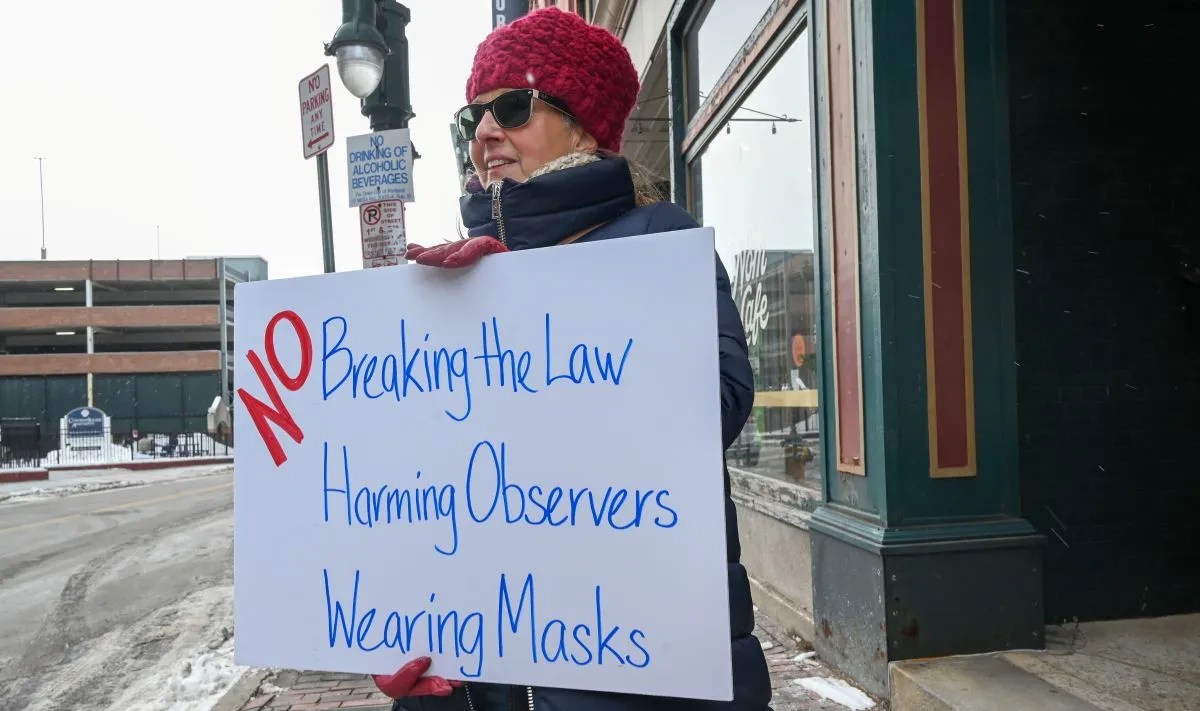
Maine Lawyers for the Rule of Law, a nonprofit organization, led a demonstration against ICE activity near Deering Oaks Park on Jan. 23. Credit: Emmett Gartner / The Maine Monitor
People have a First Amendment right to observe law enforcement in public places, including immigration authorities, said Carol Garvan, legal director for the ACLU of Maine. Government actions to deter people from exercising First Amendment rights are illegal, she said.
Garvan said she is concerned that reports of agents driving to observers’ homes or threatening arrests “could be retaliation and could be illegal under the First Amendment.”
People are allowed to walk on public streets, observe law enforcement activity and make their opinions known without being added to a watchlist, added Carol Sipperly, a former criminal prosecutor in New York who sits on the steering committee for the nonprofit Maine Lawyers for the Rule of Law. If agents are reacting to observers by following them home, or telling them they are being placed on lists, Sipperly said this could rise to the level of “wrongful intimidation to suppress speech.”
At a recent Portland protest organized by Maine Lawyers for the Rule of Law, lawyers told The Monitor that immigration agents must be held accountable if they violate people’s rights while conducting their operations. Vice President JD Vance recently made the claim — one he later walked back — that agents have “absolute immunity” that protects them from legal repercussions.
“That’s a lie,” said Webbert, who was at the demonstration. “Absolute immunity is very dangerous for obvious reasons, and the president seems to have it. That’s bad enough. We can’t have tens of thousands of ICE agents have it, or game over for democracy.”
Maine Monitor staff reporters Emmett Gartner and Josh Keefe contributed reporting.