Jimmy Kennedy grew up fishing in his native Mississippi and in neighboring Louisiana. When he moved to Vermont 40 years ago, he was skeptical of the northern practice of ice fishing — to say the least.
The idea of waiting patiently in subzero temps to catch fish through holes cut into pond or lake ice elicited a strong what-the-heck reaction, Kennedy said. He recalled thinking, “I’m not going out there, you crazy people.”
Kennedy soon joined the crazy.
The southerner said he regularly treks out on frozen ponds near his Plainfield home with his dog and his fishing gear during the deep-cold season. “It’s a great way to spend time outdoors in winter,” said Kennedy, 65. The eating can be really good, too, added the professional bass fisherman and chef.
Crappie sandwiches with maple-glazed carrots Credit: Jeb Wallace-Brodeur
Kennedy now owns JDK Catering, competes in about six fishing tournaments annually and travels to do cooking demonstrations for national food brands. He helmed the kitchen at Plainfield’s River Run Restaurant for 18 years until he sold it in 2009. At the Southern-accented eatery, Kennedy fried a ton of catfish. During Vermont’s ice fishing season, he’s always ready to fire up a portable propane burner or his wood-fired grill on the ice to cook brown trout, pike and crappie, or a mess of smaller panfish such as yellow perch.
At 6 a.m. on January 19, the temperature was creeping toward 20 degrees when Kennedy arrived at the Waterbury Reservoir’s Blush Hill boat access. He and a fishing buddy, Monkton resident Ben Cayer, schlepped sleds full of gear and a portable shanty across the thick, snow-frosted ice to the far edge of the reservoir.
“Ice fishing is gear-heavy,” said Cayer, 34. “If you’re gonna cook, it’s even more gear-heavy.”
Ben Cayer waiting for a bite Credit: Courtesy
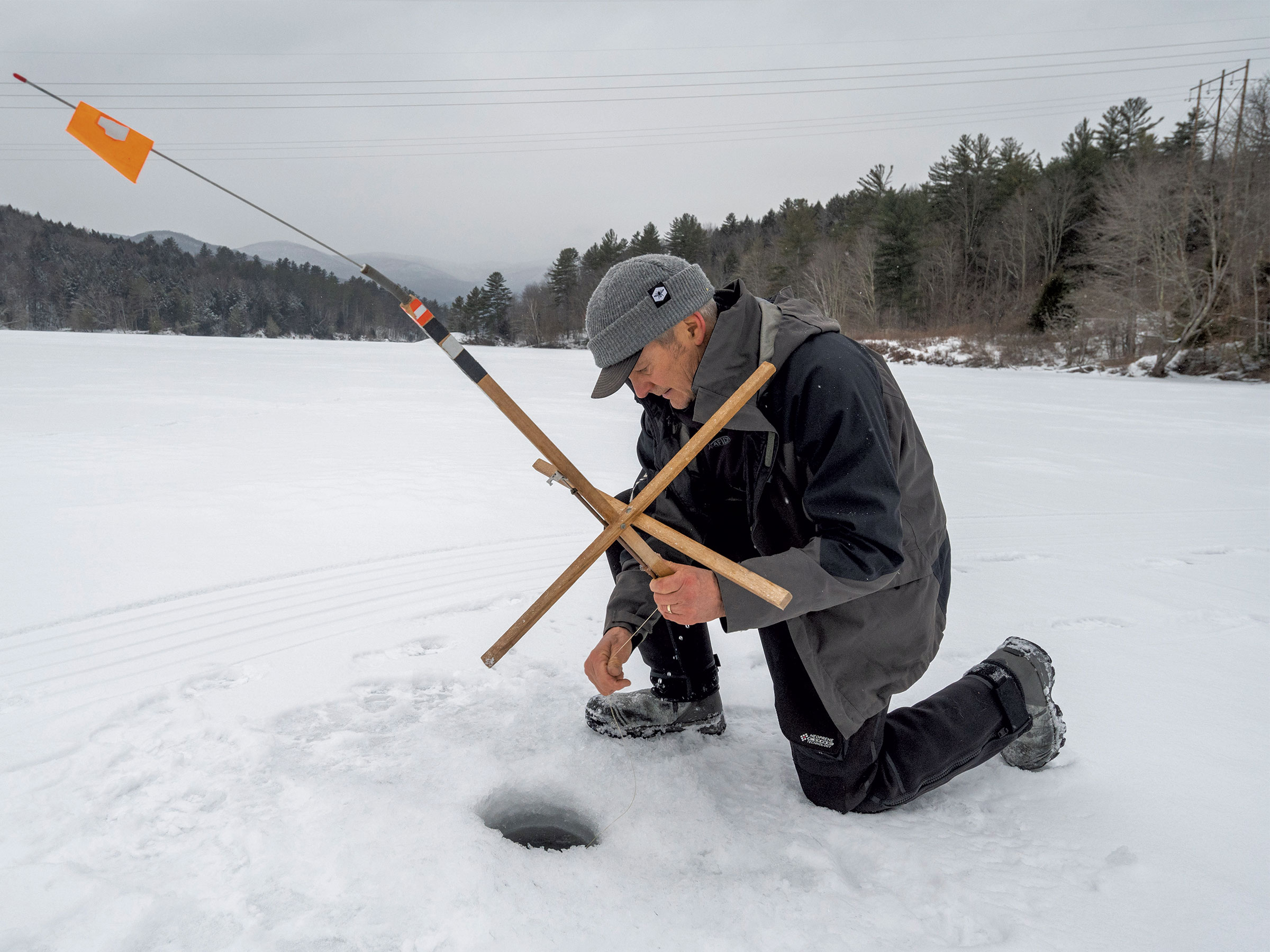
By 8 a.m., Kennedy, Cayer and a friend of Cayer’s — Jordan Koper of Stowe — had used power augers to drill 12 holes in the ice and set fishing devices called tip-ups in eight. Each wooden contraption held a baited hook at the end of a reel. When a fish bites, the action triggers a little orange flag to pop up. That alerts the angler to come check the line and potentially reel in a catch — ideally, a larger fish such as a trout or northern pike.
Fisher’s eyes are constantly peeled for popping flags. After a long day on the ice, Kennedy said, “all you see is orange flags everywhere.”
Cayer and Koper were also actively jigging through a couple of holes, gently moving their lines like puppet strings to make the bait look appetizingly alive.
An hour into the day’s fish, Cayer’s bucket held about half a dozen good-size, 10- to 12-inch gold-and-gray-striped perch, but the group was really hoping the tip-ups would yield trout.
The larger, sweet-fleshed fish, Cayer said, “you just slap on the grill whole.” Perch, he said, are tasty deep-fried or fried in butter, and he really likes his wife’s Cajun perch chowder with potatoes, corn and bacon.
Jimmy Kennedy cooking crappie on a grill Credit: Jeb Wallace-Bordeur
Cayer kept jigging, and Kennedy started cooking. The chef regularly glanced over at the small flock of tip-ups for sprung flags as he started seasoning some crappie fillets from a previous ice-fishing expedition.
“It’s the best freshwater fish to eat, so tender,” he said. Then he interrupted himself. “We got a tip-up!”
The flag turned out to be one of many false alarms that morning: Line checks repeatedly revealed that either a fish had successfully snagged the baitfish and escaped the hook or the fish on the line was yet another perch.
Kennedy put the fillets on the grill and sprinkled them liberally with his go-to Cajun spice blend of paprika, cayenne, thyme, black and white peppers, and salt. He threw half a stick of butter into a cast-iron pan and added bias-cut carrot chunks with a slug of maple syrup.
Set up against the outside wall of the shanty, the chef’s mise en place sat on two wooden folding tables, his great-aunt’s TV trays. In addition to fresh sourdough rolls, baked by his wife, Kennedy had brought three spreads to dress the fish sandwiches: a Louisiana-inspired remoulade sauce, a chimichurri herb sauce and a diced-tomato bruschetta-style topping.
Simple garnishes don’t work out on the ice, Kennedy said: “Every time I bring lettuce and tomato out here, they freeze.”
Kennedy building a fish sandwich Credit: Jeb Wallace-Bordeur
“Jimmy doesn’t mess around,” Cayer said approvingly as he bit into a crusty roll stuffed with fish and flavor.
The friends recalled another meal made with fresh-caught crappie out on Lake Iroquois in Hinesburg. For a recipe Kennedy dubbed Shanty Sushi, he lightly steamed skewered fish nuggets over oolong tea before wrapping them in seaweed.
Cayer and Kennedy fish together year-round, including competing as a tournament team. But ice fishing’s the most fun, Cayer said: “There’s more camaraderie.”
In another shanty across the reservoir, there was camaraderie to spare — though the trout were similarly making themselves scarce.
Snug as bugs in an insulated shanty with a propane heater, Eric Calacci of Jericho and his twin brother, Matthew, of Georgia, Vt., were shooting the breeze with their friend Rob Schantz, also from Jericho.
The trio had set up their shanty over a set of six holes they’d augured into the ice. They sat in camping chairs, a line in each hand, jigging as they chatted while keeping an eye on their tip-ups out the tent windows. Eric, 55, got a bite on one of his jig lines and pulled up a small perch. He gently removed the hook from its mouth and slipped it back into the chilly water. “That one’s going back to get bigger,” he said.
The Calaccis grew up ice fishing in the Northeast Kingdom with their grandfather, from whom they inherited a beautiful wicker fishing creel, or basket, and learned tricks, such as using a button threaded on their tip-up line to help measure its depth in the water. Matthew said they also learned not to keep everything they catch — even when their haul falls below state fishing limits — “to let other people have a chance at filling a creel.”
The brothers often cook up their catch or bring fish from a previous outing, but on January 19, the planned menu was ham-and-cheese sandwiches with tomato soup and freshly mixed Moscow mule cocktails. Sometimes they get more elaborate, starting with Jamaican jerk shrimp, for example, Eric said, and moving on to dust just-caught smelt with flour and pan-fry them.
Ben Cayer holding a perch Credit: Jeb Wallace-Brodeur
The small ones can be eaten bones and all, Eric said. You pop them into your mouth whole “like French fries,” said Schantz, 72.
Rather than fishing trips, Eric joked, their forays “are more of an eating trip interrupted by fishing.”
The trio had successfully jigged a bunch of smelt that morning, but instead of cooking them, they were using the fish to bait their tip-ups. Their hope was that trout might make a final meal of smelt and, in turn, provide the anglers with a fresh feast.
Back at Kennedy’s shanty, he and Cayer had decided to move a couple tip-ups to holes closer to the center of the lake. They’d heard the trout might be chasing smelt down the channel.
A flag popped, but when Kennedy got to the tip-up, the reel was quiet. He pulled up the line to confirm. “Bait’s gone, dammit,” he said.
From a bucket of water equipped with a bubbler to prevent it from freezing solid, the angler scooped up a few minnows and picked a fat one to rebait the line.
Sometimes, the fish only start biting when you’re ready to call it quits. Kennedy recalled a long ago ice-fishing trip with his older daughter, who was begging to go home. They checked one last tripped tip-up, and she reeled in a huge pike.
Free Ice Fishing Day and the Vermont Fish & Wildlife Department’s Ice Fishing Festival are on Saturday, January 31. The festival is 10 a.m. to 3 p.m. on Lake Elmore at Elmore State Park. Vermont Fish & Wildlife will also host an introduction to smelt fishing on Thursday, February 26, 5 to 8 p.m., at the Waterbury Reservoir Blush Hill Access.
Chef Jimmy Kennedy is doing a series of pop-up breakfasts this winter and spring at the Farnham Farm sugarhouse in Plainfield.
Corey Hart of the Vermont Fish & Wildlife Department cautions that those trying ice fishing should take safety seriously. “Ice does not form uniform, so it’s important to check ice as you go with either an auger or spud bar. We recommend four inches of clear/black ice for walking out,” Hart said. “White ice or snow ice is about 50 percent the strength… so it’s important to look at the layers when you measure.”
In addition, Hart advised, “Always tell someone where you’re going and when you plan to return, and carry basic safety equipment such as ice picks and a throw rope.”
Learn more about ice fishing safety, fishing licenses and regulations at vtfishandwildlife.com.
The original print version of this article was headlined “Catch a Chill | Ice fishing and cooking with Jimmy Kennedy on the Waterbury Reservoir”