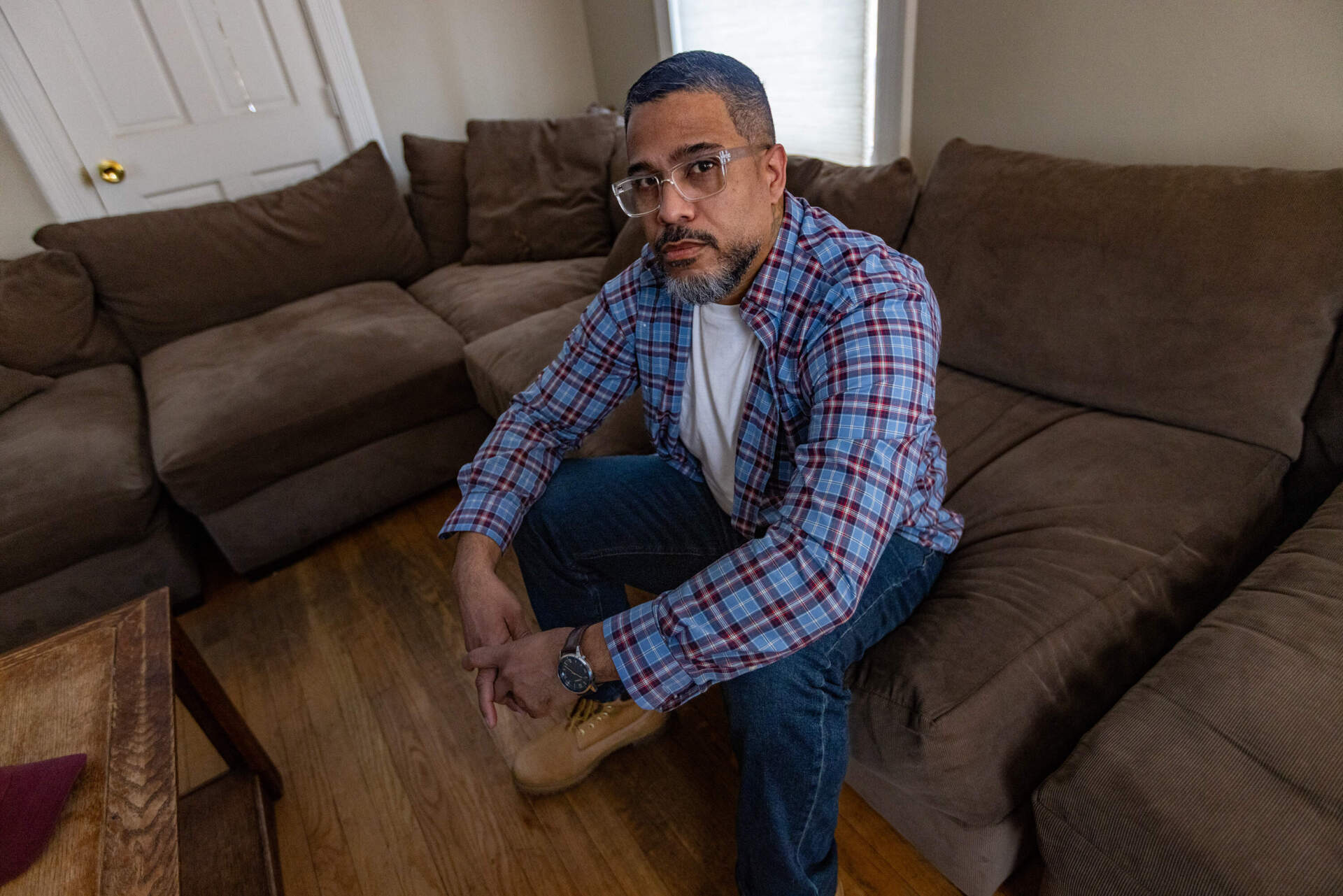
Robert Francis in the living room of Dismas House in Worcester. (Jesse Costa/WBUR)
Robert Francis grew up moving a lot, bouncing from Philadelphia to Puerto Rico to the Dominican Republic. He eventually landed in Springfield, Massachusetts. He said the instability made him an anxious kid.
“When you know what street you’re on, when you know your neighborhood, those things can breed confidence,” Francis said. “When you don’t have that, when you’re always learning your way around, you’re insecure.”
Now 49, Francis feels like that insecure kid again. He was released on parole from prison in August after serving nearly three decades for accessory before the fact to first-degree murder. Now he is re-entering a society that feels very different.
“I’m in a foreign land. I feel like an alien,” he said, choking up. “I’m 49 years old and I don’t know how to do a lot of things.”
‘Ups and downs’ of a changed world
Francis was 18 the last time he experienced a life outside of prison.
In 1995, he encouraged two men to confront and shoot Carlos Falcon, a rival gang member, in Springfield. They also seriously injured three others in the backseat. He was convicted and sentenced to life in prison without parole.
But in 2024, the Massachusetts Supreme Judicial Court ruled that adults younger than 21 can’t be sentenced to life without the possibility of parole. The landmark ruling — often referred to as the Mattis decision — meant that Francis was one of 210 people given an unexpected chance at freedom.
In August, the state’s parole board approved his release, citing Francis’ psychological assessment, disciplinary record and show of remorse.
On Sept. 15, he left prison and moved into Dismas House, a transitional residence in Worcester. He’s one of 37 people in the Mattis cohort to be released so far, according to state data. Over the past six months, Francis has navigated finding work, using new technology and building a life in a society that he was removed from as a teen.
He intentionally chose not to move back to Springfield in order to get a fresh start. But, that also meant he was far from family and friends. His daughter lives an hour away in Ware and his mom is in Puerto Rico.
“The last month feels like 10 years, man,” Francis said during WBUR’s first interview with him in November.
Even simple, everyday tasks were overwhelming.
“Just going to buy something is like, ‘Am I doing this the right way? Am I coming off aggressive?’ ” he asked. “Because when you’re in prison, you have to have this position, and then it becomes your skin. And I’m so self-conscious of that.”
Robert Francis walks in the rain to catch the bus to attend an AA meeting in downtown Worcester. Though he has no history of substance abuse, he is required to attend AA meetings in order to stay at Dismas House. (Jesse Costa/WBUR)
One of Francis’ biggest challenges was finding a job. He wanted to work for a friend’s HVAC business, but his friend was also formerly incarcerated. As a standard rule, parolees can’t associate with anyone with a criminal record unless they are granted an exception by their parole officers.
“That is the most absurd, illogical, cruel idea,” Francis said. “Why do they give sponsors to people in AA, sponsors that used to drink, too? Because they can help them.”
The parole supervision manual tells parolees they “are more likely to be successful in obeying the law if [they] stay away from people who have criminal records or who may be currently committing crimes.”
So Francis landed a part-time job working overnight for UPS as a package handler. But, he didn’t have an easy way to get there. After a month of spending almost as much on Ubers as he was earning, he quit. It had been almost three months since his release and he felt defeated.
“ There’s a lot of just the ups and downs of this whole experience,” Francis said in December. “ I’m a pretty confident person and right now I feel like a fish out of water in many ways.”
Francis thought there would have been more hands-on support during the transition.
“ You got plenty of people ready to put handcuffs on you,” Francis said. But “you need people that are gonna be active about ensuring that you have employment, that you have transportation, that you are being supported.”
A ‘rollercoaster ride’
The Executive Office of Public Safety and Security said it is “deeply committed” to preparing people for life after prison. Since 2024, Gov. Maura Healey’s administration said it has invested $30.7 million in educational and re-entry initiatives. A WBUR analysis found that the state tripled funding for re-entry services from fiscal year 2020 to fiscal year 2025.
Undersecretary Andy Peck, who helps lead the state’s office, said re-entry is a responsible use of tax dollars.
“Let’s invest in their behavior change and let’s invest in the support when they leave,” Peck said. Because when “people are successful that’s good public safety. That’s long-term public safety.”
While overall funding has grown, specific re-entry line items are subject to annual debate. Some experts say the uncertainty can be really hard for re-entry programs.
“These kinds of line items are always on a rollercoaster ride,” Benjamin Forman, director of MassINC’s Policy Center said. “It’s really hard to build good programs and serve high risk people when you don’t have funding to depend on.”
Peck acknowledged there is room for improvement. In 2024, he helped spearhead a sprawling report by UMass Chan Medical School that reviewed the state’s re-entry ecosystem. Researchers found “significant” gaps in housing, behavioral health support and employment opportunities for people leaving correctional facilities.
Recidivism rates — the share of people who reoffend after release — are often used to measure re-entry programs’ success. In 2023, the most recent year with available data, the one-year recidivism rate was almost 17%. The three-year rate for people released in 2021 was about 40%.
Peck said there are no new or special initiatives for those released due to the Commonwealth v. Mattis decision, like Francis. He acknowledged the Mattis cohort faces unique challenges, but added they have the same opportunities afforded to all former prisoners re-entering society.
One person from the cohort has been returned to custody on a parole violation as of March, according to the Executive Office of Public Safety and Security.
Robert Francis sits on his computer in his room at Dismas House using ChatGPT. (Jesse Costa/WBUR)
Moving forward
By late December, Francis said he felt increasingly isolated.
Things got particularly dark when he fell for a job recruitment scam over text message and accidentally gave a bunch of his personal information to a bot.
“I was so, so pissed at myself and, like, embarrassed,” he said. “I just felt so stupid.”
In a moment of desperation, Francis turned to another app for help. He recently discovered ChatGPT, the popular artificial intelligence chatbot, and began confiding in it. He typed his frustrations in the chat window.
“And the chat responded in the most insane way. It was comforting and terrifying at the same time,” Francis recalled.
ChatGPT told Francis he was doing everything right and he shouldn’t be hard on himself.
“I mean, everything that you would want a friend to say to you. It made me emotional,” he said before adding some caution. “When you’re lonely it can get scary. It kind of prompts you to lean on it way too much.”
Things started to look up for Francis six months after his release.
He got an exception from the parole board to work part time for his friend’s HVAC company. He started classes at Clark University and his ankle monitor was removed. He is working on a clothing line he designed in prison and has found some solace in a Jehovah’s Witness congregation.
Over months of interviews, Francis tried to catch himself whenever he complained.
“I am full of gratitude. Let me just say that I’m a ball of gratitude,” he reiterated.
He is thankful for the second chance and for the support he has received. He also wants to avoid an unwelcome response he’s heard before: “maybe you needed more time in prison.”