Terry Tempest Williams writes about finding beauty in unexpected places, animals, plants, memories and moments. She shows us how to do that in today’s increasingly chaotic world.
Guest
Terry Tempest Williams, writer. Her latest book is The Glorians: Visitations from the Holy Ordinary.
The version of our broadcast available at the top of this page and via podcast apps is a condensed version of the full show. You can listen to the full, unedited broadcast here:
Excerpt from “The Glorians”
Transcript
Part I
MEGHNA CHAKRABARTI: Today, although I’m sad you can’t see it, I am wearing the t-shirt I bought at Grand Teton National Park. That’s because one of the most eloquent advocates for America’s natural spaces is here with me in the studio.
For decades, Terry Tempest Williams has been exploring America’s wilderness, our religions, our ethical struggles, our history. Not the boundaries between them, mind you, but how truly there should be no boundaries between those ways of seeing the world at all.
She’s the author of many books, including “Refuge: An Unnatural History of Family and Place,” also “The Open Space of Democracy” and “Finding Beauty in a Broken World.” And in that book she writes, “Finding beauty in a broken world is creating beauty in the world we find. To be whole, to be complete. Wildness reminds us what it means to be human, what we are connected to rather than what we are separate from.”
Well, her latest book is out now and it’s called “The Glorians.”
Terry Tempest Williams, welcome back to the show
TERRY TEMPEST WILLIAMS: Meghna, it’s so great to be with you. And I love your t-shirt, by the way.
CHAKRABARTI: (LAUGHS) It’s like a light blue, maybe a periwinkle blue, with, of course, Grand Teton.
WILLIAMS: I know. And a big moon behind it.
CHAKRABARTI: Right in the middle of it. I was just there last summer. A really transformative experience, which I can bore you with later. But we’re here to listen to you.
And I was wondering if we might start this way. Put us in your shoes. Let us see through your eyes and share with us a moment where you encountered a Glorian. What do we see?
WILLIAMS: Well, one morning I woke up and the coyote willow was magenta. It was so beautiful, and I ran inside and I thought, I’m gonna get my camera and take a picture. I went outside and while I’d been gone, a wind came and blew all the blossoms off. And I thought, okay, I’m just gonna go in the kitchen and get a basket and save them. So much for attachment, right? So I run and get the basket. I come out, the wind blows them all off. And I laughed.
And there was one blossom left. I bent down to pick it up. It moved. It had six legs. I realized it was an ant carrying one of the coyote blossoms on its back like a sail, in its mandibles. During the pandemic, what do we have? Time. And I thought, I’m just gonna follow this wee little thing. Followed it around the patio. It turns, I’m respectfully behind it.
It keeps going and I think, okay, demise coming. It’s going to pour off the lip of the porch to the desert. And as it did, three little attending ants came, lifted the blossom over its head, it takes it back. They disappear. It goes on its journey. Continues on. Up ahead, I see this huge prickly pear patch and I think that’s it. It’s over. It’s going to be impaled. Again, attending ants appear. Up, over, around, not impaled, around each spine, out on its own. They disappear, vanish. It continues.
Up ahead, I see this clay covered fist. The ant colony. It continues. We’re now about 30 minutes into this trek. It turns, it goes up, up, up, up this hill. It gets to the top, moves to where the opening is. Dozens and dozens of ants come. Within seconds, it eats all of the, you know, little pieces of this pink magenta blossom. They disappear. And I imagine it’s lining the pathway to the queen. That ant carrying that blossom with attending ants was a Glorian.
CHAKRABARTI: Why?
WILLIAMS: Because for that moment, my attention was completely focused. And I thought this is the way of the world. Visitations from the holy ordinary. What is more ordinary and extraordinary than an ant? And the way their community thrives, how they help each other. You know, we never see the queen, rarely.
But these are moments of extraordinary significance that we don’t pay attention to. I don’t pay attention. And that was one of the gifts I think of returning home to the desert from Cambridge during the pandemic, when all we had was time in the desert with quiet, wind, water, rain, ants.
CHAKRABARTI: Mm. Utah?
WILLIAMS: Yes. Southeastern Utah. Just outside Arches, which I am extending an invitation to you.
CHAKRABARTI: I will take up that invitation someday. Okay. So these moments, I mean, is that what a Glorian is? It’s kind of a unique moment of transcendence?
WILLIAMS: Meghna, I don’t know exactly what a Glorian is.
CHAKRABARTI: Okay.
WILLIAMS: I will tell you that before the book was finished, I had a four points definition. I thought they were smart. I thought they were reasoned, well thought out. I thought this is what I’ll have right up front so the reader knows what a Glorian is. And at the last minute, at the last hour, I pulled it. Because I thought, who am I to say what a Glorian is? Who am I to say what the ineffable is? But we each know it in our own way, from our own perspective.
And for me, the Glorian, that name was given to me through a dream. And for some that might be highly suspect, like my father who’s 92 and just said “what?”
CHAKRABARTI: (LAUGHS)
WILLIAMS: But I trust my dreams. My grandmother was a self-taught union scholar. And when we would go to her house, we would vie, you know, whose turn is it? But it came with a cost. That cost was we would have to tell her what we had dreamed the next morning. So we often slept in late.
But one dream I remember I was excited to tell her. And we had, we sat down, she always cooked buckwheat pancakes. And I said to her, “Mimi, I had this great dream. I was walking across Commonwealth, our street where we grew up, to Martha Young’s house,” who was my best friend, she was two years older. “I knocked on the door, no one was home. I went around the back, the sliding glass doors were open. I walked in, I stood on the hearth, the stone fireplace. And just then, a great horned owl flew through the the doors and landed on my shoulder.”
CHAKRABARTI: On your shoulder?
WILLIAMS: Yes. And Mimi said, “Oh, darling, that’s wonderful. I think you’re about to menstruate.” (LAUGHS) And that was not what I expected, or nor wanted to hear, I think I was 12 or 13. And would you believe me if my period did come? And my grandmother had great credibility.
CHAKRABARTI: (LAUGHS)
WILLIAMS: But in that moment we talked about the symbols. What did an owl mean to me? What did my friend mean to me? She was always ahead of me. What does a home mean? And then my grandmother would say, “In the collective unconscious, an owl is the divine feminine, associated with a 28-day cycle of the moon. Was found in the folds of Athena’s robes.”
CHAKRABARTI: Aha.
WILLIAMS: And suddenly there was a larger world.
CHAKRABARTI: I was just thinking actually what an amazing experience it would be if every young woman whose entry into womanhood came on the wings of an owl. It seems like an actually kind of a blessed moment.
WILLIAMS: It was. It really was. And that’s why when I had this dream, it was May 20, no, excuse me, March 20, seven days, one week after lockdown. On Friday the 13th of March 2020.
The dream I had was this. I was walking through Harvard Yard. It was fall, resplendent red maples, bronze oaks. I knew I had to get to the tower. There is no tower. I turned, there’s the tower. I walked toward it. There’s two ways to the top. One, a direct staircase to the top of the tower. The other, a spiral staircase to the side. I chose the spiral staircase to the side. Around and around.
When I get to the top, I look at my feet and I’m standing in the ruins of Cassandra’s Tower. I have the strong feeling I’ve forgotten something. I hear my name called. I turn. There’s a woman coming up the direct stairs with students behind her. The gate is locked. She says, “Terry, do you remember the vow you made to us?” And I said, “Remind me.” And she said, “Your vow is the epic documentation of the Glorians.”
CHAKRABARTI: Wow.
WILLIAMS: And then I woke up. And I thought, “What is a Glorian?”
And as my grandmother always taught us, we had a pad of paper and pencil by our bed. I wrote in the dark, “the epic documentation of the Glorians.” I didn’t wanna forget that vow for a second time. And that’s been this seven year, six year journey.
CHAKRABARTI: Before we get more into how that journey unfolds in the book, I feel like you could look back on your career as it has unfolded thus far as part of that epic documentation. I mean, just the few titles of your many books that I read, it seemed they’re all in that same flow.
WILLIAMS: I think, you know, I hadn’t thought about that. You know, I don’t think of career. I think of what questions do I hold? And I think you’re right. You know that it is beauty and brokenness, and how do we bring these two hands together in prayer?
CHAKRABARTI: Yeah.
WILLIAMS: I think the difference is I didn’t have a name for it. I don’t have a definition, but at least I can say, “Oh, that’s a Glorian.” That’s a moment where attention is fused. It comes unearned, unbidden grace.
CHAKRABARTI: Mm. It seems significant to me that the appearance of this word came to you in the first days that the world essentially was broken by the pandemic.
WILLIAMS: And we could say, you know, the pandemic was a Glorian. It brought us all to our knees. I mean, I don’t think the Glorian has to be all light, beauty and wonder. I think a Glorian, you know, my mother’s cancer was a Glorian. It, again, brought us to our knees, focused attention, giving us the strength and courage to not look away.
CHAKRABARTI: Mm-hmm. Hmm. Okay. This is gonna make me think a lot more because over the past few days, I’ve been leaning into sort of the incandescent beauty part of what a Glorian might be. And now I’ve gotta rethink it because we can be brought to our knees by the most horrible things as well. How can those horrors be Glorians, too?
WILLIAMS: I think it’s awakening.
CHAKRABARTI: Okay.
WILLIAMS: You know, I’m thinking about five flash floods. We can talk about that later.
Part II
CHAKRABARTI: So you wanna talk about floods.
WILLIAMS: We had five flash floods in our little community in southeastern Utah, just outside Arches National Park, within a matter of weeks.
And the last flood, where to even begin? The first flood was — it was like a liquid hand that spread all across our valley. And one could say this was devastating, or one could say it was transformative. And I chose the latter.
And what was the most profound is that the next morning, bird song. I walked out. Dry. Followed the path of water. Prickly pear, a color green I’ve never seen. Signatures in the sand of great blue heron, badger, coyote, raven, lizards. Ants were up. I heard the sound of water. I panicked. I turned. It was the memory of water in the leaves of cottonwood trees blowing. Life goes on. The very reason we’re in Castle Valley is because of the erosional beauty. It’s that same erosional beauty that may take us out.
But the last flood was the most instructive because you could smell it before you heard it. You heard it before you saw it. And when you saw this wall of water turn that corner with such velocity, it was like staring into the face of God and it was not human.
The next morning, again, I walked that path of water to see what had happened. And we’ve lived there 30 years. I did not notice this one shadow. I thought, I’ve never seen that shadow before. Suddenly, I walked through it. It was a newly formed canyon that was 40 feet long, 12 feet across and 10 feet high. I sat down in what could be construed as new earth with my back against where it had — head erosion moved all the way back. And I thought I saw floaters.
CHAKRABARTI: Mm-hmm.
WILLIAMS: You know how in your eyes? When it’s the sun>
CHAKRABARTI: (LAUGHS) I have them all the time.
WILLIAMS: (LAUGHS) I thought, oh my God, my retina is separated. And then I stood up and realized it looked like black glitter. And then I turned and I realized I had not seen the side wall. We know ants from the top down. I had not seen it excavated, like a cross section of an ant colony that was 10 feet high. The ants were throwing out their dead.
CHAKRABARTI: Oh, wow.
WILLIAMS: And as soon as they were throwing out their dead, they were closing those walls.
Just as this rain of ants was coming down onto the sand, on the other side were darkling beetles. We called them stinkbugs as kids. They were dropping out onto their back, turning over, eating the dead ants. Then crawling out of the canyon onto the desert floor with ravens waiting for the darkling beetles. It was this trophic cascade of life and death.
I called it a holy room of the sublime. It was life. It was death. It was erosion. It was everything all at once.
CHAKRABARTI: Yeah. You know, I am certain that everybody listening to this right now can think of at least one moment in their life where they experienced what you’re talking about — that focused attention that you’re saying that that sort of moment of grace or a Glorian. But it also takes takes the ability to allow oneself to feel that, right? To be able to, instead of just walking past the scene that you described, to turn and look and like you said, watch this trophic cascade of life.
And I just wonder if — do we have to train ourselves to be able to welcome those moments or — maybe and — are these moments of experiencing the profound, do they just break in on onto us whether we want to or not?
WILLIAMS: I love that idea of breaking through. Don’t you?
CHAKRABARTI: Yeah.
WILLIAMS: That they command our attention. And I really believe in that reciprocity. You know, I remember in the book Animals and Why They Matter with Mary Midgley, the philosopher. She said, the ultimate act of anthropocentrism is to assume that other beings don’t feel, don’t see, don’t think, don’t grieve.
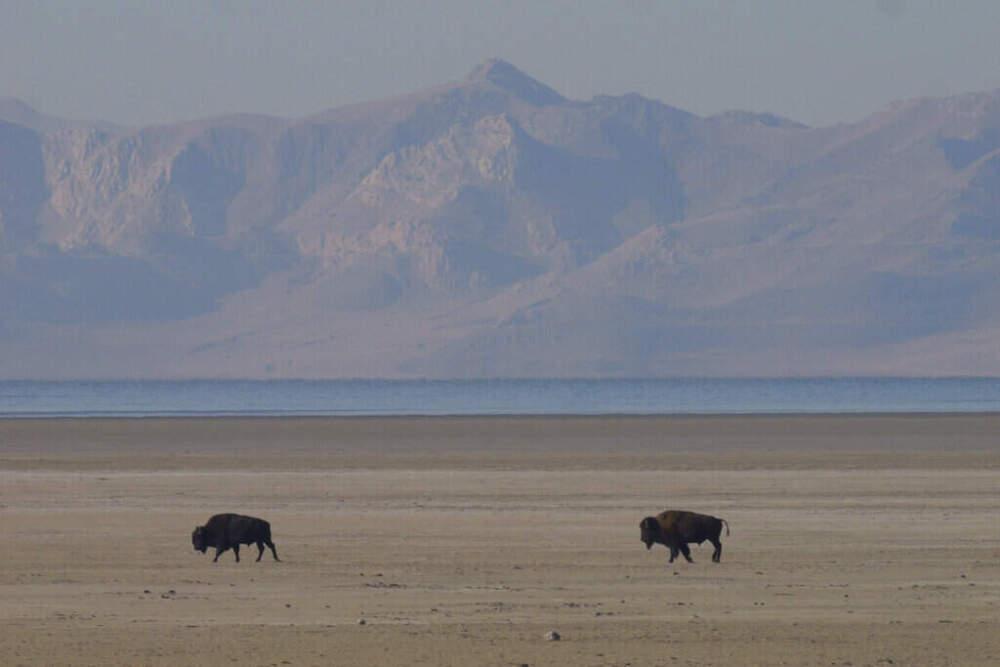
And so I think that realization that we can be called forth by other beings, whether it’s sage, whether it’s a pronghorn on the prairie or a bison out at Great Salt Lake, I think there is a commanding presence of all life. And if we are open to it, if we do take time, I think these are everyday occurrences. We know this with our pet kin, right?
CHAKRABARTI: Yeah.
WILLIAMS: I mean, who can say that our cats aren’t — you know, I remember when Brooke had open heart surgery, my husband, our cats, Issa and Vasho, just purred on his chest for four months. I think that was healing. They knew. And I think the natural world is alive with this knowing.
CHAKRABARTI: Yeah. They absolutely know. My dog — my mother lived with me for the last few months of her life. And she passed away beautifully. I mean, it’s the way I wanna die, surrounded by loved ones at home. But actually the day before my mother passed away, my dog actually just sort of camped out in the hallway, right outside her room.
WILLIAMS: Wow.
CHAKRABARTI: We didn’t let him in because she was too fragile and he likes to jump on beds. (LAUGHS) And he wouldn’t move. He didn’t move.
And then the day that she passed away, we actually did manage to get him outside a few times so that he could take care of his own needs. But a few hours before she actually died, he’s a greyhound, so he likes to wind himself up in a little donut. And he unwound himself all of a sudden and stood up outside the door and actually just urinated right then and there.
WILLIAMS: Wow.
CHAKRABARTI: And he had been out several times already. So it wasn’t that like, you know, he was holding it.
WILLIAMS: Right.
CHAKRABARTI: It’s just — he knew.
WILLIAMS: He knew.
CHAKRABARTI: And he was, I think, beginning his mourning process.
WILLIAMS: Yeah.
CHAKRABARTI: And like it just, like I said, basically just two hours away — two hours later, my mother passed away and I’ll never ever forget that. It was — it broke through my own emotional myopia.
WILLIAMS: Yes.
CHAKRABARTI: Right? because it suddenly took me out of like how I was feeling about losing my mother, and it reminded me of everyone else who was present, who was also experiencing a loss at that moment.
WILLIAMS: Mm. Thank you so much for sharing that. And I’m sorry for your loss.
CHAKRABARTI: Oh, you know what, it’s a part of life.
WILLIAMS: And it’s the beauty, right?
CHAKRABARTI: Yeah. And it came through this creature.
WILLIAMS: Yes.
CHAKRABARTI: Who had no words, you know?
WILLIAMS: And I love that, that breakthrough that pulls us to a, a deeper sense of intention. And again, that awakening, but that’s such a powerful story.
CHAKRABARTI: I can’t take credit for this idea of breakthrough. Because as I was reading The Glorians and thinking back on your work, I could not stop thinking of my favorite absolute, one of my favorite American writers of all time, who you remind me so much of, Marilynne Robinson.
WILLIAMS: Mm. I love her work.
CHAKRABARTI: Right? Just a masterful woman of letters. And I don’t know if you read Gilead?
WILLIAMS: Mm-hmm.
CHAKRABARTI: Right. So that’s the book that she won the Pulitzer Prize for in fiction. And there is a specific quotation, which I’ve like written down in my own journals multiple times. And I have it here in front of me, if you don’t mind. And again, it just came back to me when I was reading The Glorians.
And Robinson writes in Gilead, “There is no justice in love, no proportion in it. And there need not be. Because in any specific instance, it is only a glimpse or a parable of an embracing incomprehensible reality. It makes no sense at all because it is the eternal breaking in on the temporal. So how could it subordinate itself to cause or consequence?”
WILLIAMS: I love that. I think, I think you’ve — I think this is all about love. And grief is love, and love is grief. The minute we allow ourselves to love a person, a home, a landscape, we make a bow toward grief.
CHAKRABARTI: Mm.
WILLIAMS: You know? And I think whenever we are in that grieving state, that ache that is physical, that’s also love.
CHAKRABARTI: Mm-hmm.
WILLIAMS: I think they’re siblings. We can’t have one without the other.
CHAKRABARTI: Do you mind talking more about how grief, as you’ve experienced it, is part of the book?
WILLIAMS: You know, I don’t think I thought I was writing about grief when I was writing The Glorians. I, like you, I was thinking about the beauty, what focuses our attention. But it’s all the same. I mean, it’s the flood, it’s erosion. It’s — I came into the pandemic grieving my brother’s death by suicide.
CHAKRABARTI: Mm.
WILLIAMS: And it wasn’t — I thought I had grieved, Meghna. But it wasn’t until I saw the death of the Divinity Tree. It was a red oak, 200 years old, that literally had been a canopy of care for generations of students at the Harvard Divinity School. When that tree was killed, taken down because of a construction project, ironically, to create an interfaith space, the one thing that haunted me about my brother’s death is who — and I should warn the audience — I wanted to know who took the noose off his neck.
CHAKRABARTI: Mm.
WILLIAMS: And as they were cutting down the tree, beginning with the crown, they cut every branch. And there was a man who put a noose around those branches as the crane carried across the face of that gothic structure, the divinity school, and brought it down. And there was one man who received each branch and took that noose off of that branch with such care and such compassion, that in the four hours that it took to kill that tree that it took 200 years to create, I saw my brother.
And there was a healing in that moment. As well as tremendous heartbreak — for the tree, for my brother, for every tree that has been cut down, for every life that has been taken. But again, there’s something about not looking away, of staying with. And that that’s what I’m talking about.
CHAKRABARTI: Yeah. You know, Terry, if I may be honest, I have an internal struggle between maintaining an openness or an ability to accept when moments like this that are this, you know, as you say, this mixture of grief, love, beauty when they arrive in my life versus kind of a sense of fury and defiance. Right?
WILLIAMS: I have that, too.
CHAKRABARTI: And a lot of people do. And so part of, as I’m listening to you talk and I was reading the book, I was thinking, well isn’t it just as understandable to instead, you know, let this glory break over you to say, no, I shouldn’t be in this situation? I shouldn’t be having to mourn the loss of — the terrible loss of a loved one.
I shouldn’t, you know, I’m thinking about people who have lost everything in natural disasters, for example. Yes, on the one hand, we can do nothing about it. Nature is all powerful no matter what we think. But on the other hand, to have a life, your life ripped away like that, I understand why people might say, no, I’m not going to subjugate myself to some kind of lofty ideal of beauty. I’m just in, instead gonna say, “This is wrong. I’m furious and I want my life back.”
WILLIAMS: And I have been there. Many times. And with a name like Tempest —
CHAKRABARTI: (LAUGHS)
WILLIAMS: You know, people who know me, there is rage. But again, I have chosen. You know, when I realized nine women in my family have all died of breast cancer and seven survived. I mean, seven died, two survived. I can’t even talk about it. What do you do with that? And so how do you take your anger and transform it into sacred rage?
I did choose to cross the line at the Nevada test site with other brothers and sisters and with Shoshone elders that gave us a pass over on that military terrain. We did fight for the life of that tree, and we lost. And I know it wasn’t an easy decision for our dean who had to make that decision. But I think what I’ve learned, I’m now 70, is that we’re in the middle of the story.
CHAKRABARTI: Mm.
WILLIAMS: And rage matters. Rage is a tremendous fuel. It’s fire. But water is also a story with fire. And how do we allow ourselves to seep into the nooks and crannies and find a larger frame to look at?
What I couldn’t have known when the tree was being, and it was Robin Wall Kimmerer who came to pay her respects to the tree and said, “This is murder.” I couldn’t call it that. That was too painful. What I couldn’t understand is that six years later, I would receive a telephone call from a man named John Monks who said, “Is Terry Tempest Williams there?” And I said, “This is she.” And he said, “My name is John Monks. I have the body of the Divinity Tree.”
And the man who was instructed to take the body of the Divinity Tree — huge, big pieces of the trunk — to Maine for firewood, to the chipper, made a detour to Vermont. And under the cover of darkness, left this beautiful body on the front lawn of John Monks, who was an artist and who took heirloom trees and gave them an afterlife in art, tables, et cetera. Would call and say, “I knew there was a story here when I saw green spray paint on the body of this beautiful red oak that said, ‘good luck humans, you’re going to need it.'”
And that two years later there would be a procession at the divinity school with 100 students from Memorial Church walking around one of the descendants of the divinity tree that had been cared for and planted by the very dean who made that decision.
CHAKRABARTI: Mm-hmm.
WILLIAMS: And it was fostered and nurtured and cultivated to where it’s now six feet tall — five foot eight, I think. To greet the tree back in the form of a bench, an altar and also now a table has just been added. Does that make up for the tree’s death? No. But does it say, here’s a round table of a difficult history that we can have difficult conversations, that students can write, poetry, that students can read and learn and take solace. From what? Take solace from a remembrance of a wrong.
And that to me is what sacred rage can lead us to. We’re in the middle of the story. We don’t know what’s coming.
Part III
CHAKRABARTI: I feel like your book couldn’t have come at a better time. But then again, I could have said that last year and the year before. (LAUGHS)
WILLIAMS: I know.
CHAKRABARTI: And the year before. And I could say it next year if it got published next year. Life and human life and human history will always be full of tumult, tempests. But there’s something about the world we’re living in now which makes it seem like the chaos is like, unrelenting. Are you experiencing that?
WILLIAMS: Totally. It’s so disorienting. You know, this war, I don’t know how to wrap my arms around it. It seems so senseless. I understand the history, a little bit, of course. But what we’re seeing on the streets with ICE. And yet, and yet the heinous acts we’re seeing from this administration, from this president, we’re also seeing these beautiful acts of compassion and love and caring.
Again, I put my faith in community.
CHAKRABARTI: Mm-hmm.
WILLIAMS: And I think that’s what we’re seeing. We’re seeing it in small rural places in Utah. We’re seeing it in Minneapolis, we’re seeing it in Los Angeles. We’re seeing it everywhere. And I think this next gathering on March 28, we’re going to see it again on the streets.
But I think it is disorienting. And you add climate to that, you add fires to that. I can tell you from the American West, it is so hot and dry. There are places along the Colorado River you can step across. I don’t think we’ve been here before, in terms of certainly my lifetime, where there’s so much extended chaos.
CHAKRABARTI: Yeah. There’s a kind of — I check myself every once in a while in terms of my feeling like my head’s swimming at this point in time, because there’s a kind of American naivete to that as well, or a privileged American naivete.
WILLIAMS: Mm-hmm.
CHAKRABARTI: Because of course, we’ve had people in this country for hundreds of years who have been living in constant chaos or constant chaos thrust upon them. And then I’m also thinking about how that’s true for billions of other people.
And I wonder when tumult and chaos and confusion become a normal part of life, when we’re ripped out of our privilege of not having to experience that, how then do you leave yourself open to the, as you call it, the élan vital of the Glorians when all of life seems to be one giant exercise in trying to survive?
WILLIAMS: You know, in Utah — I think you talk about privilege and as a white conservationist, I’ve certainly been part of that. And I think we were all schooled, informed, influenced by, and tutored by the tribes during Bears Ears National Monument.
CHAKRABARTI: Mm-hmm.
WILLIAMS: It was the Diné, the Navajo, the Hopi, the Ute, Mountain Ute, the various pueblos who’ve always viewed Bears Ears, these two buttes around the Four Corners region of Utah, New Mexico, Colorado, and Arizona have been sacred.
There’s a friend, Jonah Yellowman, I just visited him shortly when I was home a couple of weeks ago, and I said, “Jonah, how are you doing with the drought?” And he said, “Like we’ve always done.” You know, “like we’ve always done.” And so I think we have a great deal to learn from indigenous people who know what it means to not only survive, but keep their traditions alive, to take care of their stories that sustain them.
And I am so grateful for the generosity that the indigenous communities have offered and shared and been generous with with so many of the outlying communities. It’s shifted perspectives. It’s shifting our perspective about Great Salt Lake as well.
CHAKRABARTI: Mm-hmm.
WILLIAMS: With again, the tribal leaders that are saying, “This is our sacred mother lake and let us view her that way.” And saying, “This is what we must call her together.”
CHAKRABARTI: Yeah.
WILLIAMS: So it is humbling.
CHAKRABARTI: Do you have these conversations with younger people, young people as well?
WILLIAMS: To me, that is what sustains me. And it’s my students with their ferocity, with their vocabulary that are saying, we need to look deeper, we need to look broader. And there is something deeper than hope, which is engagement.
CHAKRABARTI: Mm-hmm. Well, the reason why I ask is because, you know, mentioning climate, and I can’t, but bring the sort of toxic impacts of social media into this in terms of things that may prevent us from experiencing a moment of glory.
But there is a lot of sort of public discussion amongst young people about, well, you know, about the climate catastrophe. Or that, you know, why have children in a world that’s going to burn or is burning? Or income inequality is so profound, I will not have the future, et cetera, et cetera. And I understand those impulses. But at the same time, as you just said, we don’t have to look far to find the wisdom of people who say we continue as we always have.
WILLIAMS: Mm-hmm.
CHAKRABARTI: And I do wonder if there’s a way to have that same conversation with many young people who feel despondent.
WILLIAMS: You know what I’m seeing? At the divinity school, I’ve been there almost 10 years, this is my last year. Early on, people were coming to study religion. To become pastors, priests, et cetera. Now what we’re seeing is I would almost say a majority are coming as artists, writers, filmmakers, in the arts, in the humanities of how can we create new stories that can take us to a deeper place? Or to tell the hard histories that we have ignored?
And I have found that so powerful in terms of their perspective of the role that creativity can play regarding a spiritual life. A spiritual life of care. And I think that to me is something to think about. At a time when we are saying the humanities don’t matter or that the arts are peripheral and not being funded. That that may be the very road into our humanity again.
CHAKRABARTI: Yeah. Well, the reason why I bring it up, and I’m really glad to hear you say that because frequently, when I hear this despondency, maybe I’m just gonna start handing out your book. (LAUGHS) Because I wanna say what you write so beautifully in the book withthe many examples of the Glorians, that beauty can break through. It’s there.
WILLIAMS: A black widow. You know, I remember Brooke was out of town. I couldn’t sleep. It’s the world, right, breaking in. And I thought — a friend of mine sent three CDs of landscapes — the Arctic, Costa Rica, the rainforest, and the Sonoran Desert. I turned on the Arctic. It was silent. And I thought, is that what cold sounds like? Wind? (LAUGHS)
CHAKRABARTI: (LAUGHS) Says the child of the desert.
WILLIAMS: (LAUGHS) And then Costa Rica, I was totally traumatized by more water and turned that off. And then I turned on the light and I thought, “Okay, Sonoran.” I turned on the Sonoran. And I thought, “Ah, I’m home.” There’s the insects, there’s the coyotes, there’s, you know, javelinas pattering on the bedrock.
And then I saw this shadow emerge, and it was a black widow that I tell you the body was the size of a grape. And we had known her because I had left a sticky note for Brooke when I went out of town that said, “Please take care of her.” Which I meant take her outside. He thought it meant feed her. So she had grown. (LAUGHS)
CHAKRABARTI: (LAUGHS)
WILLIAMS: I had not seen her since his caretaking. And it was such a comfort, Meghna, honestly. We just sat there and listened together. A woman and a spider as companions, listening to the desert we loved. Now, you may think I’m crazy, maybe I am. But I think there are these moments when we break through to another species, they break through to us as another species. And there is a reciprocity. And that too is a Glorian.
CHAKRABARTI: Yeah. You know what I find most powerful and hopeful about things breaking into our consciousness is that, you know, as we talked about a few minutes ago, the world feels like it’s in so much chaos because of, well, human politics, right? But experiencing a moment of glory or a Glorian, that’s for everybody.
WILLIAMS: It is. And it’s simple and it is for everyone.
CHAKRABARTI: And it’s like, well, maybe we can use those moments to come together. Because there’s no difference between, you know, me hiking through the Tetons and watching the sunrise behind Grand Teton, which that was a moment. And, you know, someone else who may be, you know, light years apart from me on whatever belief you might say, who experiences a, a black widow spider and just takes it somewhere and puts it down gently and watches that spider for a moment. Do you know what I mean? Like, why can’t we come together over those fundamentals?
WILLIAMS: And I’ve been bitten by a black widow.
CHAKRABARTI: You keep coming up with more and more amazing things.
WILLIAMS: Well, there’s the other side, you know, where I felt like I was hallucinating for four days. But I just think if we’re present, we’ll know what to do. And that’s my mantra. If we’re present, we will know what to do.
And I think at a time when we have no time, I mean, living in Cambridge, it’s hour by hour by hour. How are we to pay attention to anything except for our own stress? We can make the decision to slow down. We can make a decision to be present wherever we are. And that, I think, is what is deeper than hope is that we look at each other in the eyes and we say, “I see you.”
CHAKRABARTI: Yeah.
WILLIAMS: “And I am hurting with you as well, and you are hurting with me as well. And in that we see our humanity.”
CHAKRABARTI: I just wish that there were more ways to have those experiences together. Right?
WILLIAMS: You know, we did something in our little community two weeks ago, a week and a half ago. We had an elder come and do a sunrise ceremony. It was with the lunar eclipse and in the desert we’re attuned to those things.
We had a water table. And we had two vessels. One that was filled with water from the Colorado River, one that was empty. And invited our community with a shell to take water with an intention, a prayer, a vow renewed, and place it in the empty vessel. I thought that it would be a few people. It was every single person. And there were over a hundred.
It took time. It took time. We ended up taking the water back down to the Colorado River, and I thought when we poured all of those vows, intentions, prayers, it would go right into the mainstream. The water, when we poured it in, it became like smoke. It swirled, it swirled, it stayed, it deepened. Sediments were dropped. And then all of a sudden it looked like this galaxy spinning.
And then a hundred bubbles in the shape of stars went to shooting down the main current. And it was like every single one of those bubbles was an intentional prayer, thought, vow. That is commonplace.
CHAKRABARTI: Yeah.
WILLIAMS: That can happen in any community. I think this is where I find my hope and what is deeper than hope, which is that commitment to engage.
CHAKRABARTI: Yeah. Well, that leads me to one piece of tape that I’d like to actually play for you because, like you say, it’s not just experiencing these moments with the Glorians or it’s not just hope. It’s sort of how do we want to live also.
So you’re about to hear Barry Lopez, who’s a friend of yours. We lost him in 2020. He wrote a great deal about hope and finding special moments in the natural world. So this is from a 1993 interview he did with author and poet Kevin Crossley-Holland.
BARRY LOPEZ [Tape]: I think at the moment what I’m most focused on is hope. What, what, how is it that we become hopeful? I have said on on several occasions that I’m a writer interested in participating in a literature of hope, in a creation of a literature of hope. And I don’t mean writing stories that you close the book and say, oh, everything’s gonna work out. (LAUGHS) No.
KEVIN CROSSLEY-HOLLAND: But what does it mean then?
LOPEZ: It means that when you close the book, you have a sense of your own worth and the possibility for you as a human being to lead a worthy life.
CHAKRABARTI: I’m sorry.
WILLIAMS: (TEARFUL) I haven’t heard his voice in a long time. I loved Barry, all of us who knew him did and do. And his story, The Drought, about one man who was foolish enough to dance the dance of the long-legged bird has stayed with me forever. And I just found this quote from him is, “With no more strength than there is in a bundle of sticks, I tried to dance the dance of the long-legged bird who lived in the shallows. I danced it because I could think of nothing more beautiful.”
And with the turn of his page, we learn, “A person cannot be afraid of being foolish for everything, every gesture is sacred.” And I think it’s these gestures, whether it’s paying attention to an ant or finding a fish in a shallow and taking it to the center current, as Barry’s character does in The Drought. And it’s the great blue heron that says, “Thank you. Someone had to be foolish enough to dance the dance of the long legged bird to bring forth rain.”
I don’t think that’s sentimental. I think that is absolutely essential to what it means to be alive on this planet at this time of beauty and brokenness.
CHAKRABARTI: And we can do that every day on a daily basis?
WILLIAMS: Every day. Every day. Sunrise, sunset. This conversation that we’re having now, Meghna, is a Glorian.
CHAKRABARTI: I don’t think I’ve received higher praise than that ever. And I take it with humility, Terry. By the way, folks, you should know that Terry Tempest Williams has given me a very, very precious gift. As she said, she’s been based here in the Boston area for some time. And where are you going to next?
WILLIAMS: Home.
CHAKRABARTI: Home. Back home. Well, she’s given me this beautiful gift. It’s a small sort of gumball-sized ball of salt from the Great Salt Lake. And I can’t thank you enough. I will take care of it.
WILLIAMS: Thank you for your voice.
CHAKRABARTI: Well, Terry Tempest Williams, her new book is called The Glorians.
The first draft of this transcript was created by Descript, an AI transcription tool. An On Point producer then thoroughly reviewed, corrected, and reformatted the transcript before publication. The use of this AI tool creates the capacity to provide these transcripts.