How can people possibly afford to live in one of the most expensive cities on the planet? It’s a question New Yorkers hear a lot, often delivered with a mix of awe, pity and confusion.
We surveyed hundreds of New Yorkers about how they spend, splurge and save. We found that many people — rich, poor or somewhere in between — live life as a series of small calculations that add up to one big question: What makes living in New York worth it?
Ask Lori Perkins what was the biggest bargain she ever scored and her life story comes pouring out. The Advanced Placement classes she took at a public high school, Bronx Science, helped her do four years of N.Y.U. in three. She bought her first apartment with money from a buyout she negotiated with a landlord. Got a break on her wedding from a hotel banquet director who was about to retire and a deal on her divorce for landing her lawyer a book contract.
“Every big thing in my life has been a bargain,” Ms. Perkins said last month as she stood in her apartment high above the Hudson River surrounded by the fruits of a lifetime of haggling.
The Herman Miller Noguchi glass coffee table? An invisibly chipped floor model for $700. To save the $700 delivery fee, she and a friend drove up to Westchester, wrapped it in a blanket and rolled it home “like Lucy and Ethel through the hallway.” The fox fur coat hanging over the chair? $20 new at a vintage shop. “When I looked it up, it was a $575 coat.”
The co-op apartment itself — three bedrooms on the 18th floor of a building on a hilltop in Riverdale in the Bronx — was a foreclosure special: $125,000 in 1992.
It is the apartment of someone who has lived — who is living — a full existence. A sign on the bright orange wall in the kitchen says “A clean house is the sign of a wasted life.” Shelves in every room groan beneath the weight of thousands of books.
Setbacks and Silver Linings
As a literary agent, Ms. Perkins, 66, has sold some 3,000 titles, including seven best-sellers — perhaps you’ve read Jenna Jameson’s memoir “How to Make Love Like a Porn Star.” She runs a publishing house, Riverdale Avenue Books, specializing in L.G.B.T.Q. erotica. She edited the zombie bodice-ripper anthology “Hungry for Your Love” and has written or co-written nine books herself, including a pair of paperbacks, “Two Dukes and a Lady” and “Two Dukes Are Better Than One,” that birthed a hybrid genre she calls “duke ménage.”
In the last few years, she’s endured some setbacks, but each one has had a silver lining. Burning through her 401(k) — over $100,000 — to pay for her late mother’s dementia care let Ms. Perkins qualify for Medicaid so that when she got breast cancer early in the pandemic all her expenses were covered. Her treatment at Mount Sinai led her to teach journaling to breast cancer survivors, which led to a grant from the Bronx Council on the Arts to teach at her local senior center, where she has discovered a whole community.
The aftereffects of cancer, coupled with a plunge in her publishing house’s overseas sales, which she attributes to Trump-fueled anti-American sentiment, forced her to downshift a couple of gears, take more time to enjoy things and embrace frugality as a lifestyle.
Here’s the state of her hustle, 2026: She’s getting $22,000 from Social Security, about $20,000 as an agent, a couple thousand for freelance writing and, hopefully, another couple for running writing workshops. She signs up for focus groups, “usually about being old,” and will squeeze about $1,000 out of that. And she has lined up a 10-day, $3,000 gig as a Board of Elections poll worker. All told, she’s looking at little under $50,000.
How to Afford the Day-to-Day
On the spending side, the monthly maintenance on her apartment is $2,000, though she’s looking to downsize and move to a lower floor, which she figures could cut her cost in half. “Somebody can call me and buy my apartment right now.” $750,000!
The maintenance includes use of the complex’s outdoor pool, but she rents a cabana with an umbrella for $500 a year “because I can’t go in the sun, after radiation,” she said.
Insurance on her aging Volkswagen Beetle is $1,900 a year. Her annual pilgrimage to Maine costs about $1,200. Most of the rest is day-to-day stuff. Groceries are maybe $200 a month. “I go to Stew Leonard’s where they have dollar beers,” she said.
She allots $250 a month for entertainment, including meals out. She gets the $10 lunch special to go at the local Chinese restaurant and heats it up for dinner. She never misses Restaurant Week.
She does $5 movie Tuesdays at the Showcase Cinema in Yonkers, $4.50 for Broadway tickets through Club Free Time, an online publication. She re-ups her Hulu and Disney+ subscriptions on Black Friday, when they’re $1.99 or $2.99 a month. She’s going to see Bruce Springsteen at Madison Square Garden on Saturday and the tickets were $130, “so that’s most of my budget for May, but it’s worth it.”
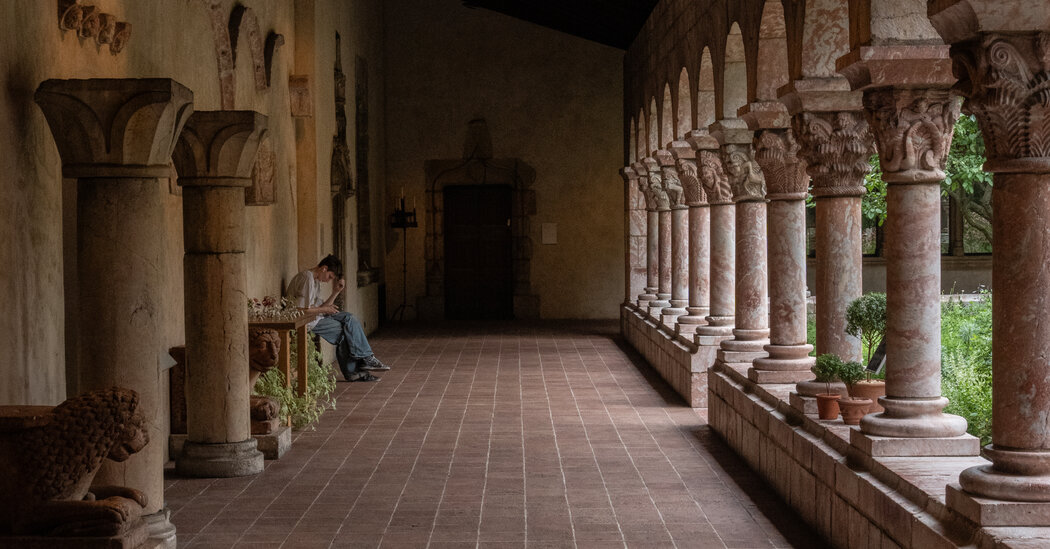
What about museums? Dollar admission at the Metropolitan Museum of Art and the Cloisters for city residents, free Fridays at the Whitney, pay-what-you wish hours at the Guggenheim. “I used to be a member of all of them, and if I ever had more money I would go back to being a member, but right now I’m taking advantage of their generosity,” Ms. Perkins said.
Her wardrobe budget is minimalist like her fashion. “If it’s winter, I’m wearing black pants and a black shirt. And if it’s summer, I’m wearing a black dress.”
Even her splurges have been bargains. The cruise she took in Italy, using money she had saved by taking the toll-free Broadway Bridge instead of the Henry Hudson Bridge when she drove to Manhattan, was effectively free after she won $1,000 gambling on board.
The Middle Class Fantasy
“I really believe you can do almost anything if you research and plan,” Ms. Perkins said. “It’s the spontaneity that’s hard. And we as Americans are really spoiled.”
Looking back on her journey, Ms. Perkins has reached some conclusions that surprised her.
“Cancer saved my life,” she said. “The life that I was leading was exhausting because I was trying so hard to keep up with this fantasy of middle-classness.”
Now, she said, “I don’t care if I’m wearing last year’s shoes, I don’t need to go out every night to a Michelin-starred restaurant, because I go two times a year, and you know what, when you save up for it, it’s more joyful. Every single thing. Every little joy is a bigger joy. I can’t explain it. I took so much for granted when I had more money.”
Did she mention she’s working on another book?
“It’s called ‘La Vida Broka: How to Live Richly When You’re Dirt Poor,’” Ms. Perkins said. “Just buy the book, because it’s all going to be in there.”
We are talking to New Yorkers about how they spend, splurge and save.
Show more