Three and a half decades ago, arguably the two most famous females in the Upper Valley were living in Orford. One was a woman who had served in the New Hampshire Legislature and later ran spirited but unsuccessful campaigns for governor and then Congress.
The other was an ornery cow named Tullando Royalty Maxima that had blown the doors off milk production records and had the dairy industry across the United States and Canada agog over her amazing performance and itching to get in on her genetic prowess.
And the Orford community was so excited about the cow’s spreading fame that people got together and put on a fest that drew in hundreds for barbecue, free ice cream, wagon rides, barn tours, speeches by dignitaries, a square dance and even a softball game to warm things up.
The woman was Deborah “Arnie” Arnesen, now a nationally syndicated radio political commentator who fondly recalls the community spirit that pulled Orford together to celebrate the achievements of the lowly bovine residing in their midst.
“We all felt so proud. That time was the essence of what could be done by our neighbors. Maxima represented that, showing what they can accomplish,” Arnesen said recently. “Times like that are like Velcro, holding a community together.”
The neighbors she was referring to were the Tullars, the multigenerational family that still operates Tullando Farm, the 500-acre landmark on Route 10 just south of Orford Village. It began as a dairy operation in 1956 and over the years since has consistently ranked at the top of the industry ratings for productivity. The Tullars have nailed the basics of excelling in dairy farming by conquering the challenges of feeding, breeding and herd management.
So, who was this Maxima? She was a cow that just wanted to eat, lie in her favorite stall, chew her cud and be ready to deliver copious volumes at milking time. She didn’t like being fussed over and balked when someone tried to put a halter on her and walk her out to be shown off. Growing up, there was little about her that foretold her mighty performance. She was big-framed, but not a freak of nature.
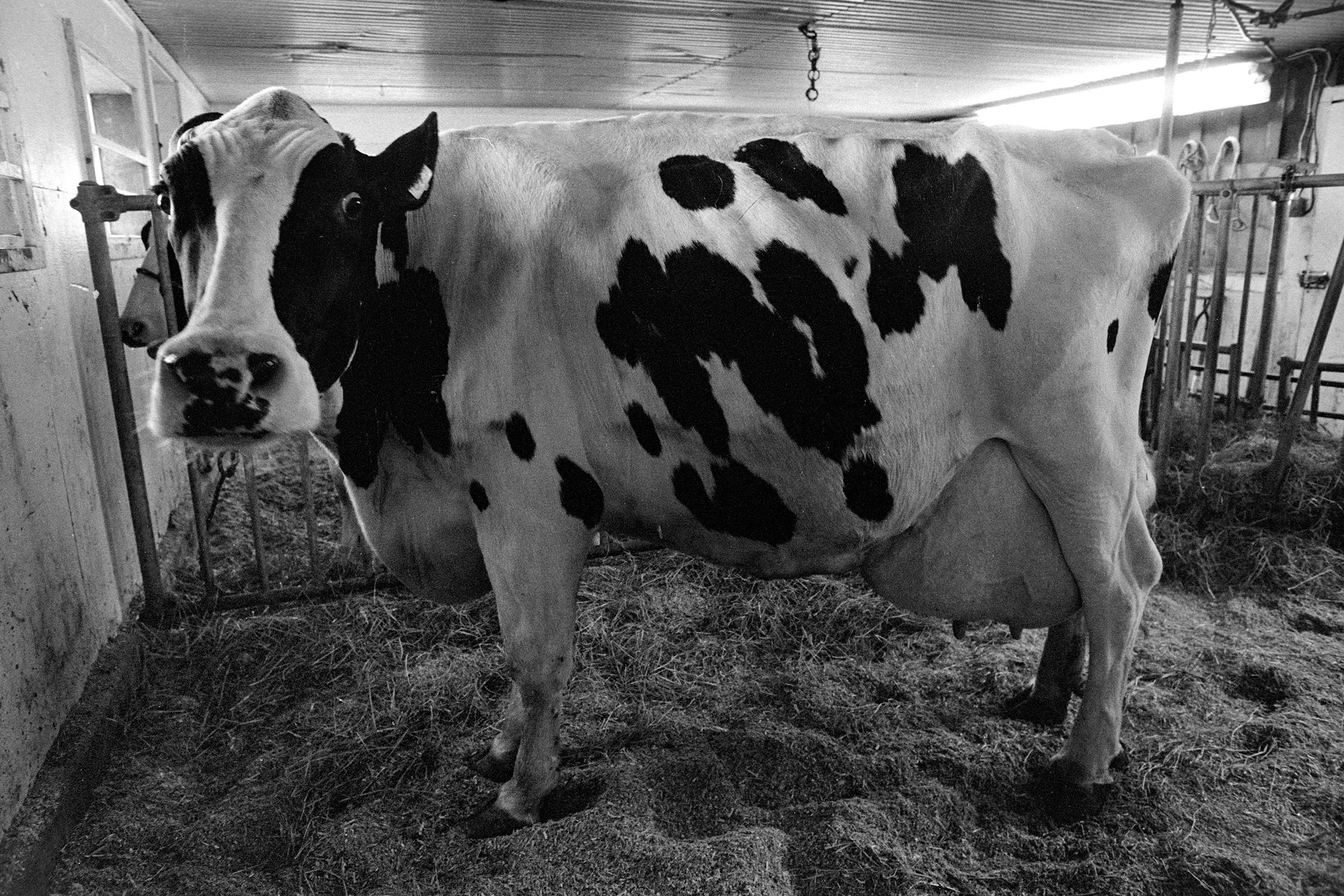
At Tullando Farm in Orford, N.H., on April 8, 1992, Maxima takes a look outside the barn window. GEOFF HANSEN / Valley News Credit: Valley News
In early 1993, she broke milk production records that had stood for 18 years. Milk output at the farm level is denominated in pounds. When the official statistics were tallied up, in 365 days she had made 58,923 pounds of milk. In consumer terms, that’s about 6,900 gallons.
She was 6 years old by then, but leading up to her record performance there was scant inkling of what was coming. She had no fancy pedigree; her genetics were on the same level as those of her herdmates; and her initial years of production weren’t extraordinary. But she stood out for her behavior.
She had a favorite stall in which to lie, and if she found another cow had taken it over, she’d promptly root that offender out of the way. Once she had occupied the space, she turned around so she could recline, having a view of goings on elsewhere around the barn. She had her routines down flat and those working amid the animals soon learned not to try to mess with the lady.
Records are made to be broken
Following her record-breaking achievement, there were high hopes that her DNA would be transmitted on a new generation of milkers. The Tullars tried at-the-time cutting-edge procedures to harvest eggs from her ovaries to be fertilized by sperm from bulls with the right pedigrees. But in the end, the efforts netted only three female daughters, and none went on to perform anywhere close to their mother in making milk.
As is so often the case, records are made to be broken, and Maxima’s would eventually be surpassed again and again, higher and higher. One cow has recently hit a mark of over 88,000 pounds. Productivity throughout the dairy sector is driven by advances in science, especially in the area of genomics, both in animals and plants. The genetic base for dairy cattle keeps rising, just as it is for corn and other feed crops. And there’s ever-expanding knowledge about how the animals metabolize the feeds they are given.
The continual advances in cow production have led to jests about how eventually there’ll be only one cow needed to make all the milk New England consumers require. In Maxima’s day, a decent average Holstein cow would produce around 18,000 pounds in a year’s work; a comparable animal today would be in the 26,000-pound-plus range.
How those Orford folks got the celebration of the Tullando super cow going is a part of the town’s own rich history. The idea arose out of the mud season in spring 1993.
“It started around town meeting time,” fest organizer Marcia Knapp said back then. “You know, school board meetings, budgets, tempers flaring, and then we had a big snowstorm and things looked very discouraging.” She talked with neighbor Tom Trunzo about the situation, and they both had the same reaction after reading a news story about Maxima breaking the world’s milk production record.
“We wanted to cut it out and send it to relatives and say good things happen in Orford,” she told an interviewer. Knapp and her 4-year-old son approached the Tullar family about having a party for their great cow. The family said it would be great, and they told Knapp about how in the old days the community was more close-knit. A party for Maxima would be a good way to get people back together.
The Tullars also noted how they had gotten scores of inquiries and plaudits from all over North America about Maxima, but not many people in Orford knew much about her. A committee was formed and it set to work planning the event. Schoolkids had a contest to name the revelry, and the winning entry was “Maxima’s Milky Way.”
Vivid memories
People around Orford today still have vivid memories of how the show went down. They’ll talk of the elaborate floral garland that Cottonstone Farm, a local flower and vegetable enterprise, fashioned to be draped around Maxima’s neck. But the grand lady would have none of it, as such stuff just wasn’t her thing. So, the flowery necklace was placed on a large cutout of the cow out on the farm’s lawn.
Maxima never got any kind of special diet on the path to her stellar production record. She ate the same mix of corn and grass as her herdmates, which numbered about 160 animals at the time. Tullando had shifted the daily milk schedule from the traditional two times to three, or 3X in the trade. That resulted in gains for both Maxima and the rest of the herd and kept the farm at the forefront of the U.S. dairy sector.
The cow had some health issues along the way, but pulled through, thanks to excellent veterinary care and the skill of the Tullar family team. George and Barbara Tullar had founded the dairy operation in 1956; by the early 1990s, a new generation of Tullars was at the helm, and soon there was yet another layer of Tullar men and women involved.
A great change would come to Tullando in 2014, when eight robotic milking machines were installed, new barn facilities came on line and the farm geared up to handle between 450 and 500 milking cows. It required significant shifts in many aspects of the operation, but the greatest benefit was elimination of the labor needed to harvest the milk from the cows every eight hours. Laser beams, camera-like sensors and computer-guided mechanical arms took over the tedious work.
It was an event akin to a barnraising when a band of Upper Valley farmers turned out in a mid-July week to help get the Tullando cows acclimated to the new technology. Robotic milking machines would prove to be good for the cows, too, as it allowed them to choose when they wanted to be milked, thereby easing the discomfort and stress presented by engorgement of their udders.
Rendy Tullar, the lead manager of the farm, says the operational philosophy is not to try to bust per-cow production records but to maintain a sweet spot where all cows can produce at their genetic potential without being pushed hard with special diets and individualized handling.
It’s an approach old Maxima surely would have appreciated. And it still works today as Tullando consistently sits in the upper reaches of the industry’s charts for herd production averages.
Today, Rendy Tullar speaks reverently about Maxima, and of how the people of Orford came out to celebrate her achievement.
“She was just a cow, totally herself. And it was great fun to have the town be in on it,” he says.
Steve Taylor of Meriden is a longtime Valley News contributor. He was among the Upper Valley farmers helping to acquaint the Tullando herd with robotic milkers in July 2014.