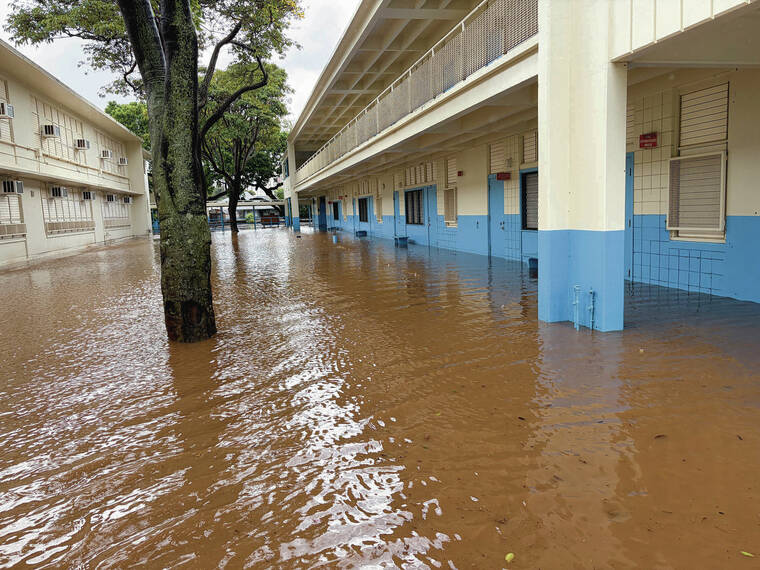
Hokulani Elementary School teachers had to carry some students out as floodwaters surged across the campus on March 23, with some younger children crying and frozen in fear.
“There’s definitely some trauma,” Hokulani Elementary School Principal Ervin Pasalo said.
About 270 students were
displaced when muddy water from nearby Manoa Stream surged across the campus during school hours that afternoon.
With 12 of its 18 classrooms heavily damaged, the campus has been forced to close for the remainder of the school year.
Students will resume in-person learning Thursday at nearby campuses while repairs are underway. Pre-K through second grade students will attend Palolo Elementary School, while third through fifth graders will go to Aliiolani Elementary School. All students will remain with their original teachers.
Pasalo said Tuesday that Hokulani teachers will focus on students’ emotional well-being when they return, noting that a counselor will lead guidance lessons and that teachers
will hold off on academics for
at least the first day — and
possibly the first week — to help students adjust to their new campuses.
Don’t miss out on what’s happening!
Stay in touch with breaking news, as it happens, conveniently in your email inbox. It’s FREE!
“We want to make sure they feel safe and see familiar faces, even as they navigate a new environment and meet new classmates,” he said.
Pasalo said the flooding unfolded rapidly after Manoa Stream overflowed onto the Kamakini Street campus between the University of Hawaii at Manoa and Chaminade
University.
“It was kind of like any other rainy day,” Pasalo said. “What we didn’t know was that the stream behind our school was about to overflow.”
Around 1:45 p.m., a neighbor alerted staff that the stream was spilling over its banks. Within minutes, floodwater had submerged vehicles in the back parking lot and pushed toward
campus buildings.
“By the time we got to the back, the cars were already almost halfway underwater,” Pasalo said.
The water quickly wrapped around the campus, entering classrooms, the cafeteria and the main office as students were preparing for dismissal.
Kindergarten and first grade students were already being released, while staff rushed to evacuate others.
“We had to tell them, ‘pack up your things, we’re going,’” Pasalo said. “Within minutes, classrooms in the back building had almost
2 feet of water.”
Students were moved to higher, drier areas such as the cafeteria stage while parents were urged to pick them up immediately. Although there were initial concerns that cars could get flooded or stalled, all students were safely picked up by their parents.
Despite the speed of the flooding, there was no strong current, allowing most students to walk through the water safely. No injuries were reported.
Emergency responders were limited in their ability to access the campus. Pasalo said he called 911, but fire crews could not reach the school. A police officer assisted with traffic control.
The floodwaters receded almost as quickly as they arrived.
“By about 2:15 p.m., you wouldn’t even be able to tell there was a flood,” Pasalo said. “The only signs were water lines and mud everywhere.”
The damage, however, was extensive.
Mud covered classrooms, destroying books, rugs and supplies. Carpeting, tiles and wooden cabinets
will need to be replaced, and electronics such as Chromebooks may be unsalvageable.
The hardest-hit area was the campus’ C Building, which is closest to the stream.
Pasalo said the decision to close the campus for the rest of the school year was made with Department of Education leadership after determining that two-thirds of classrooms were unusable.
Rather than shifting to distance learning, school leaders opted to relocate students to maintain
in-person instruction.
“We wanted to keep things as normal as possible,” he said. “We want to make sure students know they’re safe before we transition back to learning.”
To support that transition, staff will rotate between both campuses so students continue seeing
familiar faces.
Repairs are expected to continue through the summer, with plans to reopen the campus at the start of the next school year. Cleanup crews already have begun initial restoration, with additional work planned to replace flooring, cabinetry and furniture.
Pasalo noted that flooding of this magnitude was unprecedented, even for longtime staff.
“I’ve had teachers here for over 30 years, and they said nothing like this has ever happened,” he said.
The damage at Hokulani is part of a broader pattern of storm impacts across the state.
According to DOE spokesperson Nanea Ching, Hawaii public schools statewide experienced widespread disruptions from the two Kona-low storm systems in March, including campus flooding, water intrusion, road access issues and temporary closures.
More than 500 work orders have been submitted for storm-related damage, with over 40 incidents serious enough to be referred for insurance review, Ching said. The most common issues included roof leaks, classroom flooding, mud and debris, and downed trees.
While most campuses saw minor to moderate damage, several sustained significant impacts requiring extended closures or
relocation.
As of Tuesday, total estimated damage across the state is about $170 million, covering repairs to facilities, instructional materials, IT infrastructure and other school resources.
On Oahu, schools on the North Shore — including Waialua Elementary, Waialua High and Intermediate and Haleiwa Elementary — temporarily closed due to flooding and a boil-water notice, before reopening on Friday.
In the Manoa area, both Noelani Elementary and Hokulani Elementary were hit by flash flooding. Noelani reopened as of Monday.
On Hawaii island, several campuses in Kona sustained significant flood damage, including Konawaena High School, Konawaena Middle School and Ke Kula O Ehunuikaimalino.
Floodwaters moved through classrooms, hallways and buildings, damaging flooring, furniture and instructional materials, while ceiling failures and standing water raised additional safety concerns, Ching said.
Konawaena High transitioned to distance learning for most students, while limited in-person instruction resumed Monday for vulnerable student populations including students with special needs and students in the Alternative Learning Program Support Services and Twilight
Program.
Konawaena Middle and Ehunuikaimalino remain closed through today for professional cleaning and safety clearance before reopening Thursday.
In Maui County, schools on Molokai and campuses including Hana High and Elementary School and Paia Elementary School closed briefly due to flooding and impassable roads but reopened March 25 after conditions improved.
Schools and facilities crews used spring break for cleanup, debris removal and safety checks, with custodial teams playing a key role in restoring classrooms and learning spaces, Ching said.