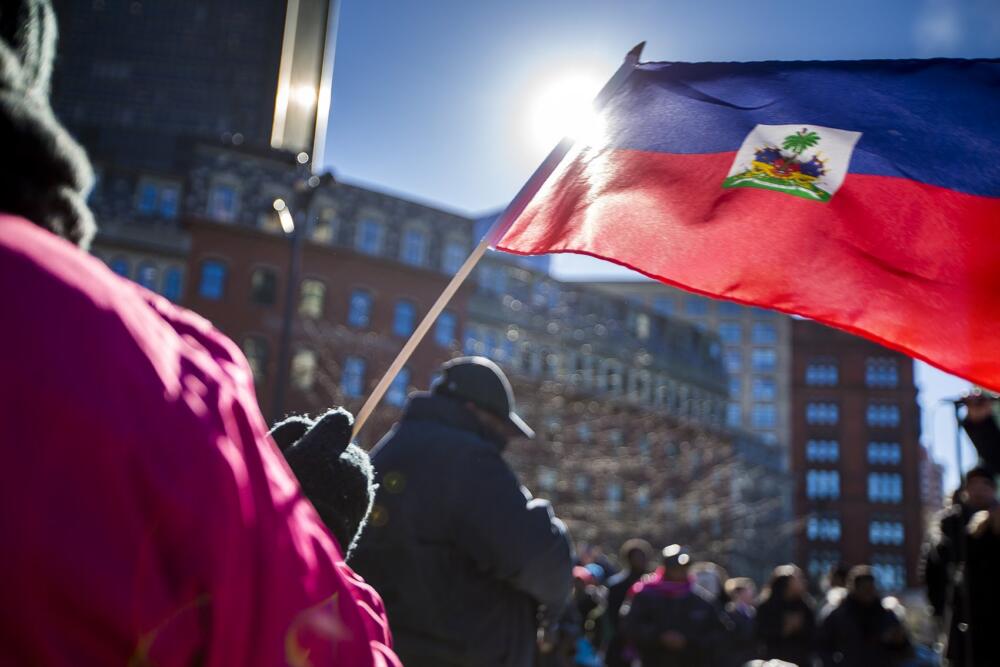
D. and his family came to the U.S. in 2010 after a catastrophic earthquake struck their home country of Haiti. Now 32 years old, D. has lived half his life here, through the Temporary Protected Status, or TPS, program.
He lives with his mother and brother in a home they recently bought south of Boston.
But after the Supreme Court helped clear the way Thursday for President Trump to revoke the program, D. said his family is considering what they’ll do if they lose legal status.
“We will have to make sure that we make the right decision at the end of the day,” he said after learning of the high court’s decision. “Whether we stay under the radar or go back to Haiti or go to a different country.”
We’re using only D.’s first initial because he fears being targeted by federal immigration agents.
He dreams of being a chef, and he has a certificate that allows him to work as a biotech lab assistant, though he’s struggled to find a job recently. He said it’s because employers are hesitant to hire someone who might lose work authorization.
D. is applying for a green card, and remains hopeful his family will be allowed to stay in the U.S., whether that’s “because we have employment, or whether we stay because we go to school or we’re college graduates, or whether we stay because we also contribute to the community or the American economy.”
The Supreme Court in Washington. (Jacquelyn Martin/AP file)
Immigration attorney Ahilan Arulanantham, who is a professor at UCLA, argued the case before the Supreme Court. He said the new ruling is not likely to take effect for at least 32 days, and then a lower federal court will have to implement it. In the meantime, Arulanantham said, immigrant advocates across the country are weighing next steps.
In response to a question about further legal strategies, he said in a text message: “Nothing certain I’m afraid. The legal teams are exploring different avenues now, but they are narrow for sure.”
Former immigration judge Andrew Arthur expects litigation around TPS to drag out for months — potentially for up to a year and a half before all the legal issues are exhausted.
“I think that what you are going to see is immigrant advocates filing constitutional challenges,” said Arthur, who’s now an analyst at the Center for Immigration Studies, a group that advocates for stricter immigration laws.
Arthur recalls how this played out under the first Trump administration: The government tried to end Temporary Protected Status for Haitians, and the matter was tied up in the courts until Trump left office. The Biden administration extended the program, allowing a new generation of Haitians to apply because of fraught humanitarian conditions in the country.
In Trump’s second term, the fight started over again, as the administration took a hard line on many aspects of immigration.
“One of the things that advocates are going to try to do is to stretch it out as long as possible, as close to the 2028 election as possible, and hope that there is a new president and/or a new Congress,” Arthur said.
As litigation continues, advocates are worried about what will happen to the more than 330,000 Haitian TPS recipients across the country. Massachusetts is home to roughly 19,000 Haitians with temporary legal status, according to researchers at Princeton University who based their count on U.S. Census data.
Massachusetts Attorney General Andrea Campbell speaks at the State House Thursday after the Supreme Court announced their decision allowing the administration to revoke the Temporary Protected Status for thousands of Haitians and Syrians. (Robin Lubbock/WBUR)
Massachusetts Gov. Maura Healey and Attorney General Andrea Campbell decried the high court’s ruling on Thursday. The Healey administration said they are working with state agencies and community groups to support people affected.
Haitians aren’t the only immigrants with TPS in Massachusetts.
Thursday’s Supreme Court ruling doesn’t directly affect the program for Salvadorans with TPS, who Princeton researchers estimate number around 5,000 in Massachusetts, but recipient Jose Urias said he’s worried the government will soon terminate his status as well.
“You think you achieve the North American dream,” he said. “I do everything what they told me: Go to school, learn the language, assimilate the culture, and now, you know, you’re not welcome.”
Urias is 48 and has been in the U.S. since he was 16. He serves on the executive committee of the National TPS Alliance. The Malden resident said he’ll have to close up his construction business if he loses legal status.
“ It has to shut down, and the people who work with me, they have to be laid off,” he said.
Protesters and politicians stand on the steps of the State House at a rally following the Supreme Court’s decision Thursday. (Robin Lubbock/WBUR)
This week’s ruling sparked fears that U.S. Immigration and Customs Enforcement agents could round up scores of former TPS recipients once their status expires.
Brian Concannon, who heads the local nonprofit Institute for Justice and Democracy in Haiti, said ICE agents could easily target the Haitians because the government knows their addresses.
“So far, they have not been doing large-scale raids in Haitian neighborhoods, and I believe that’s because so many people have TPS that that’s just not a target-rich environment,” Concannon said. “But once TPS is gone, then I think you’re going to see more large-scale roundups of people in Haitian communities.”
Even so, Concannon said, it’s hard to imagine people voluntarily returning to Haiti.
Given the ongoing violence in Haiti, D. — the Haitian man living south of Boston — said he equates returning to his native country with a “death sentence.”
Staying in the U.S. without TPS would mean he loses his work authorization.
“How long are we going to be able to stay under the radar?” he said. “And if we do, what are we going to be doing? Because we won’t be able to work, we won’t be able to pay our bills, we won’t be able to pay rent.”
Concannon said he expects the majority of Haitians who had TPS will try to stay in the U.S. without legal status, though they’ll lose healthcare, and be forced to work under the table.
Another option would be to try and gain entrance into a third country. But according to Concannon, that won’t be easy: “It’s very hard for Haitians to get into other countries and so that’s not going to be a choice for many of them.”
Also a long shot, some Haitians — like D. — might try to pursue other ways to gain legal status in the U.S.