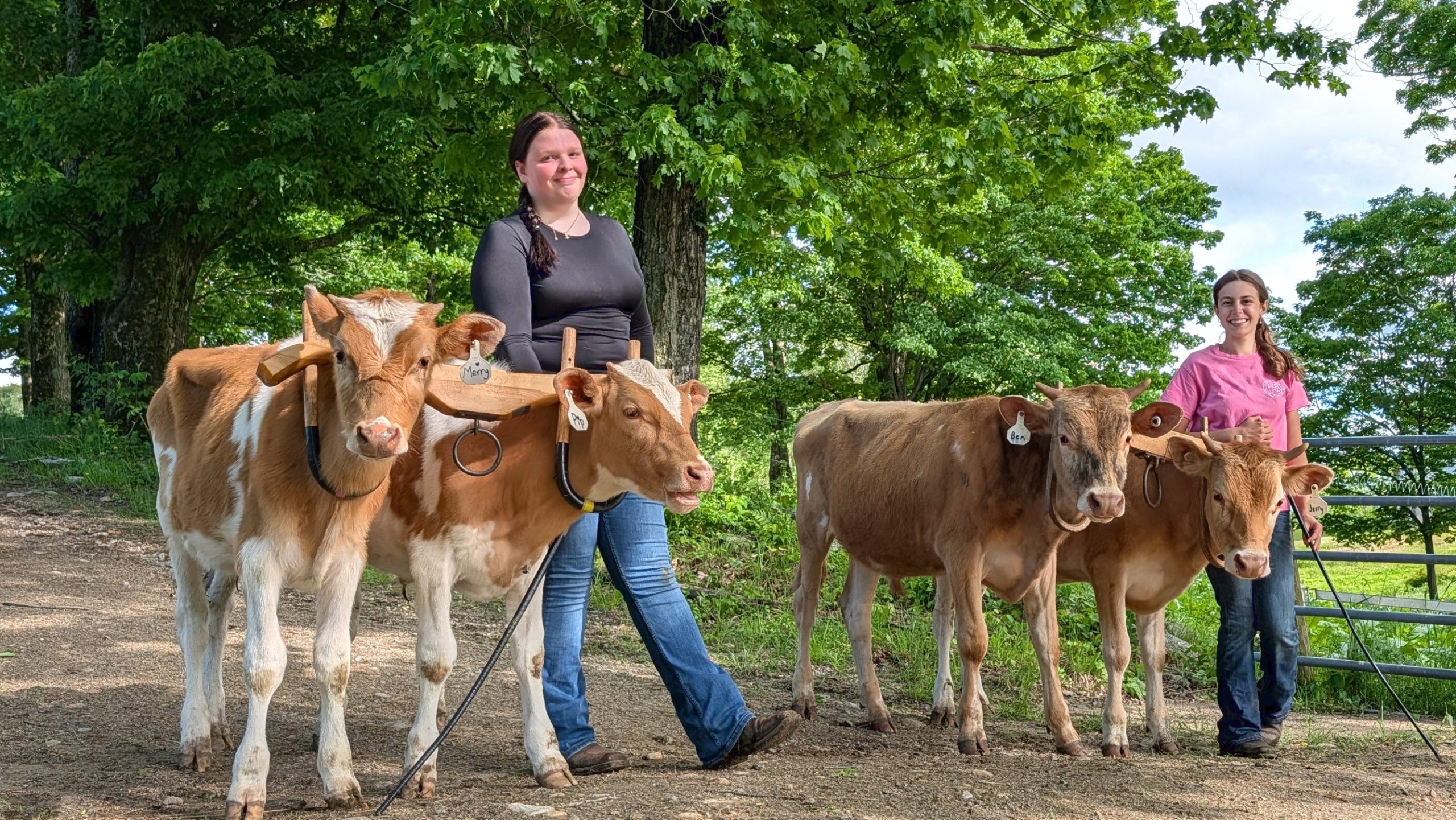
“What type of cow is that?” asked Jane, a visitor to Miles Smith Farm, pointing to Merry. When I told her Merry was a dairy calf, Jane’s follow-up stopped me cold: “When will you start milking her?” Where to begin? For starters, Merry is a he — a steer. Jane’s question, though, revealed a common and charming misconception: Cows simply fill up with milk on their own, like vending machines restocked overnight.
If only things were that simple. A cow produces milk for one reason: to feed her calf. She doesn’t make it for your latte, grilled cheese sandwich, or ice cream cone. Just as a human mother produces milk for her baby, a cow does the same for hers.
Understanding this natural process helps explain modern dairying. Dairy cows, like those black-and-white Holsteins, are the product of generations of selective breeding aimed at one goal: more milk, and lots of it. Soon after a calf is born, it’s separated and bottle-fed formula. The cow is then milked twice daily, and that milk is consumed by non-vegan humans in many delicious forms.
These two pairs of dairy-born calves are learning the commands of working steers under 4-H teamsters Molly Potter and Rose DeFreitas, who are training them to pull as yoked teams. They’ll put their training to the test this summer at New Hampshire county fairs. Credit: CAROL SOULE / For the Monitor
The realities of dairy farming can seem harsh. Dairy calves like Merry are separated from their mothers within days or even hours of birth. This happens for a reason: A calf left in the pasture risks being trampled when the herd rushes in at milking time. (Cows, it turns out, are very motivated employees.)
There are also key health factors. Dairy cattle produce so much milk that even twins or triplets couldn’t drink it all. If the udder isn’t fully emptied, a cow can develop mastitis, a painful, potentially fatal infection. Conversely, a calf with unlimited access to this milk will overindulge and develop scours, a dangerous diarrhea. Calves drink more than they should — something I understand, having faced a breakfast buffet or two.
Faced with these concerns, farms find different approaches. Smaller dairies often split the difference, letting the calf nurse once a day and milking the cow the other time. Large commercial operations separate cow and calf right after birth. Male calves are usually raised for veal or beef — but Merry is on a different path.
Merry and his brother, Pippen, were born at Huckins Farm, a commercial dairy in New Hampton, N.H. I bought them to train as a yoked team. Our 4-H member, Molly Potter, visits weekly to teach voice and body commands. This summer, Molly and her team will compete at county fairs — proving a dairy-born steer can be more than dinner.
Carole is co-owner of Miles Smith Farm (www.milessmithfarm.com) at Loudon, N.H. She can be reached at carole@cow-coach.com. Carole Soule is co-owner of Miles Smith Farm, in Loudon, N.H., where you can have an Ultimate Cow Experience and sit on gentle giant, Scottish Highland Curious Bleu.