“Ask him,” Todd Ortego prompted.
Ask him what?
“Ask Floyd about the time he played the wrong record,” he said.
Ortego is already laughing on this August afternoon visit with Floyd Soileau as Soileau prepares to tell the story of how he started out as a disc jockey at KVPI-AM in his hometown of Ville Platte before opening a record shop in 1956.
Floyd’s Record Shop’s museum displays photos, awards and memorabilia from the Louisiana music artists whose music was produced by the shop’s owner, Floyd Soileau.
STAFF PHOTO BY ROBIN MILLER
The shop eventually made the now 87-year-old a national figure in the music world. It’s where he produced recordings of Louisiana artists, some of whom made it into Billboard magazine’s top 20. But it was a wrong record on the turntable at KVPI that set him on the recording path.
Those were the days before vinyl gave way to CDs, which were finally overtaken by digital formats — the days when cover art was as important to the album as the music itself.
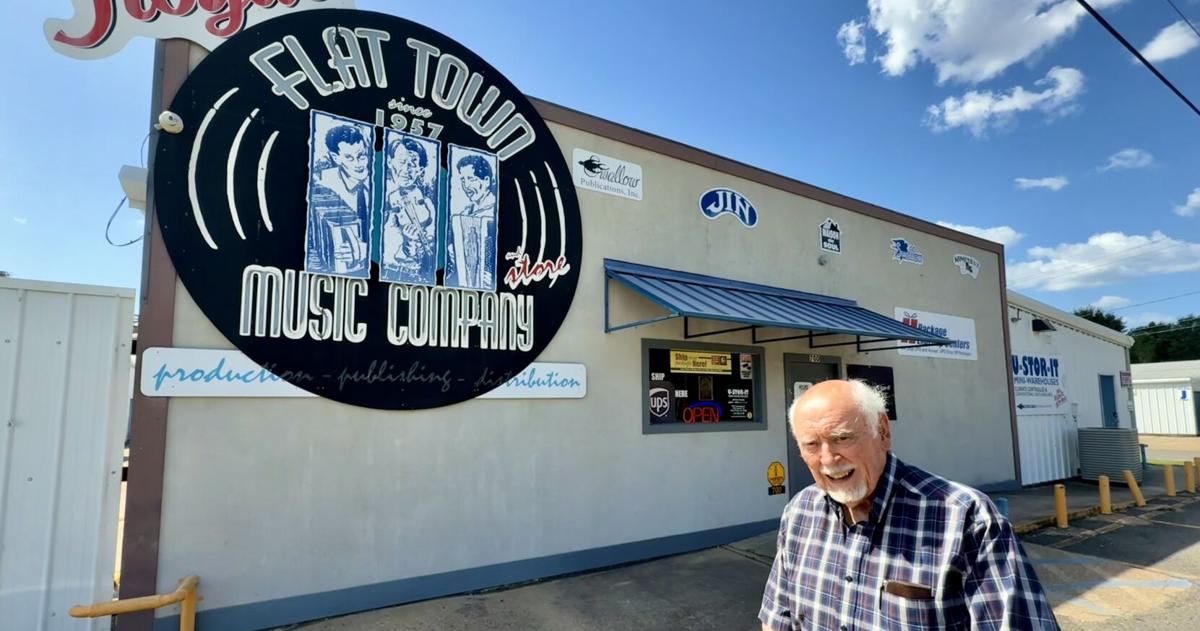
Soileau began selling these albums, along with the single 45s, out of his Ville Platte shop in 1956, calling it Floyd’s Record Shop. Today, the shop stands among a collection of storage units at 700 Chataignier St. in the little St. Landry Parish town. Floyd’s is stocked with CDs, though vinyl is still available.
A door in the back leads to the shop’s museum that’s filled with memorabilia from decades of Louisiana music history.
Floyd Soileau, owner of Floyd’s Record Shop in Ville Platte, sits in front of a photo of himself from his younger days in the shop’s museum.
STAFF PHOTO BY ROBIN MILLER
Christmas in July
Ortego urges Soileau from the opposite side of the museum’s conference table to tell the DJ story. Ortego loves the story, because he knows a bit about disc jockeying. He started out working in the shop, then left to become a disc jockey at KBON 101.1-FM in Eunice.
So Soileau relents, recalling the station’s owner who hired him right out of high school because Soileau could deliver the news breaks in French, the everyday language of the station’s rural listeners.
A walk through the museum at Floyd’s Record Shop in Ville Platte, Louisiana. The museum features photos, awards, gold records and other memorabilia from artists whose records were produced by record shop owner Floyd Soileau in his Flat Town Music Co. studio. Staff video by Robin Miller
The owner also gave Soileau permission to open a record shop in the room next to the studio. Soileau borrowed $300 from his parents, visited a Baronne Street record distributor in New Orleans and returned with $240 worth of records and a $60 phonograph on which to play them. One Saturday, while manning the studio by himself, a couple came in to look at records.
Soileau grabbed a random record, placed it on the studio’s turntable and stepped into his little shop to help the customers.
An album of Cajun hits on the Swallow record label produced by Flat Town Music Co. in Floyd’s Record Shop in Ville Platte. Soileau’s name for the record company, Flat Town, is the English translation for Ville Platte.
STAFF PHOTO BY ROBIN MILLER
“As soon as I could get the news done, I grabbed a 15-minute program and put it on the turntable,” Soileau said. “Then I went out there and started selling records.”
It wasn’t long before the station’s owner stormed through the door.
“I said, ‘Oh my God, what did I do now?'” Soileau said. “He said, ‘What did you do now? You played a Christmas transcription in the middle of July, that’s what you did.'”
Ortego has heard the story a million times, but he still doubles over in laughter. His mentor wasn’t fired that day, but the mess-up was a sign.
A new direction and self-education
At that moment, Soileau knew that his life’s purpose wasn’t playing records but selling them. So came the birth of Floyd’s Record Shop, where he would soon discover that Cajun music recordings were in short supply.
Floyd Soileau stands in the shop portion of Floyd’s Record Shop, which he has owned and operated since 1956. The shop originally sold vinyl records. Now it’s stocked mostly with CDs.
STAFF PHOTO BY ROBIN MILLER
Not that there weren’t any Cajun recordings — there were — but previous producers of the genre were fading. In 1957, Soileau founded the Flat Town Music Co. (the English translation for Ville Platte) next to the radio station.
Then he partnered with Mamou nightclub and jukebox business owner Ed Manual to record musicians Milton Molitor and Austin Pitre performing “Manuel Bar Waltz” and “Midway Two-Step.” The business partners named their label Big Mamou.
“I taught myself how to produce records,” Soileau said. “I took everything I learned in the radio station and applied it to the recording studio.”
His self-education proved successful. Jukeboxes were the hitmakers in 1950s south Louisiana, because all of the nightclubs and restaurants stocked them, and the Big Mamou label had a hit with “Manuel Bar Waltz.”
The gold 45 record for Rockin’ Sidney’s 1985 single, ‘My Toot Toot,’ is on exhibit in the museum section of Floyd’s Record Shop in Ville Platte. Floyd Soileau produced the Grammy Award-winning record on his Maison Soul label at Flat Town Music Co.
STAFF PHOTO BY ROBIN MILLER
Which prompted other Cajun musicians to approach Soileau. By then, he’d created his own label, Vee Pee — for Ville Platte — then dissolved it in 1958 to establish the Swallow label for Cajun recordings and Jin for swamp pop.
“Vee Pee just didn’t stand too good for me, so I said, ‘Well, I’m gonna call it Swallow, because that’s my last name, but I spelled it like the bird,” Soileau said. “After I recorded my first record on that label, I was proud, and I showed it to my dad.”
His dad looked at the spelling and asked Soileau if he was ashamed of his last name.
“I said, ‘No, dad, but I’m thinking maybe, by luck, some day this record and this label are going to be far away from here,” Soileau said. “And they’ll be able to pronounce that label name.”
A Floyd Soileau-produced Warren Storm single is on display in the museum at Floyd’s Record Shop in Ville Platte.
STAFF PHOTO BY ROBIN MILLER
As for Jin, Soileau chose the name to impress a young lady named Jinver Ortego.
“I said, ‘I need to make some points here,’ and it worked,” he said, laughing. “She became my wife.”
Attracting music legends
The hits came rolling in, including Rod Bernard’s 1958 “This Should Go on Forever” on the Jin label, which made the Billboard Top 20 and led to an “American Bandstand” appearance. Others included Jivin’ Gene Bourgeois’ 1959 “Breaking Up is Hard to Do,” Johnnie Allan’s 1959 “Lonely Days and Lonely Nights” and Tommy McLain’s 1966 “Sweet Dreams.”
The Swallow label attracted such Cajun musicians as Dewey Balfa and The Balfa Brothers, Nathan Abshire, Hadley Castille, D.L. Menard and Wayne Toups.
Records recorded on the Jin label at Floyd Soileau’s Flat Town Music Co. are on display in the museum at Floyd’s Record Shop in Ville Platte.
STAFF PHOTO BY ROBIN MILLER
Framed photos of these musicians hang on Soileau’s museum wall complemented by display cases exhibiting their records and awards, including a framed copy of McLain’s gold 45 single of “Sweet Dreams,” which Soileau enhanced with an echo in the studio.
By 1964, Soileau moved his shop and recording studio to a bigger space at 238 Main St. in Ville Platte, where a little song by Lebeau native Sidney Joseph Simien, “My Toot Toot,” became an international hit. Most music fans know him as Rockin’ Sidney.
“Sidney had been recording some stuff on his own at home, and he brought some tapes to me,” Soileau said. “We cut an album, and there were two songs on it that were doing fine on the jukeboxes, but there was another that was really getting attention.”
“My Toot Toot” had a zydeco beat, and though listeners were loving it, it was Simien’s weakest recording. The singer told Soileau that the song had been in his composition book for 10 years, and he’d recorded it on the fly.
A photo of Rockin’ Sidney’s hit, ‘My Toot Toot,’ is on exhibit in the museum at Floyd’s Record Shop in Ville Platte. Shop owner Floyd Soileau produced the record in his Flat Town Music Co.
STAFF PHOTO BY ROBIN MILLER
An international hit
Soileau brought the musician back in the studio and re-recorded it. That was in 1985. The song skyrocketed to a gold record, earned Simien a Grammy Award and led to an international audience.
Back in Ville Platte, Soileau established Floyd’s Wholesale Distribution, Inc., to distribute his Cajun and swamp pop records, along with other labels, to small record shops throughout the region. And he wasn’t limiting himself to selling records. He also sold the Hitachi Rice Cooker out of his shop after a test-run by his wife.
Sales were so high that the Hitachi heating division president paid Soileau a visit.
Local indie musicians and labels still have their CDs wholesale distributed to music retailers throughout the U.S. by Flat Town Music Company today, but Soileau is trying to take it easy.
“He takes a nap every afternoon now,” Ortego said.
His wife passed away in 2021, and he hopes to make it to his birthday in November.
“My dad made it to 88, and if I make it, I’ll be 88,” he said.
At the record shop, Soileau’s iPhone rings. The name on the screen is swamp pop hitmaker Jivin’ Gene.
“Sorry, I have to take this,” he says.
The nap might have to wait.