by Brenna Witchey, Oklahoma Watch
August 10, 2026
In June, police detained Damari Duhon the day after his 18th birthday. Months earlier, he was the youngest in a group of four that attempted a robbery during which the man they targeted, Chimei Zounon, died, investigators allege. Days after the arrests, prosecutors charged all four with murder.
Another teenager, Mariely Lopez, was 17 in 2021 when she was driving down U.S. 412 during a robbery and her accomplice and the man they were robbing started shooting at each other. The accomplice died, and a bullet hit Lopez’s leg. She crashed into a highway cable barrier, and police apprehended her.
In 2014, Aaron “Ayjay” McNulty, then a high school student, brought his mother the oxycodone pills she asked him for. Pills he said he got from kids at school. She died of an overdose, and police arrested McNulty.
Prosecutors charged all three teens with felony murder.
Amid pushback from human rights organizations, three states — California, Hawaii and Kentucky — have banned or restricted the application of the felony murder rule.
But in Oklahoma, a person can be charged with first-degree murder, regardless of intent, if someone dies during the commission or attempted commission of one of a list of specific felonies. Those include robbery with a dangerous weapon, first-degree burglary, kidnapping, forcible rape, first-degree arson and drug trafficking. A death during any other felony is second-degree murder.
First-degree murder in Oklahoma is punishable by life in prison, life without parole or death.
Nazgol Ghandnoosh, director of research at the Sentencing Project, said murder, in general, is an intentional homicide. But felony murder is different and really only exists in the United States.
“The idea is that if you’ve committed a serious felony, and someone gets killed over the course of that felony, you will be treated as if you committed murder, an intentional killing,” Ghandnoosh said.
Tim Laughlin, former executive director of the Oklahoma Indigent Defense System, said that when a child is charged with first-degree murder in Oklahoma, the child is treated as an adult if they are above a certain age.
That certain age is 13.
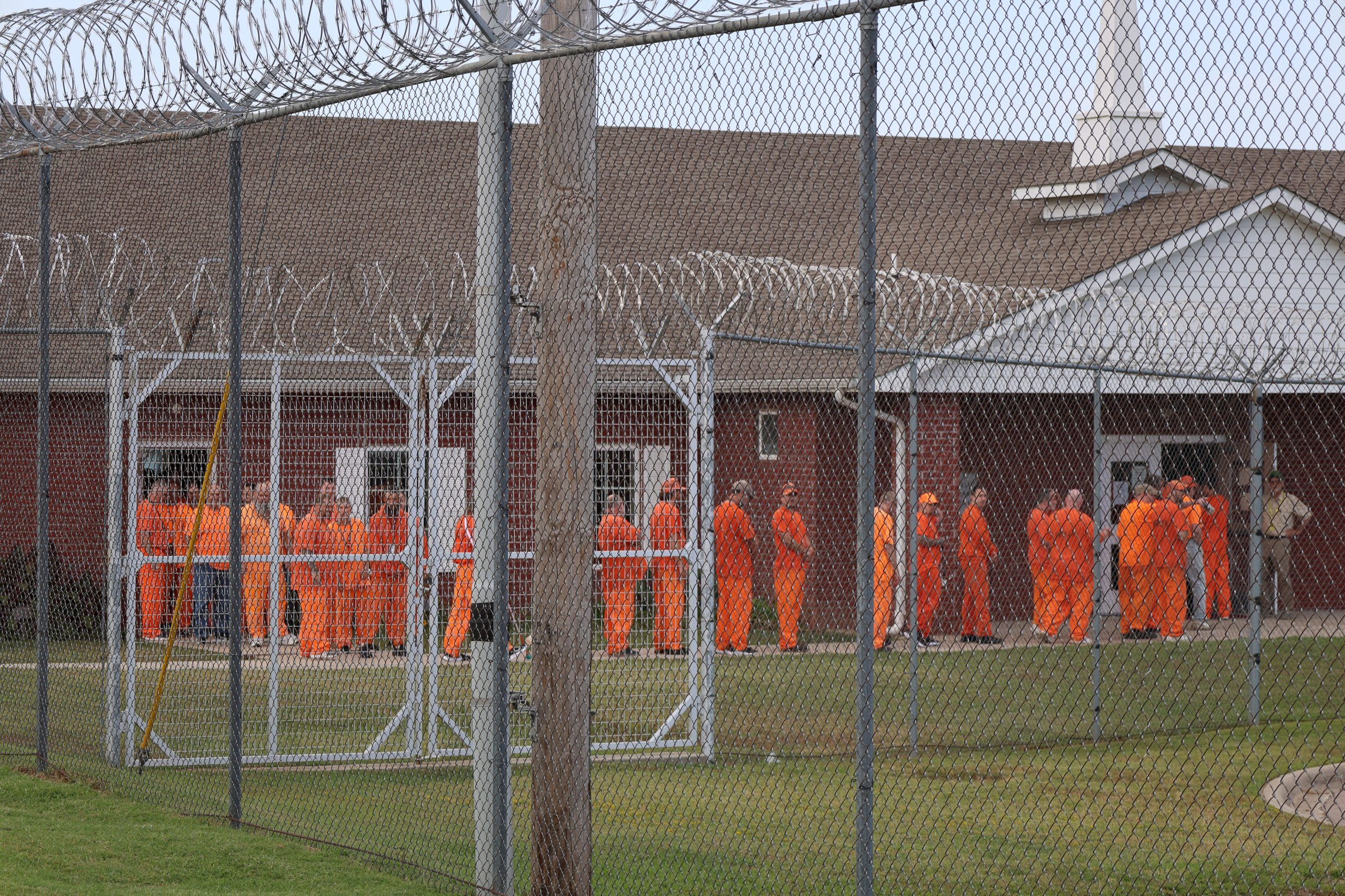
Children facing adult charges can be housed in adult facilities. In 2025, 31 people were serving Oklahoma prison sentences for crimes committed before they turned 18, according to the Oklahoma Department of Corrections.
Young people placed in adult facilities can face time in solitary confinement and an increased risk of physical and sexual violence, according to the nonprofit Human Rights for Kids. Being in adult prisons can limit the educational and rehabilitative programs children may need.
In Miller v. Alabama, the U.S. Supreme Court ruled in 2012 that mandatory life-without-parole sentences for minors convicted of murder violate the Eighth Amendment’s prohibition of cruel and unusual punishment. States may still impose the sentence at a judge’s discretion, and banning it outright is up to each state. Advocates, such as Ghandnoosh, contend the Supreme Court should abolish juvenile life-without-parole sentences.
“Most of the crimes that happen in our society are committed by people that are relatively young,” Ghandnoosh said. “There’s a lot of research beyond criminology, and within criminology, that shows that people in that age group of adolescents and emerging adults are very susceptible to peer pressure; they’re especially unlikely to be able to understand the consequences of their actions. There’s just a lot of neurological development and maturity that’s happening still at that age, and so for that reason laws like felony murder are not effective at deterring people from criminal activity.”
Former Attorney General Mike Hunter disagreed. In his experience, if people know the consequences of their crime, not all of them, but many, will hesitate and take the consequences of their actions into account.
Ultimately, Hunter said, the felony murder rule is another tool in a prosecutor’s toolbox. It’s optional and important. Determining when and where to apply it depends on who is most culpable.
“That’s the whole idea behind punishment,” he said. “Crimes have consequences”
Maria Kolar, a professor at Oklahoma City University of Law, said felony murder is easier to prove than intent to kill or actual malice.
While Kolar is critical of the felony murder rule, she noted that not all felony murder charges and convictions are disproportionate. She said that much of the critique of the felony murder rule comes from the rule’s potential for unfairness.
Hunter said that a part of a prosecutor’s job is considering the effect on victims’ families.
“We always want to worry about the offenders,” Rep. John George, R- Oklahoma City said. “A lot of people do, but the first priority is, we should be worried about the victims and their families.”
However, Laughlin said that in his time as an attorney, he didn’t see increasing the range of punishment up to and including death for felony murder as a form of justice for families.
“I don’t see it because people can be sentenced to life for lesser degrees of homicide, multiple lesser degrees of homicide,” Laughlin said. “All it really does is put life without parole and death on the table for someone who might have been the wheelman in a liquor store robbery gone bad.”
Ghandnoosh instead suggested holding people accountable for the crimes they actually commit.
When it comes to holding children accountable, Teresa Kominos, policy counsel for Human Rights for Kids, said no one is arguing that children who commit serious crimes shouldn’t be held accountable.
“We just want that accountability to be done in a trauma-informed way that takes into account their child status, that really looks at the full picture of what’s happening here,” Kominos said.
In its 2023 report, “Crimes Against Humanity,” Human Rights for Kids identified more than 32,000 adults who were still incarcerated for crimes they committed as children, about 3% of the total U.S. prison population.
In 2025, Human Rights for Kids published a different report, “The Childhood Trauma-to-Prison Pipeline: The Prosecution and Incarceration of Traumatized Children as Adults.” Its team distributed an adverse childhood experiences survey to people who were incarcerated for crimes they committed as children.
“All it really does is put life without parole and death on the table for someone who might have been the wheelman in a liquor store robbery gone bad.”
Tim Laughlin, former executive director, Oklahoma Indigent Defense System
Of the 2,220 respondents, 70% reported emotional and physical abuse before their sentencing, and 74% reported household substance abuse.
“Exposure to early childhood trauma has a significant impact on the way children’s brains develop,” Kominos said. “These teens, not only are they not developing on the same course as what you would expect a typical teen, but they have adverse impacts on their brain development, which send new neural pathways.”
Those new neural pathways cause adolescents to have different coping mechanisms to deal with stressors or trauma, Kominos said. That creates another layer of context when it comes to understanding the motivation behind adolescent crime.
Laughlin recalled the case of Aaron McNulty.
“That kid, he spent a long time at risk of life without parole or a life sentence because he did what his mother told him to do,” Laughlin said.
The charges against McNulty were eventually dropped.
In 2024, Oklahoma executed Emmanuel Littlejohn for his role in a 1992 convenience store robbery that led to the death of the store’s owner, Kenneth Meers. Littlejohn admitted taking part in the robbery but maintained until his execution that his accomplice fired the fatal shot. He was 20 at the time, older than the teenagers in these cases, but his death shows how far the felony murder rule can reach.
In Mariely Lopez’s case, prosecutors reduced the murder charge to second-degree, and a judge sentenced her to serve 18 years in prison.
Damari Duhon has been charged but not convicted in the death of Chimei Zounon, the man he and three others allegedly attempted to rob.
“We’re taking someone who is not fully developed; we shouldn’t be making permanent decisions about their character and saying you should be in jail for the rest of your life without the opportunity for parole,” Kominos said.
George said that while he thinks age should be taken into account during sentencing, at 16 and 17, people know right from wrong and they know murder is murder. Although he said he believes in thinking outside the box, he’s a bigger believer in justifiable punishment for criminals.
“Even though I’m pretty tough on crime, I do believe in second chances for people that want it and will work for it,” he said.
This fall, Sen. Dave Rader, R-Tulsa, will conduct an interim study on parole review for emerging adults convicted under the felony murder law. The study is slated to focus on people who were 25 or younger at the time of their felony murder charge, have a documented history of mental health issues, have served at least 20 years and did not personally commit the violent act that led to death.
While that may address the sentences people are already serving, it doesn’t address what got them there in the first place.
Senate Bill 2097 by Sen. Nikki Nice, D-Oklahoma City, proposed minimizing children’s encounters with judicial and carceral systems. The bill would have set the minimum age of adjudication at 12, meaning a child would have to be 12 or older to stand trial, and allowed for interventions such as mental health or substance abuse treatment. The bill died in committee this year.
“We did that interim study last year for me to understand it a lot more, and that shed a light in a different way of really seeing how our system impacts youth under the age of 12,” she said. “We know the school-to-prison pipeline starts in the third grade. Kids get in the system, and unfortunately, they’re never able to get out.”
Nice said the most alarming thing she learned is that there are children as young as 7 in the Oklahoma judicial system.
When those children are deemed unfit to stand trial, no existing legal remedy addresses what a child who may have committed a serious crime needs, Jill Mencke, youth policy analyst at the Oklahoma Policy Institute, said.
The Oklahoma Policy Institute estimated that about 15 children go through that process every year.
Mencke said childhood interaction with the legal system increases the likelihood of it in adulthood. Children, however, are especially amenable to rehabilitation like community-based services and therapy.
These are better suited to help children learn from their mistakes in the long-term, and reduce the likelihood of anti-social or criminal behavior as an adult, Mencke said. She added that children need more spaces to gather safely.
“When we see young people join a gang, it’s not because they have some inherent desire to commit crime; it’s because they’re looking for community, and a gang might be the path of least resistance,” Mencke said.
Nice suggested looking into what she called the missing middle for young people: a lack of resources, no support at home or experiences with poor educational environments.
“This is the land of opportunity,” Nice said. “And our young people should have that same option for them to thrive as we want them to do in Oklahoma.”
This <a target=”_blank” href=”https://oklahomawatch.org/2026/08/10/felony-murder-rule-in-oklahoma-can-send-children-to-jail-for-murders-they-didnt-personally-commit/”>article</a> first appeared on <a target=”_blank” href=”https://oklahomawatch.org”>Oklahoma Watch</a> and is republished here under a <a target=”_blank” href=”https://creativecommons.org/licenses/by-nd/4.0/”>Creative Commons Attribution-NoDerivatives 4.0 International License</a>.<img src=”https://i0.wp.com/oklahomawatch.org/wp-content/uploads/2019/10/okwatch-icon.png?fit=150%2C150&ssl=1″ style=”width:1em;height:1em;margin-left:10px;”>
<img id=”republication-tracker-tool-source” src=”https://oklahomawatch.org/?republication-pixel=true&post=761407&ga4=G-6G6K9FYSH8″ style=”width:1px;height:1px;”><script> PARSELY = { autotrack: false, onload: function() { PARSELY.beacon.trackPageView({ url: “https://oklahomawatch.org/2026/08/10/felony-murder-rule-in-oklahoma-can-send-children-to-jail-for-murders-they-didnt-personally-commit/”, urlref: window.location.href }); } } </script> <script id=”parsely-cfg” src=”//cdn.parsely.com/keys/oklahomawatch.org/p.js”></script>