Story by Janice Podsada. Photos by Olivia Vanni
WOODINVILLE — One fine Saturday morning — just right for lounging— I surprised my out-of-town visitor with tickets for a tour of the Brightwater Wastewater Treatment Plant.
“We’re going where?!!” she said.
Happily, I wasn’t the only one with my mind in the sewer.
Another dozen people joined us for a 90-minute trek through the bowels of Brightwater, a mostly underground facility near Woodinville that spans the length of three football fields. Among the curious, Adam Welman, who teaches ninth grade at Mountlake Terrace High School.
My wife gave me this tour as a birthday present,” Welman said.
Um. What did you do to deserve that?
“We’re bio-nerds,” explained his wife, Kate Macneale, an environmental scientist.
Once a month, the King County Wastewater Division offers free guided tours of the Snohomish County plant, which sits on 120 acres at the intersection of Highway 9 and Highway 522.
“Ever wonder what happens after you flush? Join us on a free walking tour… and see the journey of wastewater through the treatment process!”
Who can resist a plug like that?
King County launched the tours when Brightwater opened in 2011 to give visitors an up-close look at the operations, Kristin Covey, Brightwater’s program manager said. Every day the plant treats 20 million gallons of wastewater from south Snohomish and King counties — enough to fill 900 railroad cars.
“When people see the size of the plant and the technology it requires to get wastewater back to a state where it can be returned to the environment, it’s pretty eye-opening,” she said.
But sign up quickly — the tours fill up faster than a toilet tank. (For a deep dive, visit all three King County treatment plants: Brightwater, Seattle’s West Point and Renton’s South Point. Together, they treat 200 million gallons of wastewater a day.)
Since 2011, more than 10,000 people have visited Brightwater, and that’s not counting the 54,000 school children who’ve taken a tour or the hundreds of wedding guests.
Did you say wedding guests?
The sprawling campus also houses the Brightwater Center, a public events venue with a commercial-size kitchen, fireplace and seating for up to 230 people. And that makes it an ideal setting for couples in the flush of love.
Soon after it was built, plant officials talked up the location as the perfect place to get hitched. “Why not get married at a wastewater treatment plant? Lovely gardens, outdoor patios.”
Fifty-two couples can’t be wrong. That’s how many weddings have been held at Brightwater since 2014, Covey said.
LAKE STINKO
The tour kicks off at the Brightwater Center. From our guide, KayLani Siplin, we learn that until the early 1960s, the region’s wastewater was only partially treated. Twenty million gallons of pretty nasty stuff was dumped daily into Lake Washington.
Unsafe for bathing” signs dotted the shoreline, a far cry from the coveted waterfront properties — including Bill Gates’s 66,000‑square‑foot mega-mansion — that now hug the lake. Back then, algae blooms darkened the lake, reduced the oxygen levels and killed the fish.
Lake Washington became known as “Lake Stinko.”
A call to action ensued. In 1958, King County voters approved a plan to modernize the region’s sewer system. New treatment plants were built in Seattle and Renton, and by 1971, the lake was clear.
In 2002 King County proposed building a third treatment plant, which generated another big stink. Brightwater — its name was the endless butt of jokes — touched off a heated battle between King and Snohomish counties.
King County had the final say over where it would be built, and when officials revealed that the two finalists — the former Unocal site in Edmonds and the current Highway 9 site — were located in Snohomish County, Snoco residents cried foul.
No sanitation without representation!
When the Highway 9 site was chosen, Edmonds breathed a sigh of relief, but locals feared the worst. Back then, the property was home to a soup factory — yes, soup. “You really could smell it when they made French onion soup,” a tour mate piped up. “It was not good.” The neighbors’ reasoned that odors from a sewage plant could only be worse.
As a result, lawsuits bloomed like algae. In the end, King County paid Snohomish County $70 million to drop the litigation and approve the permits. The plant’s $1.89 billion price tag included a big chunk of money for construction of the Brightwater Center, outdoor trails and odor control.
SCREEN GRAB
The first step in the treatment process is taking out the trash. When wastewater enters the plant, it flows through a maze of steel screens designed to catch the crud we carelessly toss down the drain.
To illustrate, Siplin held up a Plexiglas box stuffed with some of that bounty — items that should never be flushed: Baby wipes — which contain microplastics — straws, candy wrappers, money, credit cards and other plasticky stuff that clog pipes, including cell phones.
The number of people who lose their phones while visiting a Porta-Potty is sad, Siplin said. When they’re pumped out, the contents end up in the wastewater system.
“We had one guy call to say that his Find My Phone app was showing his phone was in a pipe at the South Seattle treatment plant,” she said. “We told him: ‘You’re not getting it back — and you wouldn’t want it back.’”
Only four things should go down the drain or into the toilet: Poop, pee, toilet paper and puke.
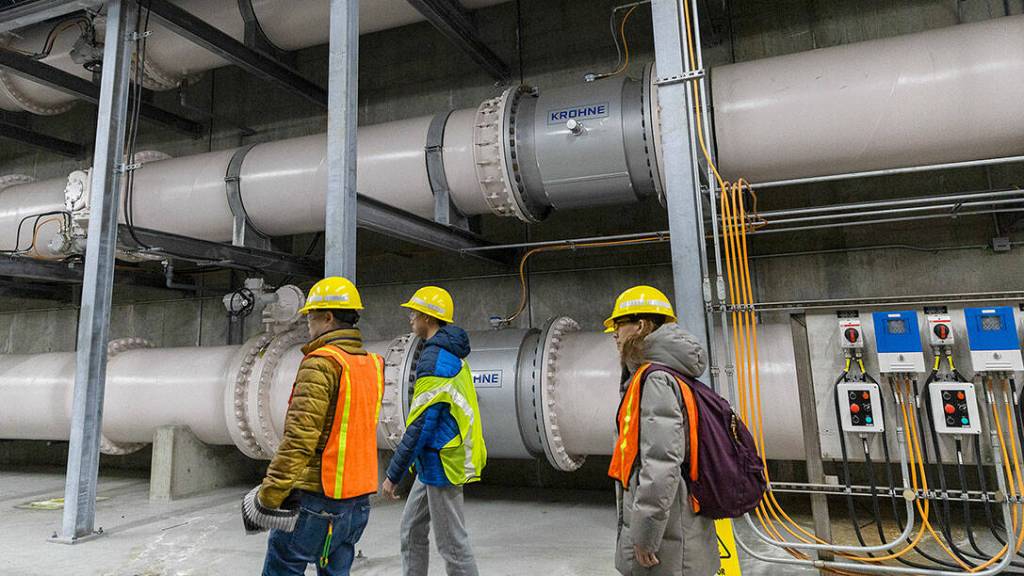
Armed with this information, we donned hard hats and orange safety vests and walked the short distance to the plant for an hour-long walking tour.
We descended a set of stairs into a subterranean corridor filled with giant pumps and pipes. Our first stop was a room filled with three silo-size tanks.
Step two is separating the water from the solids, which happens inside the tanks, known as digesters. Each one can hold up to 1.2 million gallons, the equivalent of two Olympic-size swimming pools. Trillions of microbes live, work and frolic inside their steel walls. They’ve got just one job: break down the biosolids.
Brightwater’s 50-some employees, a mix of operators, engineers and mechanics, monitor the system 24/7 to make sure its littlest workers are content. Toasty temperatures inside the tanks and an oxygen-free environment are key. “Happy microbes are busy microbes,” we’re told.
Wastewater spends about 12 hours inside the tank. Then it’s pumped out and routed through spaghetti-like filters that trap any lingering bacteria. Finally, the water is treated with a disinfectant and piped 13 miles to Point Wells, a Puget Sound outfall just north of the city of Shoreline.
On the other hand, the biosolids will spend 30 days in the digester. The resulting sludge is treated and turned into fertilizer, known as Loop. Loop trucks, and you can usually spot them on I-90, haul the fertilizer to Eastern Washington where it’s used to grow corn, wheat and fruit. Farmers love it! For proof, our guide holds up a photo of two wheat stalks — one kind of puny, the other sturdy and strong like Mr. Atlas.
Guess which one got the Loop fertilizer versus a chemical fertilizer? We’re cheered to learn that our poop does not go to waste!
The tour offers much more, but I’ll let you visit and find out. If wastewater isn’t your thing, there are classrooms, public art and three miles of woodland trails, open from dawn to dusk. And for the record, the plant doesn’t smell.
Kirstie Clinko, my house guest, was impressed with Brightwater’s sights and sounds, as well as our enthusiastic guide.
“Normally, I wouldn’t want to go to a sewage plant on a Saturday,” she said with a laugh. “But, it was like Wow — they are so wanting to share what they do!”
IF YOU GO
Brightwater Wastewater Treatment Plant
22505 Highway 9, Woodinville
Find a tour date: tinyurl.com/48kb9bc8
Book a wedding: tinyurl.com/3fynsjft
Janice Podsada is a freelance writer and former employee of the Daily Herald. She can be reached at jpod2024@gmail.com
Editor’s note: This story originally appeared in Sound & Summit magazine, The Daily Herald’s quarterly publication. Explore Snohomish and Island counties with each issue. Subscribe and receive four issues for $18. Call 425-339-3200 or go to soundsummitmagazine.com