Economic outlook shows continued growth, improving job market in Juneau
Published 1:30 pm Wednesday, September 30, 2026
The Juneau Economic Development Council (JEDC) has released its annual overview of the economy of Juneau and the Southeast Alaska region.
The 2026 Juneau and Southeast Alaska Economic Indicators and Outlook Report revealed new data that showed continued private-sector growth and rising earnings. Population decline and workforce availability still remain long-term challenges, but Juneau’s economy continues to generate jobs and income.
Last year’s data shows that average monthly employment increased by 31 jobs, or 0.2%, while private-sector employment grew by 1.2% with 154 new jobs — an all-time high mark. Traded industries, such as tourism, mining, and seafood processing, added 73 jobs in 2025, with mining employment growing by 27 jobs and tourism adding 47 jobs, bringing tourism employment to 99.9% of its 2019 pre-pandemic level.
“Tourism-related employment and earnings continued to grow,” JEDC stated. “Juneau’s leisure, hospitality, and transportation industries employed an average of 3,157 people in 2025, and total earnings in those industries reached $150.3 million.”
Inflation-adjusted total earnings in Juneau rose by $38.6 million to approximately $1.3 billion last year, a 3.1% increase, while inflation-adjusted private-sector earnings increased by 4.1% with $29.9 million.
While overall government employment declined by 110 jobs, government-sector earnings still increased by 1.6% with $8.6 million.
“Juneau’s economy continues to create jobs and generate opportunity, but the community’s long-term prosperity depends on having people here to fill those jobs, build careers, raise families, and sustain the services and institutions we rely on,” said Brian Holst, JEDC executive director.
“The data reinforce the need to focus on broader factors that shape whether people choose to build a life in Juneau like housing, childcare, healthcare, including services for seniors, education and career opportunities, amenities, and recreation.”
Juneau’s unemployment rate remained low at 3.4% last year and was 3.3% through July 2026, placing Juneau as one of the lowest unemployment rates in the state.
Gross business sales rose 11.2% in 2025 to approximately $3.82 billion, with strong metal prices playing an important role to the larger increase. New business applications also increased for a third consecutive year and reached a 20-year high, rising 21.6% from 2024 to 2025.
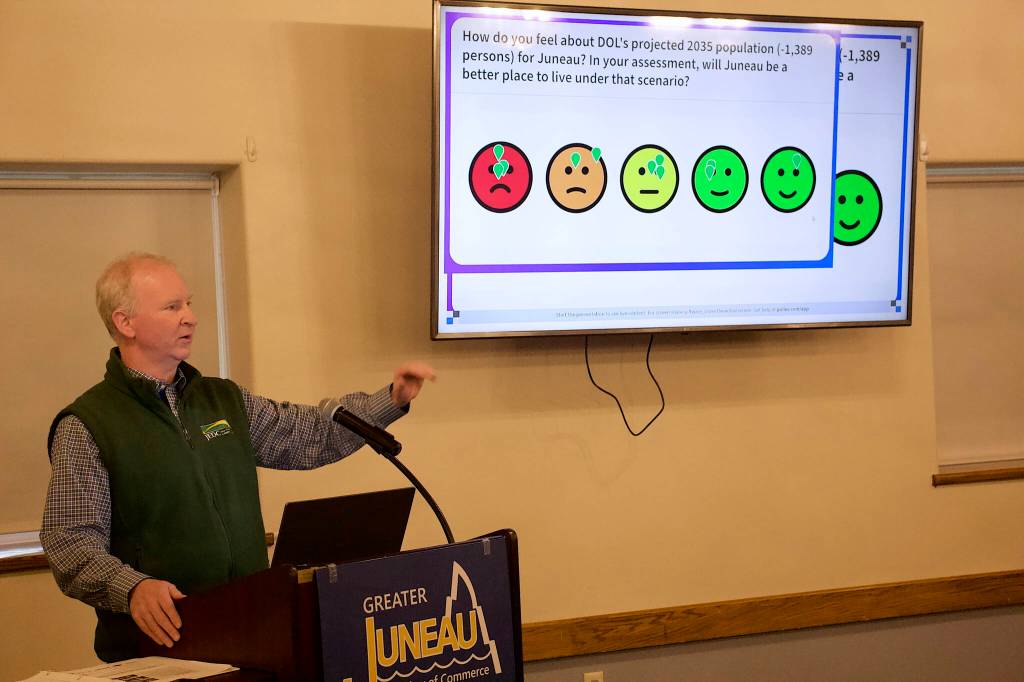
“The report underscores that economic growth alone does not resolve Juneau’s workforce challenge,” JEDC stated. “In 2025, Juneau’s population of residents age 20 to 39 declined 0.7%, while the number of residents age 60 and older increased 1.3%.”
Since 2015, Juneau has lost 16.4% of it residents under 20, 10.9% of residents age 20 to 39, and 18.3% of residents age 40 to 59. Over the same period, the number of residents age 60 and older grew 32.7%.
Housing remains a critical component of attracting and retaining residents, as Juneau’s median rental price increased 3.7% to $1,554 last year, while the community’s rental vacancy rate remained at 4%, which is below the 6 to 7% range identified in the report as an ideal level for a healthy rental market.
The median price of a single-family home was $550,000 in 2025.
“Creating the conditions for population stability and growth will require a sustained, community-wide response,” Holst said. “We need more young people and families to see a future in Juneau — that means continuing to expand housing options while also strengthening the services, opportunities, amenities, and sense of connection that make Juneau a place where people want to stay.”
JEDC works in collaboration with other organizations to implement initiatives to maintain, expand, and create jobs and economic opportunities.