Building an Egg-acy
When Douglas Osborne joined the University of Arkansas at Monticello in 2012, he had one goal in mind: to build a waterfowl program in a state that, despite its abundance of hunting opportunities, had no waterfowl research activities to speak of.
Today, with the new Snowden Waterfowl Center of Excellence up and running, UAM is graduating researchers who will help ensure the longevity of the birds not just in Arkansas but across the United States.
“My goal was to build a waterfowl program, and from the ground up, that’s what we’ve done,” he said. “We’ve finished 16 master’s students with master’s degrees, and they’re all out, doing waterfowl work all over the country in 10 different states. It’s been great. We’ve gotten involved with a lot of conservation partners and private landowners, helping them make better management decisions for their land.”
With a passion born from hunting ducks while growing up in Illinois, Osborne earned his doctorate at Southern Illinois University and completed postdoctorate research at the University of Tennessee before landing in Arkansas.
During his time at UAM, he has worked to understand the movement and distribution of ducks, as well as influences on the landscape that affect bird populations. Of particular importance is his work to understand how sanctuaries increase their numbers.
“A lot of people go in thinking that the refuge and the sanctuary on the refuge is killing our duck hunting and we can’t shoot any ducks because of the sanctuary,” he said. “Well, that’s not true. If that sanctuary weren’t there, there would be no ducks in that area. Those sanctuaries are absolutely critical.”
He added that by understanding how the birds use sanctuaries, he has been able to share his data with hunting clubs and land managers to encourage them to provide more sanctuaries or better optimize existing ones.
“I think what our program has really done a good job of is bridging the gap between the landowners and science, right, and the landowners and policy,” he said. “A lot of people don’t understand how hunting regulations are made and the process on it. For a long, long time, they were kept out of that circle. Nowadays, there’s so many more communication opportunities and educational opportunities for us to teach people about what the data says.”
His findings have even been used to guide policy decisions both at a state level and in Washington, D.C. — policy decisions that are more crucial than ever before.
The mallard population has declined nearly 50 percent over the past five years, Osborne said, adding that the main reason is the decline of the prairie potholes in the Dakotas and Canada, where the ducks nest. As ponds dry up and much of the land is converted for agricultural use, fewer ducks breed successfully, he said.
With limited ability to control the climate and, to some degree, agricultural conversion, Osborne said it is time to focus on what can be controlled — harvest numbers. While limiting hunting has not been shown to be impactful historically, Osborne said previous data was gathered when populations were much higher.
“I think we need to take a deep dive as a science community to understand population dynamics, the abundance of ducks that we have in the population and how it responds to modified harvest,” he said. “If we reduce the harvest a little bit, how impactful is it going to be?”
As a young generation of conservationists arrives equipped with new tools and technologies, it is important to think critically and be willing to experiment with new ideas, he said.
“We’re going to keep fighting from the policy standpoint to provide the data [landowners] need so maybe additional funding can come for the farmers to help them manage their lands,” he said. “We’re going to keep fighting for trying to increase and understand the mechanisms that are impacting ducks so we can try to increase their populations again, and I’m going to keep on putting all my energy into students so we can have waterfowl managers all over the country.”
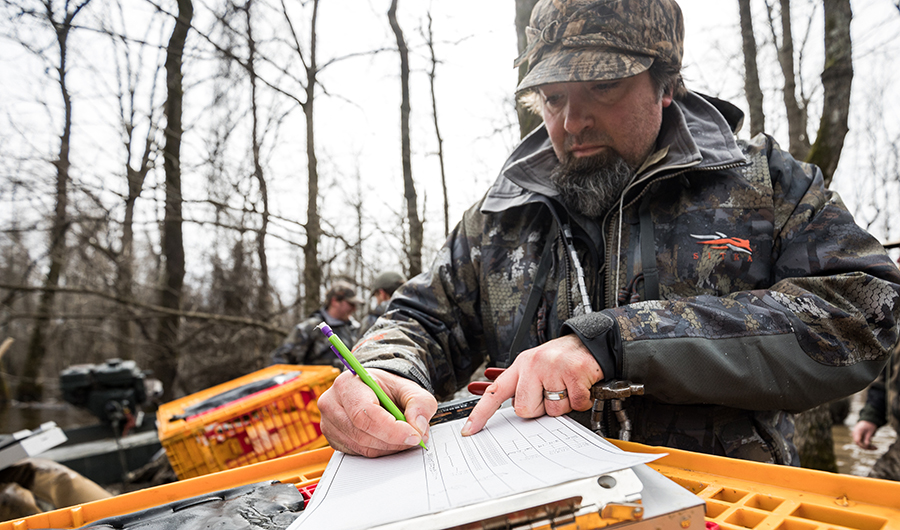
(Photo courtesy of the University of Arkansas at Monticello)
READ ALSO: Avery Anna Promises Big Energy, New Music for Little Rock Show