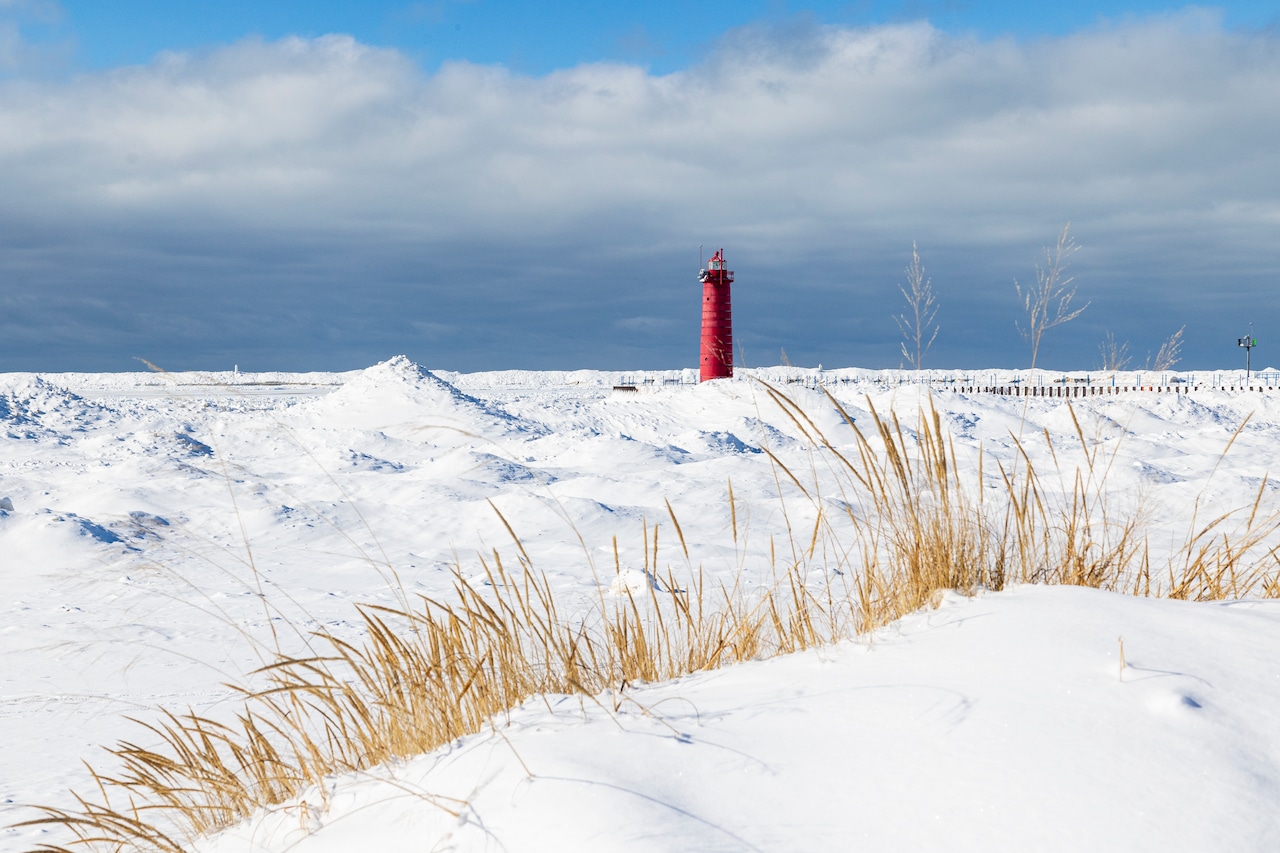
GRAND RAPIDS, MI – Snow-covered dunes and frozen lighthouses. Beaches that have disappeared under sheets of shelf ice that seem to stretch out for miles on the surface of our big lake.
After spending several weeks in Mother Nature’s deep freeze, a lot of weather nerds are asking the same question: Does Lake Michigan ever really freeze over?
The short answer is no – at least not during the latest record-keeping window that spans a half-century. But there is some interesting data on why people think this big lake looks frozen, even when it’s not. So let’s jump in.
First, we all know that several weeks of bitterly cold Arctic air has left our fingers and noses cold, and been responsible for a surge of rapid ice development across the Great Lakes. This week, ice covered more than 50%of the Great Lakes, according to NOAA, and shallow Lake Erie was more than 95% encased in ice. This has prompted ice-breaking assists from the U.S. Coast Guard for big freighters that are trying to make late-season runs across Lake Erie, then are getting stuck in the ice fields.
By contrast, Lake Michigan’s ice is only at about 36% this week.
These icy conditions had local meteorologists reaching out to the National Weather Service team in Grand Rapids with the question: When is the last time in recent memory that Lake Michigan froze over? Apparently never, at least in the record-keeping window that dates back a half century.
Ice coverage on the Great Lake exceeded 50% this week.Graphic provided by NOAA
Here’s what our friends at the NWS found when they looked back through the records:
- We’ve had persistent deep-freeze stretches like this during a handful of winters in the last 50 years. Some of these stints have lead to really high ice coverage levels on our big lake.
- A winter storm and trailing Arctic blast in late February/early March of 2014 caused ice to spread rapidly across Lake Michigan, data shows. On March 6, 2014, the new ice coverage record of 93.2% was set.
- That 2014 ice coverage nudged out the old record of 93.1%, which had been set in 1977.
So as we look at the ice extending far from the shoreline this month, we still have a long way to go before Lake Michigan approaches any record-setting territory this winter. Any growth will depend on how many more Arctic blasts we get before we start turning the corner to spring.
“One thing to keep in mind with these numbers is that a large percentage of the ice is not solid. It’s fragmented, floating ice and slush that you would not be able to walk on. So even with 93 percent ice coverage, you would not be able to walk across the lake,” an NWS meteorologist in Grand Rapids said in this week’s forecast notes.
“Another thing is that one strong low (pressure system) with high winds could cause a sudden reduction of ice coverage by piling up the floating slabs and dispersing the slush.”
1/69
Ice coverage grows on Lake Michigan off Muskegon shoreline