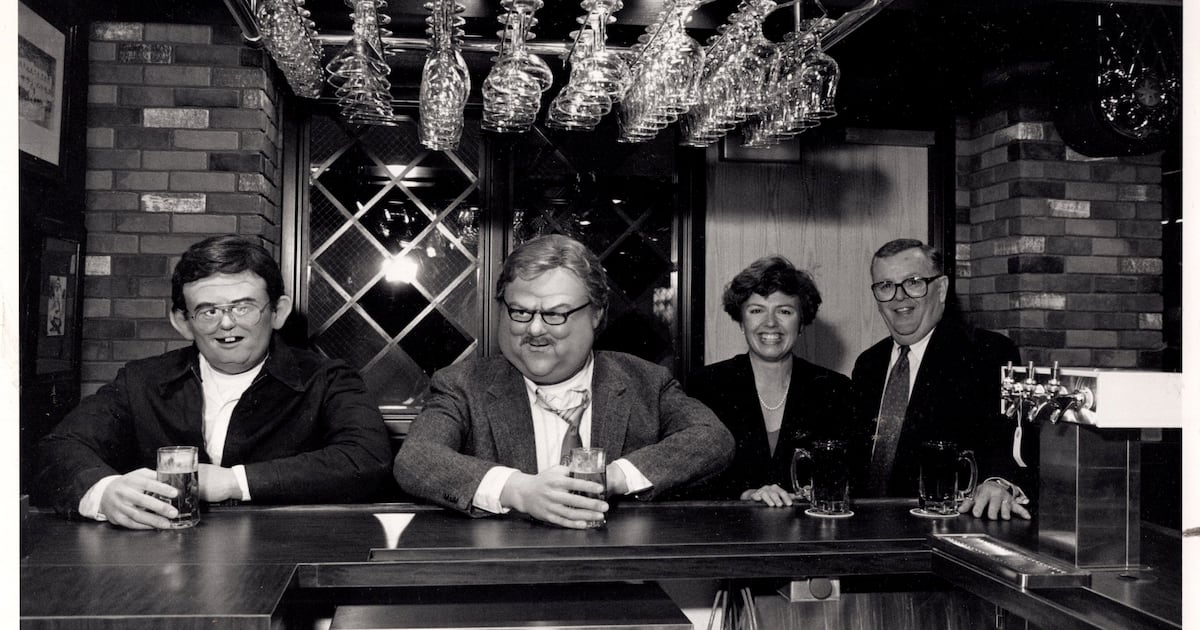
This marketing image shows the Cheers bar at the Anchorage International Airport on June 25, 1992. The text accompanying the image read: “Although the new Cheers bar at Anchorage International Airport just opened, it has already attracted a number of regulars, including two robotic regulars named Bob Johnson (left center) and Hank Gifford (left). Gina Marie Lindsey (right center) Director, Anchorage International Airport, and Francis McGurgan (right), general manager of Host International’s food and beverage operations at the airport, take a minute to meet the ever-present patrons. The characters are just two of the unique aspects of Cheers, a new bar modeled after the popular television comedy by the same name. Cheers are already open in Detroit, Minneapolis/St. Paul, and Christchurch, New Zealand.” (Image provided by David Reamer)
Part of a continuing weekly series on Alaska history by local historian David Reamer. Have a question about Anchorage or Alaska history or an idea for a future article? Go to the form at the bottom of this story.
“Where everybody knows your name, and they’re always glad you came. You wanna go where people know, people are all the same. You wanna go where everybody knows your name.” Maybe you can sing along right now, no matter where you are, right out loud.
That was the theme song to “Cheers,” the ratings smash sitcom that ran from Sept. 30, 1982 to May 20, 1993, earned 117 Primetime Emmy nominations, won 28 of those Emmys and launched stars like Kelsey Grammer, Ted Danson and Woody Harrelson. If you lived through that time, then you know “Cheers” was an inescapable cultural phenomenon. But do you remember the “Cheers” commercial spinoff that included a location in Anchorage? There were robots and lawsuits, the story of the brief and quite well-forgotten licensed “Cheers” bars.
The original cast of “Cheers” from top left: Shelley Long, Ted Danson; (middle) Rhea Perlman, Nicholas Colasanto; (bottom) George Wendt, John Ratzenberger. (Wikimedia Commons)
However, in an oddity among oddities, more than one “Cheers” bar existed in Anchorage: two establishments whose lifetimes overlapped, with varying legitimacy. The first local Cheers bar was the unofficial iteration. The Eatery opened on Northern Lights Boulevard in 1987. In its time, the restaurant sat across the street from Gary King’s Sporting Goods. For the modern reader, it is now Serrano’s Mexican Grill.
Well, the Eatery used to have a sort of patio on its east side, tables with umbrellas. In 1990, the building was renovated, turning that space into a 1,600-foot bar named Cheers. Owner Cecil Holland told the Anchorage Times, “I am trying to get Ted Danson or one of the other guys from the television program ‘Cheers’ up here for the opening,” though there is no sign that he succeeded. The Eatery and Cheers were closed by 1997, when the site became Casa Grande.
In June 1990, Host International, a subsidiary of the Marriott hotel empire, announced a partnership with Paramount to license the Cheers name for a chain of bars, right around the same time as work commenced on the Eatery extension. This arrangement, though, was official, including the rights to sell legitimate “Cheers” merchandise. By then, “Cheers” licensing was a proven moneymaker for Paramount, bringing in millions of dollars through assorted tchotchkes, T-shirts and retail products like bloody mary mix, even Las Vegas slot machines.
A hat from the Cheers bar at the Anchorage Airport. (Image provided by David Reamer)
Host International’s initial plans called for an eventual 46-bar and lounge chain entirely located in airports, which aligned with contemporary retail trends. For decades, airport food, beverage, concession and other stores were generally unique options, idiosyncratic features that made each airport feel different from one another. At their best, they were rich with local character, suitably overseen by local folk. At their worst, they were generic operations, nameless snack bars offering nameless sandwiches of questionable quality.
Then corporate people realized the opportunity thus presented. People who traveled typically possessed spending money, and travelers in airports meant a more captive audience for their wares. The logic was overwhelming. Beginning largely in the late 1980s, waves of Burger King, Pizza Hut, TCBY, Mrs. Fields, Sbarro, McDonald’s and other familiar roadside franchise names replaced the less familiar alternatives. In Anchorage, the first proper Starbucks — meaning not Starbucks-branded coffee sold at Barnes and Noble — and the first Cinnabon opened at the international airport in 1997 and 2011, respectively.
The first of these airport “Cheers” bars opened on Feb. 5, 1991, within the Detroit Metropolitan Airport. The pub featured wood and brass accents to better mimic the version on TV. The stools, walls, and jukebox looked like those from the show. There was a Red Sox jersey for Ted Danson’s Sam Malone character, a washed-up relief pitcher.
Televisions aired episodes. “Cheers” logos adorned everything in sight, from surfaces to walls to napkins to glasses, appropriate given the cost. Four percent of sales was routed to Paramount. The entrances were the telltale difference between TV and real life, whether you descended stairs or passed through metal detectors.
The “Cheers” bars were ambitious operations, and the conceit carried over to the employee interview process. There was nothing so pedestrian as “now hiring” announcements. Instead, there were “casting calls” that tested applicants’ ability to engage with customers. Improvisation was a desired skill. Once hired, staff were required to break into frequent chants, spelling out the “Cheers” name like a cheerleader and introducing each server, bartender and manager on duty.
A “Cheers” casting call advertisement for hiring bartenders and servers that ran in the June 2, 1992 edition of the Anchorage Daily News.
Then there were the robots. No, there were no robots in the “Cheers” show, but there were indeed robots in the licensed “Cheers” bars. Somewhere in the development process, it was decided that a “Cheers” bar was not a “Cheers” bar without regular patrons, a familiarity that could not be naturally replicated in an airport, by definition a nexus of ever-changing travelers. An artificial creation was installed instead.
Each airport “Cheers” bar featured two fleshy caricatures of animatronic patrons slouched in their seats, both of them slightly familiar. They may have looked and sounded a little like Cliff Clavin and Norm Peterson — as portrayed by actors John Ratzenberger and George Wendt, respectively — but these were Bob and Hank. Yup, there was no Cliff and Norm here, just good old Bob and Hank. There may have been several winks involved in that distinction, but it was an important one as regards the law, as will come up again in a bit.
As Host International spokesman Richard L. Sneed described them in 1993, “They sort of slump forward at the bar, and then every few minutes they sit up straight, look at each other and have jovial conversations.” A screenwriter conjured about 30 lines like this back and forth. Hank: “Didn’t the doc tell you to watch what you eat?” Bob: “I am. I’m watching to make sure I don’t eat anything healthy.” And thus, an atmosphere was set.
Around the time of the Detroit grand opening, Marriott regional vice president David Bennett said, “I’m a little leery about projections, but let me say that we think it will do over a million dollars a year.” In other words, the concept seemed to work. Crowds came and occasionally lingered beyond crucial deadlines, seduced by the ambiance.
One couple among the early customers entered the bar during a layover, ordered their drinks and began watching reruns. Time passed, and they forgot why they were at the airport. Manager Robin Krugler noted, “They came back and said it was our fault that they missed their flight. They were having too much fun.”
The Anchorage International Airport branch opened on June 24, 1992, over by the B concourse. It offered Anchorage-specific merchandise, hats and shirts, chances to memorialize a drink in an authentic Alaska airport. Each “Cheers” bar had its own gear. “Meet Me In Cheers,” they beckoned.
The Cheers sign in Boston, Massachusetts in 2005. (Wikimedia Commons)
At that time, there were three other locations: Detroit, Minneapolis-St. Paul, and Christchurch, New Zealand, the veritable Beatles of international airports. Host International still planned for a globe dotted with “Cheers” bars. Marriott representative Stan Novack told the Daily News the show “has been renewed for another year. There are 250 shows in existence, and it has been sold into syndication. It doesn’t age.” Also, disco will never die.
Max Cunningham, a University of Alaska Anchorage student, was a day-one server. He gushed about the opportunity. “I looked in the paper, I saw ‘Cheers.’ I thought the show is coming up here. I’ll get discovered.” He continued, “I got here and learned the rest of the deal, but who knows? Maybe Steven Spielberg will come through Anchorage and come in.”
Gilberto Baraclat Jr., a São Paulo, Brazil, travel agency operator, was one of the first customers. And naturally, he had never heard of Cheers in any form. “I’m just waiting for my flight,” said Baraclat. “And the best way to wait for my flight is to drink a beer.” As for the bar, he offered, “This is a curiosity of the mind. It is nothing like Brazil bars.”
Sally Strong came along a few years later, after whatever buzz existed after the opening wore off. After a stint at another Anchorage International bar, she moved over to “Cheers” to fill a staffing shortage. She told me, “It’s just like any old bar, nothing special, except the two guys sitting right next to me,” meaning the robots. And she watched the show, enjoyed the show, especially Rita the waitress played by Rhea Perlman. “And she’s got a mouth. I like her.” But the robots were too much.
Customers could stay in the bar for only so long, at least if they actually wanted to make their flight. So, the robots rarely annoyed them. After all, they could leave at any time. Tom McGrath was an executive at Viacom Entertainment after it purchased Paramount in 1994. In 2018, he recalled, “People were only there for limited amounts of time. It’s an airport bar. If you were there for a long time like a normal bar, it would be repetitive and annoying. Just passing through, stopping for a drink, it was fine.”
Staff had different opinions about the robots. “Those two dummies were talking,” said Strong, “and later on it got to be too much, so I shut it off.” Eventually they burned out, or something broke within. I asked Strong if anyone came to fix them, and she replied, “No, I don’t want them to fix.”
But there were benefits to working in an airport bar versus one elsewhere. The clientele tended to act a little different. Strong insists, “If you want to work in a bar, work in an airport bar.” “They don’t want to give you a problem. They give you a problem, you call the security. They’re gone.”
Time passed. The show finally ended its run in 1993, and though reruns maintained a presence in the cultural landscape, its peak had passed. Additional “Cheers” bars opened in Boston, Cincinnati, Cleveland, Kansas City, Las Vegas, Memphis, Vancouver and Washington, D.C. The concept succeeded without reaching the 46-location heights dreamed of in the halcyon days of 1990.
Ron Wiggans waits for his flight to Las Vegas to attend a builders conference at the mostly-empty Cheers bar at Ted Stevens Anchorage International Airport on Sept. 11, 2002. (Erik Hill / ADN archive)
The lengthy legal battles perhaps played a role. For John Ratzenberger and George Wendt finally noticed the, well, let’s call it an homage, and filed suit in early 1993. Their lawyer, T. Patrick Freydl, stated, “It’s our contention that the license from Paramount does not address bringing in robots that take on these characters.” Meanwhile, Paramount argued it owned the characters and could use those likenesses as seen fit, even if those likenesses included Ratzenberger’s and Wendt’s faces. Or an approximation thereof.
The case was dismissed in 1995, reinstated on appeal. This turnaround was, in turn, appealed all the way to the Supreme Court in 2000, which ruled that the case could proceed. In 2001, Paramount and Host International settled with the actors for an undisclosed sum, avoiding a full court battle.
By then, the chain was on its last legs, perhaps regardless of the lawsuit. As of early 2000, it was down to four locations: Anchorage, Las Vegas, Memphis and Vancouver. Sometime in the early 2000s, the Anchorage location disappeared, all but forgotten before its death.
The robots faded faster than the bars themselves. For management, the animatronic features were always causing trouble. During the lawsuit, someone noted, “They break all the time. And Host found that the bars did just as well without them. Now when they stop talking, they just throw them away.” Still, we must not forget that there was a time when robotic incarnations of 1980s sitcom characters haunted our airports.
• • •
Key sources:
Agos, Alicia. “Tavern’s Name, Concept, Chirpy Staff Mimic TV Show.” Anchorage Daily News. June 26, 1992, A1, A12.
“Airport Concession Stands Go from Bland to Brand-Name Food Outlets.” Anchorage Times. December 31, 1990, C7.
Chandonnet, Ann. “The Eatery Under Construction for ‘Cheers’ Bar.” Anchorage Times. May 23, 1990, D1, D8.
“Cheers!” Petoskey News-Review. March 5, 1991, 9.
Goldfarb, Aaron. “Cheers! At These Robot-Filled Airport Bars, Everybody Knew Your Name.” VinePair. October 31, 2018.
Greene, Bob. “A Barstool Buddy in Every (Air)Port.” [New York] Daily News. January 7, 1993, C15.
Severson, Kim. “Casa Grande May Be Cause for Cheers.” Anchorage Daily News, 8 insert. December 19, 1997, 5-6.
Toobin, Jeffrey. “The Case of the ‘Cheers’ Replicants.” New Yorker. March 20, 2000.