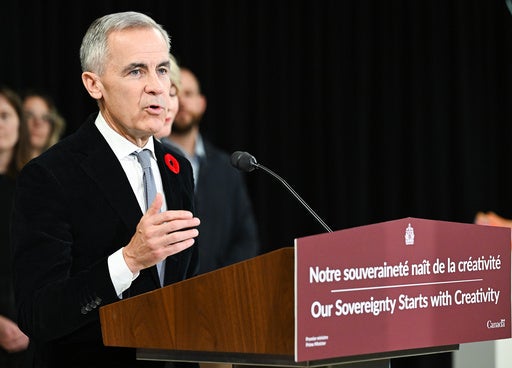
TORONTO (AP) — Canadian Prime Minister Mark Carney said Tuesday that U.S. President Donald Trump’s administration will remain the key decision-maker on trade agreements despite Democrats’ sweeping victories in last week’s U.S. midterm elections.
His remarks suggested Canada will continue looking to the White House for a trade deal even as Democrats prepare to challenge Trump’s tariffs.
U.S. tariffs on Canadian goods became an issue in the midterms, with Democrats blaming them for higher prices and pledging to challenge them.
“What is clear is that the people who decide on trade agreements are the executive in the United States over the next two or three years,” Carney told reporters in Montreal. “The President, the executive and Americans, not necessarily legislators.”
He was responding to Quebec’s plans to contact U.S. officials, including governors and senators.
The Democratic victories have left Canada with a dilemma: Accept a deal that reduces Trump’s tariffs but leaves some in place, or hold out for free trade as Congress prepares to challenge them.
“In a negotiation, it’s always a good idea to have one negotiator. And that is the government’s responsibility,” Carney said.
Carney said he spoke with Trump over the weekend and could meet him at upcoming summits. The leaders communicate regularly.
“It’s good to sit down, but it’s not absolutely necessary,” Carney said.
Carney said issues remain unresolved with Washington, although Canada has overcome disputes involving French-language protections and Canadian cultural programming that helped derail an agreement in August.
“There are still some tough issues to resolve with the Americans in this negotiation,” Carney said.
Canada suspended trade negotiations in August after what Carney described as unacceptable U.S. demands involving Canadian sovereignty, cultural protections and other issues. Trump imposed 50% tariffs on billions of dollars in Canadian goods, prompting Canadian retaliation.
Trump said before the midterms that the countries were “very close” to an agreement, while Carney said Washington had backed away from demands involving Canada’s culture, French-language protections and ability to negotiate other trade agreements.
Carney welcomed Democratic efforts Friday to repeal Trump’s tariffs but did not say whether the election changed Canada’s negotiating strategy. Democratic Sen. Ron Wyden has made tariffs on Canada a repeal priority, though Trump could veto any legislation.
Carney emerged as a prominent international counterpoint to Trump after warning at the World Economic Forum in Davos in January that great powers were weaponizing economic ties. Without naming Trump, he urged middle powers to unite against economic coercion.
Carney accused Stellantis of betraying Canadian workers after the automaker agreed to sell its idled Brampton, Ontario, plant to armored vehicle manufacturer Roshel. Stellantis shifted planned Jeep Compass production to Illinois as Trump pushes automakers to move production to the United States.
Carney said he will meet Chinese President Xi Jinping next week at the APEC summit in Shenzhen. He said Canada’s economic relationship with China carries fewer security risks than the United States’ broader relationship with Beijing.
Copyright 2026 The Associated Press. All rights reserved. This material may not be published, broadcast, rewritten or redistributed without permission.