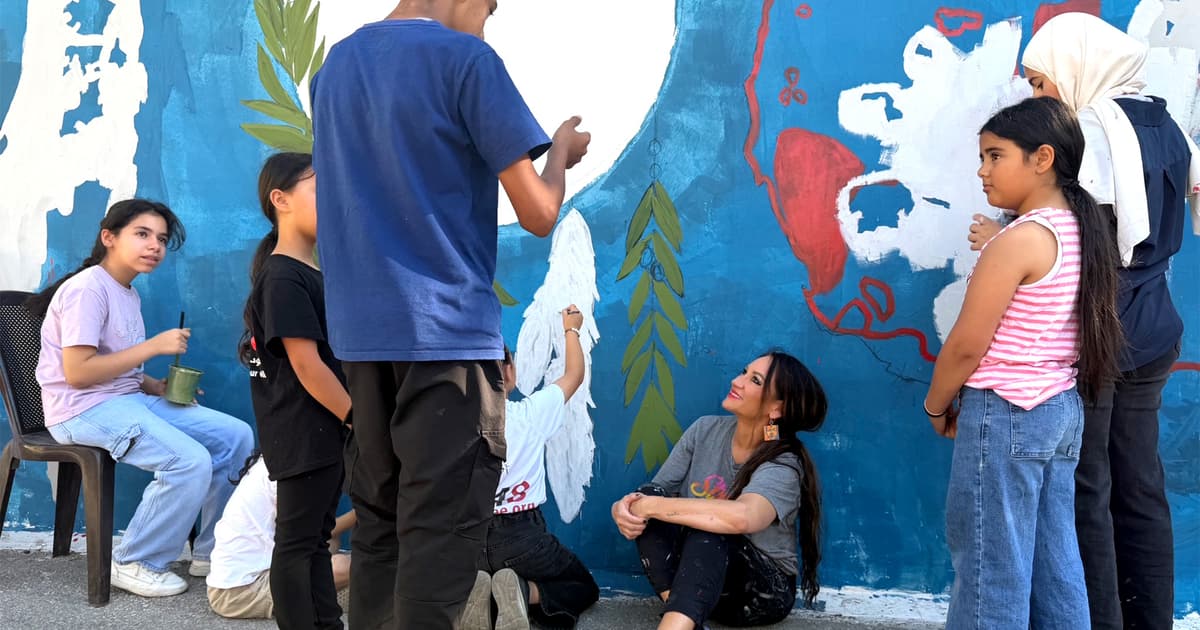
Denver-based Native American artist Danielle SeeWalker spent two weeks this summer making a series of murals with Palestinians living in the West Bank.
It involved an exhausting trip through Jordan, connecting with a Palestinian American volunteer supporter, and Palestinian artists and children. Together, they made half a dozen unified murals on the 200-foot wall leading into a refugee camp. Every day, she saw locals navigating the instability, isolation and attacks on their safety and humanity.
“I’ve been home for [a bit more than] two months now and I feel like I’m still recovering,” she said during an outdoor lunch interview, her eyes filling with tears several times. ”I still think about it daily … ”
She funded the trip with money she won settling a lawsuit against the town of Vail, who had offered and then rescinded an artist residency. It was canceled because of community members’ unreceptive feelings about a mural she’d made called “G is for Genocide.” Sold for $4,000, it depicted throughlines connecting Native Americans and Palestinians, such as loss of land and colonization. The residency would have come with a $10,000 grant, but that got snatched back as well.
“As much as it really hurt and I felt very misunderstood, very much silenced and censored … ultimately, so much more good came out of it than anything else … I’m almost thankful to the town of Vail for having such a discriminatory response, because it led to so many amazing connections that I would never ever have had,” she said.
The trip was originally set for April, but was postponed because of the Iran War. She traveled from June 26 to July 10.
Getting to her destination, Aida Camp, involved crossing from Jordan through Israel and into the Palestinian territories, with the support of Yusuf Abudi, a Palestinian American global management consultant who left the area in 1967 when he was about 4 years old. He spent the next 10 years in Kuwait before coming to the U.S. with his brother.
Now living in New Hampshire, he contacted SeeWalker when he heard her residency was canceled. They discussed the idea of painting murals in the West Bank.
SeeWalker was immediately on board. It took about two years to plan things out, according to Abudi, who connected her with the local artists he’d gotten to know while helping found the Palestinian Artists Consortium from abroad.
Courtesy: Danielle SeeWalkerDanielle SeeWalker (right) shares a meal with fellow artists at a community center in the Aida refugee camp, in the West Bank, during her mural-making trip in the summer of 2026.
“Most of my time is around making sure everything is organized well and the right people are in the right place for everything,” he said. “I [was] making sure that we have all the materials there. “I did not paint per se; I just held a ladder for her,” he said with a laugh.
SeeWalker, Abudi and five artists worked together at a large wall with six different sections for each of the local artists and one for local children. The wall transformed over the two weeks to feature images of what Native Americans and Palestinians have in common.
One of the murals included similar imagery that was in the “G is for Genocide” mural that led to the cancellation of the residency and subsequent settlement. Others depict a woman wearing both a keffiyeh and a feather and images of tipis and Native leaders on one side, Palestinian landscapes on the other.
“The theme of all the murals was this allyship and understanding of Native Americans and Palestinians and shared paralleled history,” SeeWalker said. “First Nations people … had their land taken. We had food sovereignty taken away from us, language lost. I mean, a lot of the very similar things that my community and ancestors went through, they’re experiencing now.”
Time spent at the wall was not all painting. The Palestinian artists also learned more about Native history during the two-week collaboration.
“They knew about some high-level things, but they didn’t understand the full depth of what went on here with Indigenous people,” SeeWalker said. “And so it was a really great cross-cultural interaction and conversation that we got to share in.”
Local kids participated in the mural as well.
“The children of the refugee camp also got to have input on a mural that they could do. So I did a session with them, and we worked together to develop this theme for the kids’ mural and help them install it,” she said.
The children’s mural says “Land Back” in Arabic and English, and has two maps. “The concept of the children’s mural was a map of Palestine and a map of the U.S. and showing our current occupied territories on each map,” SeeWalker said.
Besides Abudi, SeeWalker also met up with another friend, London-based photojournalist Carlotta Cardana, who was invited to document the trip in pictures and video.
Courtesy: Danielle SeeWalkerLeft: An Israeli military watchtower that muralist Danielle SeeWalker passed daily on her way to and from the Aida refugee camp, where she worked in June and July on making murals. Right: Mesh walkway coverings have been erected to protect Palestinians as they walk the streets of the Aida refugee camp, in the West Bank, from urine and acid they say is sometimes thrown by Israeli settlers.
“It was really nice to see Danielle and Palestinian artists coming together and sharing experiences from their own culture,” Cardana said, “because we could see the similarities in the shared histories of two populations that are very much far apart, but they’ve both been victims of oppression, colonization, land loss. … At first they were like, ‘Oh, why Native Americans? What do they have to do with us?’ And then having those conversations, it was really nice to see people coming together around art.”
SeeWalker and her team worked in the mornings before it became too hot. She siesta’ed during the hottest part of the afternoon. Later, she ate fresh meals at the community center in the camp, then resumed guiding the mural-making in the evenings. Abudi and some locals helped her source paintbrushes, paint, and varnish (possession of which was seen as an act of resistance) through what she called an “underground railroad.”
Abudi helped add some cultural experiences to the trip.
“The other part of [my role] was to make sure Danielle and Carlotta get as much of an experience of Palestine as possible. So I organized tours and rides to go to the different areas so they could experience it,” he said.
That included a visit to Abudi’s childhood home in the village of Ein Arik, and meeting his 98-year old aunt. SeeWalker also got invited into the homes of people she encountered in the camp, which she said is several blocks large with a new park for kids to play in. Locals invited her over for meals and asked her about herself in a way that made her feel welcome, contrasting concerns she’d arrived with because of America’s relationship with Israel.
“Walking down the street, strangers would invite me into their homes for coffee, or say, ‘Where are you from? Oh you’re American? Wow. thank you so much for being here,’ ” she said.
But SeeWalker saw things she didn’t anticipate: “My home base was right outside the refugee camp in Bethlehem,” within walking distance to the mural site at the camp. It had very few guests because of shrinking tourism. Walking from there to the mural site, she passed a guard tower with a machine gun shifting its aim using AI.
As she walked on sidewalks, she saw that Palestinians and Israelis had different license plates that prevented Palestinians’ entering areas without a permit. And she noticed that the airspace above the sidewalks was covered with mesh to protect pedestrians from the urine and acid she said Israeli settlers flung at Palestinians from windows of a high-rise apartment they’d forcibly occupied.
”There’s a building above that the Israelis occupy and they’ll throw stuff down and they’ll even tell their children to do it,” she said.
Abudi described this as different from what he remembered as a child before leaving in 1967. Then, the commercial strip called Shoda Street had merchants selling their goods. Now there are many settlers, he said. “They would throw feces, garbage, urine, at passers-by. And that is an extreme element of the settler movement, especially the fanatic settlers in that area.”
There was also very little infrastructure, SeeWalker said. “In some areas, there’s no organized trash collection … [and] most everybody has giant drums on the top of their roofs that collect water.”
Besides all that, they were surrounded by the possibility of life-ending violence. SeeWalker’s friend Cardana recalled walking through a cemetery and being approached by a few children who said: “‘You really need to leave with us, because this is the time that they come out and kill us,’” she said. “These three little kids are aware of the fact that they need to be back before sundown, because in the night, that’s when the army comes into the camp and takes people [and] destroys houses … to me, it was just incredible to see how at such a little age, those are your concerns.”
SeeWalker said the concerns were valid. “Shortly after I left, one of my friends sent me a video of the IDF coming in and raiding the camp. They took a couple kids prisoner for no reason … you don’t know when they’ll come back.”
Now that she’s back in Denver, she’s reflecting on the experience of working on the murals and seeing some of the area while absorbing the dark realities of Palestinian life.
“I mean, it’s forever changed the DNA of my whole existence. Yeah, I don’t know if I’ll ever fully recover … It’s very tough. Their daily struggles and what they face every day is … there’s not even words for it, but … all of those things that they’re doing just to maintain their culture without an apology, I think, is the most beautiful thing. I’ve never felt more welcomed into a community, ever, than I was there.”
Toward the end of the lunch, she mentioned that she never got an apology from the town of Vail.
One isn’t coming, according to Kris Widlak, a town spokesperson who responded to a recent email with a statement which says in part: “The town of Vail denies any wrongdoing.”
Although there’ll be no formal apology, Vail will hold its first Native American art market on October 4, and host a private meeting on Oct. 6 with town leaders, SeeWalker and Abudi to discuss Israel, Palestinian experiences, and according to Abudi, “differences.”
Both SeeWalker and Abudi hope the Native American/Palestinian mural gathering will lead to other Indigenous groups, such as the Maori in New Zealand, working on murals in the West Bank featuring stories of shared oppression.
He wondered how it’s possible to be creative when drones and bombs are heard overhead. “It’s a survival method, It’s the concept of resilience that people have, that they want their message to be out there, and artists are the best at doing it, because they use a beautiful format of telling a story.”
“The list goes on and on and on,” SeeWalker said, “about the opportunities that came out for other people from this.”