Meyer, Working Families Party favor higher rates on upper incomes; Ramone says Delaware should rein in spending before asking taxpayers for more
DOVER, Del. — Delaware’s debate over taxes and spending is sharpening after progressive candidates scored major victories in the Democratic primary, giving greater influence to a political movement that openly supports higher income-tax rates on the state’s highest earners. Gov. Matt Meyer has also continued to support adding new upper-income tax brackets, arguing Delaware can ask higher earners to contribute more while reducing taxes farther down the income scale.
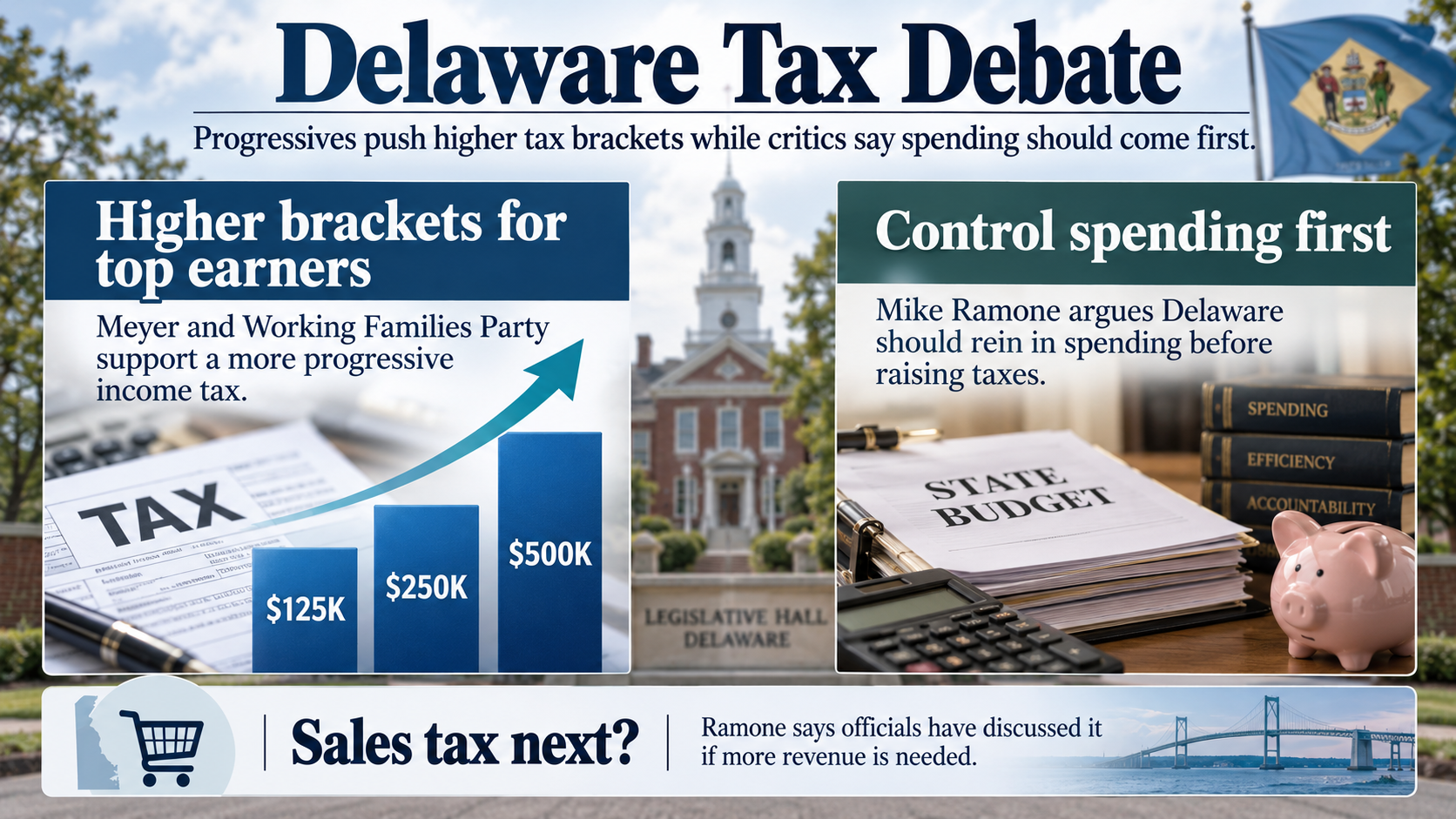
Republican state treasurer candidate Mike Ramone is making the counterargument: Before Delaware aims at implementing a sales tax, state leaders should first determine whether the state government’s spending is correctly targeted and delivering real results for taxpayers.
Ramone said there have been behind-the-scenes discussions in Dover for the implementation of a sales tax for over a decade (years), and a new, more radical legislature in January might finally pull the trigger on it to keep the tax and spending express going.
Progressives gain influence
The Sept. 15 primary strengthened the Working Families Party’s position within Democratic politics.
Working Families Party-backed candidates won one state Senate and five state House primaries. Five Democratic incumbents were among those defeated.
The results matter because the organization has a detailed economic agenda.
Its platform explicitly calls for making Delaware’s personal income tax “more progressive” by adding additional high-income brackets at increased rates.
The party also supported legislation last year that would have added tax brackets at $125,000, $250,000 and $500,000.
Meyer wants higher brackets
Meyer has made a similar argument. Delaware’s highest personal income-tax rate of 6.6% currently begins at $60,000 of taxable income.
Meyer proposed adding three higher brackets at $125,000, $250,000 and $500,000 as part of his fiscal 2026 budget proposal.
His administration argued that the change would make the system more progressive while reducing taxes for 92% of Delaware taxpayers. Under that proposal, taxpayers with taxable income below $134,667 would have faced no overall increase.
The proposal did not become law, but Meyer has continued to argue that taxpayers at substantially different income levels should not face the same top marginal rate.
The progressive argument is straightforward: If Delaware requires additional revenue to finance education, health care and other services, higher-income residents have a greater ability to absorb an increase than working- and middle-income families.
Ramone: Look at spending first
Ramone approaches Delaware’s fiscal problem from the opposite direction.
The former House minority leader and longtime small-business owner has made fiscal accountability and independent analysis of state finances central themes of his campaign for treasurer.
Ramone has said the treasurer should help taxpayers understand the economic impact of proposed taxes, fees and major spending decisions and provide an independent voice on state finances.
His broader argument is that a projected budget shortfall does not necessarily mean Delawareans are paying too little. It can also mean spending is growing too quickly.
“Every time Delaware faces a budget problem, the answer cannot simply be to go back to the people who are already paying the most and ask them for more,” Ramone said. “At some point, we have to ask why spending continues to grow, whether every program is delivering results and whether taxpayers are getting value for the money they already send to Dover.”
Ramone has previously supported directing surplus revenue toward long-term state liabilities instead of using it to support continuing expansions of government spending.
Could a sales tax be next?
Ramone said there have been behind the scenes discussions in Dover for the implementation of a sales tax for over a decade (years) and a new more radical legislature in January might finally pull the trigger on it to keep the tax and spending express going.
He has stated publicly that officials within the Meyer administration have discussed a statewide sales tax and that such a tax could be considered if Delaware needs additional revenue.
Meyer has not publicly proposed a general sales tax, and Delaware LIVE has not independently verified that one is being developed.
That distinction is important: Higher income-tax brackets are a documented Meyer policy position. A sales tax is an option Ramone says has been discussed internally.
The Working Families Party’s published platform does not call for a general sales tax. Its tax agenda instead emphasizes collecting more revenue through higher rates on upper-income taxpayers.
A statewide sales tax would represent a much broader approach because it would reach consumers across the income spectrum.
Who should pay?
That leaves Delaware with a basic fiscal debate.
Meyer and the Working Families Party argue the state can protect most taxpayers while asking those with the greatest ability to pay to shoulder more of the cost of government.
Opponents question whether Delaware should increase its dependence on higher earners — including entrepreneurs, business owners and professionals — without first confronting the growth of state spending.
Ramone says that is the larger issue voters should consider. “Delaware families should not have to wonder which tax comes next every time state spending outgrows revenue,” Ramone said. “My approach is to promote transparency. Help the voters understand the issues from a business and family perspective. Let’s make government live within its means, demand accountability for the money we already collect and protect taxpayers before asking them to pay more. ”
TO GO BOX
-
THE DEBATE: Delaware progressives are pushing for a more progressive income-tax structure as the state faces growing spending commitments.
-
MEYER: The governor has proposed additional income-tax brackets at $125,000, $250,000 and $500,000 while lowering taxes for most taxpayers.
-
WORKING FAMILIES PARTY: Its platform explicitly supports additional high-income brackets at higher rates.
-
PRIMARY IMPACT: WFP-backed candidates won one Senate and five House Democratic primaries, including victories over five incumbents.
-
RAMONE: The Republican candidate for state treasurer argues Delaware should address spending growth, accountability and efficiency before seeking additional revenue.
-
SALES TAX: Ramone says Meyer administration officials have discussed a possible statewide sales tax if more revenue is needed. Meyer has not publicly proposed one, and Delaware LIVE has not independently verified those discussions.
Delaware LIVE collaborates with a network of professional journalists to cover a diverse range of stories across various fields. Staff Writers include experienced journalists and young professionals. If you have questions, please feel free to contact [email protected] or our publisher, George D. Rotsch, at [email protected]