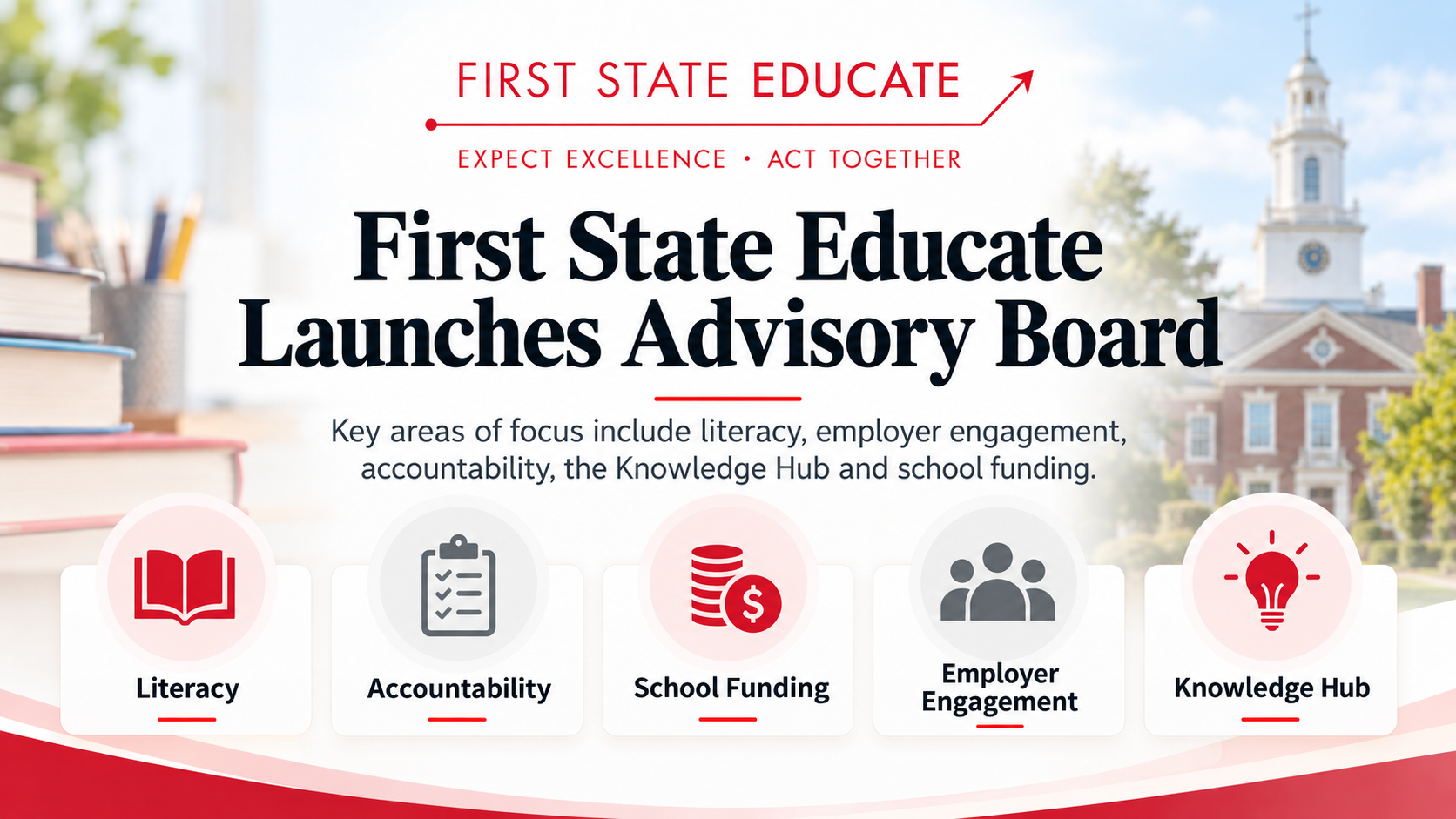
First State Educate’s new advisory structure is intended to help the organization develop resources that support those responsibilities. Image created on 10/13 using AI.
First State Educate launches 12-member advisory board to strengthen local school governance, improve student achievement and help districts navigate major changes in Delaware public education.
By George D. Rotsch, Delaware LIVE News.
WILMINGTON, Del. — As Delaware schools face growing expectations to improve student literacy, demonstrate academic progress and adapt to a new school funding system, First State Educate has assembled 12 current and former school board leaders to help strengthen the effectiveness of local school governance.
The nonprofit organization, whose mission is to empower school boards to improve public education, announced the formation of its new Advisory Board, bringing together representatives from all three Delaware counties with experience in education, business and community leadership.
The initiative comes at a significant time for Delaware public education, as state leaders advance changes to school funding and accountability while placing renewed emphasis on improving student outcomes.
First State Educate Executive Director Julia Keleher said the advisory group will help ensure the organization’s programs and resources reflect the practical challenges confronting local school boards.
“First State Educate has launched the Advisory Board to inform and ground our work; this esteemed group of Delaware leaders will ensure we are serving our state and schools in the most relevant, impactful ways possible,” Keleher said.
School boards play a critical role in student success
Although school boards often receive public attention for budgets, policies and controversial decisions, their responsibilities extend to establishing district priorities, evaluating superintendents and monitoring whether schools are delivering measurable academic results.
Delaware Secretary of Education Cindy Marten welcomed the initiative, emphasizing that those who serve on school boards should have a voice in developing the resources intended to help them succeed.
“School boards have an enormous responsibility. They set the direction for their districts, hire and hold superintendents accountable, and make decisions that directly affect students and classrooms,” Marten said.
“If we want board members to be effective, we need to understand what they need to succeed. I’ve always believed that if you want to know what works, ask the people doing the work.”
Marten said involving board members in shaping training and resources could improve the quality and relevance of those programs.
“The strongest solutions are built with people, not simply for them,” she said.
Literacy, accountability and funding top the agenda
The new Advisory Board will focus initially on five areas that could influence how Delaware school districts allocate resources, measure success and respond to community expectations.
Improving literacy outcomes: Members will help identify ways local school boards can support district literacy goals and align their priorities with the Delaware Department of Education’s strategic plan. This includes examining how board decisions about curriculum, instructional resources and student performance can contribute to improved reading achievement.
Strengthening academic accountability: The group will help school boards prepare for Delaware’s evolving performance and accountability framework, including the use of student achievement data to establish expectations, monitor progress and support continuous improvement.
The Delaware Department of Education is developing a School Performance and Support Framework intended to identify struggling schools earlier and provide increasingly intensive assistance when needed. The framework remains in draft form, with public feedback open through Nov. 1.
Delaware Department of Education
Preparing for school funding reform: Delaware’s proposed hybrid funding model represents a substantial change in how public education resources would be distributed and managed. Advisory Board members will help identify the guidance school boards need to understand funding decisions and oversee the use of public money.
The state’s Public Education Funding Commission has recommended a model combining core staffing support with additional resources based on student needs and operational expenses. The proposal also emphasizes transparency and accountability for how education dollars are spent.
Connecting employers and schools: Through initiatives such as the Delaware Education Performance Partnership, First State Educate intends to encourage greater engagement between school leaders and the business community. The goal is to strengthen connections between education, workforce needs and student opportunities.
Expanding access to school board resources: Members will provide feedback on First State Educate’s Knowledge Hub, an online resource designed to connect board members, parents and community leaders with information, tools and professional learning opportunities.
Together, these priorities reflect a broader challenge facing Delaware education: ensuring that increased resources, changing policies and new expectations translate into measurable improvements for students.
Bringing local experience to statewide discussions
First State Educate said the Advisory Board was intentionally designed to represent geographic, professional and community diversity, including newly elected and longtime school board members.
The organization also sought perspectives from individuals who have served in leadership positions and those with professional backgrounds outside education.
Patricia “Patty” Maull, a Cape Henlopen school board member, said the advisory group provides an opportunity to ensure statewide initiatives reflect the realities of local governance.
“The voice of local school board members is essential to shaping strong, community-focused educational leadership,” Maull said.
“I’m honored to join the FSE Advisory Board to continue to help ensure the voice and perspective of local governance remain front and center.”
The board will provide ongoing feedback on First State Educate’s research, training and initiatives, identify emerging challenges and recommend improvements to the organization’s work.
The advisory group will guide First State Educate’s efforts rather than replace the authority or responsibilities of locally elected school boards.
Meet the First State Educate Advisory Board
The 12 members announced by First State Educate are:
Member
School board affiliation
Jeff Allen
Vice president, Woodbridge
Dr. Jeffrey T. Benson Jr.
President, Seaford
Earle Dempsey
Former president, Lake Forest
Carlos Dipres
Colonial
Donna Johnson Geist
Capital
Patricia Maull
Cape Henlopen
Jose Matthews
Red Clay
Britney Mumford
Appoquinimink
Dr. Alison Myers
President, Cape Henlopen
Keeley Powell
Former president, Christina
Beth Twardus
President, Red Clay
Marcus Wright
Seaford
Membership and positions are as identified in First State Educate’s announcement.
A greater emphasis on results
The launch of the Advisory Board also comes as Delaware policymakers reconsider how schools are evaluated and how education funding can be connected more closely to student needs and outcomes.
The state’s existing school accountability system measures academic achievement, student growth and other indicators of school success. Those measures provide information school boards can use to identify areas needing improvement and evaluate whether district strategies are working.
For local school board members, the challenge is translating that information into effective governance — asking the right questions, establishing clear expectations and evaluating whether educational investments are producing results.
First State Educate’s new advisory structure is intended to help the organization develop resources that support those responsibilities.
Its success will ultimately depend on whether the guidance and training provided help school board members make better-informed decisions, strengthen oversight and support improved academic outcomes.
For parents and taxpayers, those results may prove more important than the creation of another statewide advisory group.
TO-GO BOX: First State Educate Advisory Board
- What’s happening: First State Educate has formed a 12-member Advisory Board of current and former Delaware school board leaders to strengthen school governance and improve student outcomes.
- Who’s involved: Representatives from school districts across all three Delaware counties, bringing experience in education, business and community leadership.
- Five priorities:
-
- Improving student literacy
- Strengthening school performance and accountability
- Districts navigate the new school funding formula
- Building partnerships between schools and employers
- Expanding resources and training for school board members
- Why it matters: School boards oversee district leadership, budgets and academic priorities. Better-informed board members can strengthen accountability for student achievement and public education spending.
- Learn more: Visit FirstStateEducate.org to explore the Knowledge Hub and learn about the organization’s initiatives.
Delaware LIVE collaborates with a network of professional journalists to cover a diverse range of stories across various fields. Staff Writers include experienced journalists and young professionals. If you have questions, please feel free to contact [email protected] or our publisher, George D. Rotsch, at [email protected]