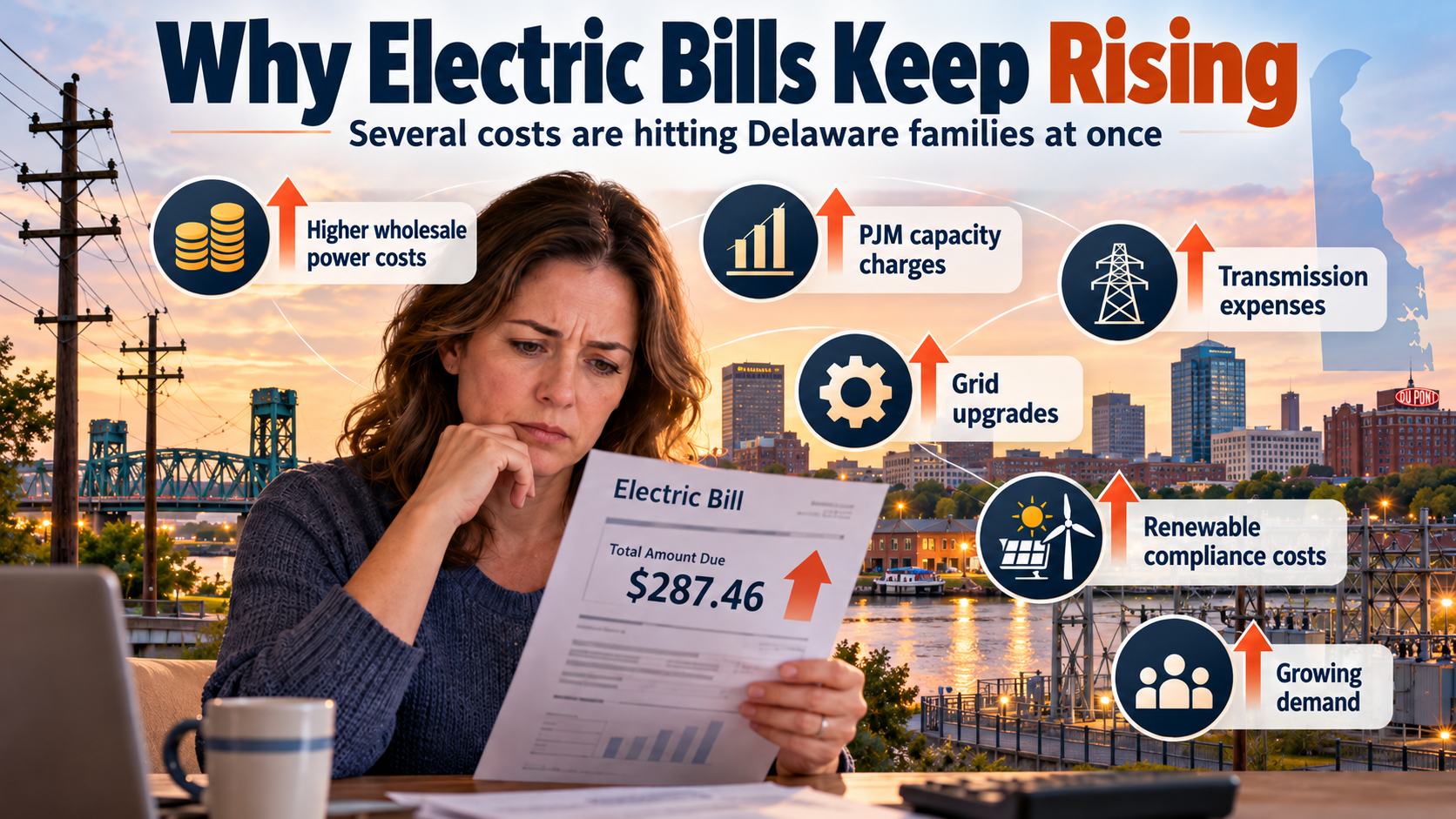
Who is responsible for the increases? There is no single cause behind Delaware’s rising electric bills. Several organizations, market conditions and government policies influence what customers ultimately pay. Image created on 10/22 using AI.
Delmarva Power seeks $67.8 million more in annual revenue as regulators weigh grid investments, rising energy costs and what Delaware can do to protect consumers.
By George D. Rotsch, Delaware LIVE
WILMINGTON, Del. — Delaware families already paying substantially more for electricity face another potential increase as state regulators consider Delmarva Power’s request for $67.8 million in additional annual revenue.
The proposal would increase the utility’s distribution base rates by 21.7%, although that does not mean customers’ total electric bills would rise by that percentage.
The request comes after a separate increase in electricity supply costs took effect June 1, adding an estimated $14.64 per month, or about $176 annually, to the average residential customer’s bill.
For households struggling with higher prices for food, insurance, housing and other necessities, the latest rate case raises a broader question: Why does electricity keep getting more expensive, and what can Delaware officials do about it?
Electric bills keep climbing
The cost of electricity has increased substantially in recent years, adding pressure to household budgets.
According to the U.S. Energy Information Administration, Delaware’s average residential electricity price reached 17.15 cents per kilowatt-hour in 2025. Preliminary monthly data show prices climbing further in 2026.
Unlike groceries or gasoline, electricity is difficult for consumers to avoid. Families can reduce consumption, but heating, cooling, refrigeration and other essential household needs place limits on how much they can cut.
The June increase was particularly significant.
Delmarva’s standard electricity supply rate increased approximately 19%, largely because of higher regional power costs. Changes in renewable-energy compliance charges slightly offset the impact, resulting in an estimated 9% increase in the overall bill for a typical residential customer using 811 kilowatt-hours per month.
The pending distribution-rate case represents a separate cost pressure.
Delmarva implemented temporary higher distribution rates July 9 while the Delaware Public Service Commission reviews its request for a permanent increase. The final decision will determine how much additional revenue the utility can collect, with the interim rates subject to adjustment.
Who is responsible for the increases?
There is no single cause behind Delaware’s rising electric bills. Several organizations, market conditions and government policies influence what customers ultimately pay.
The major cost drivers include:
- PJM Interconnection — Regional electricity costs: PJM manages the wholesale electricity market serving Delaware, 12 other states and Washington, D.C. Rising demand, limited generation capacity and higher prices for ensuring adequate electricity supplies have contributed significantly to recent increases.
- Delmarva Power — Local delivery costs: Delmarva maintains the poles, wires, substations and other equipment delivering electricity to homes and businesses. Its pending rate request would increase revenue collected from customers for distribution services and infrastructure investments.
- Delaware Public Service Commission — Rate oversight: The PSC reviews Delmarva’s proposed distribution rates and determines which expenses are reasonable for customers to pay. The commission does not directly control regional wholesale electricity prices.
- Delaware lawmakers — Renewable-energy requirements: State law requires utilities to obtain 40% of electricity from renewable sources by 2035, including a 10% solar requirement. Renewable-energy credits and other compliance expenses can add costs, although supporters argue the requirements deliver environmental benefits and reduce long-term exposure to fossil-fuel price volatility.
- Regional Greenhouse Gas Initiative — Carbon compliance costs: Delaware participates in this regional emissions-reduction program. Power generators must purchase allowances for certain carbon emissions. Some expenses can be reflected in wholesale electricity prices, while program revenues support energy-efficiency and environmental initiatives.
- Growing electricity demand — Pressure on the regional grid: Data centers, economic development and increasing electrification are expected to place additional demands on the power system. Meeting that demand could require more generation, transmission capacity and local infrastructure.
The distinction matters.
Regional wholesale electricity costs have been a major driver of recent increases, but Delaware regulators and lawmakers have greater control over utility distribution spending, renewable-energy requirements and other state policies.
That leaves Delaware officials with an important responsibility: ensuring the costs they can control are necessary, transparent and affordable for the families and businesses paying the bills.
Delaware’s energy policies also carry costs
The debate over electricity affordability increasingly includes questions about the state’s environmental and renewable-energy policies.
Delaware’s Renewable Portfolio Standard requires utilities to obtain an increasing share of electricity from renewable sources, reaching 40% by 2035.
Supporters say the requirements encourage cleaner energy, diversify supplies and reduce dependence on fossil fuels.
Critics question whether the mandates are achieving those goals at the lowest possible cost, particularly as regional electricity prices rise.
The state also participates in the Regional Greenhouse Gas Initiative, which requires participating power generators to purchase carbon-emission allowances.
Revenue from those allowances supports energy and environmental programs, but the compliance costs can also influence electricity prices.
Neither program accounts for the entire increase in household bills, and renewable-energy compliance charges actually decreased slightly during Delmarva’s June supply-rate adjustment.
Still, the programs raise a legitimate policy question: Should Delaware review the cost and timing of its energy mandates as consumers face higher electricity bills?
Does Delaware really need more grid investment?
Delmarva’s distribution-rate request centers on the cost of maintaining and upgrading the electrical system.
The company must maintain infrastructure, respond to outages, replace aging equipment and prepare for future electricity demand.
Additional investments can improve reliability, reduce outages and strengthen the system against severe weather.
But those benefits come at a price.
The question for regulators is not simply whether improvements are needed, but whether the proposed spending is justified, appropriately timed and fairly allocated among customers.
The Public Service Commission has authority to examine the utility’s expenses, investment plans and requested financial returns before approving permanent distribution rates.
That oversight becomes increasingly important when customers are already absorbing higher supply and transmission costs that state regulators have less power to control.
What can Delaware do to lower electric bills?
Although Delaware cannot independently control the regional electricity market, policymakers have several opportunities to address affordability.
Push for PJM reforms. Regional leaders, including Gov. Matt Meyer, have called for changes intended to address rising electricity costs. Increasing available generation, reducing delays for new energy projects and improving market rules could help stabilize prices.
Review renewable-energy compliance costs. Lawmakers could examine whether current requirements are delivering their intended benefits at reasonable costs and whether adjustments to compliance mechanisms or timelines are warranted.
Expand energy-efficiency programs. Weatherization, insulation, efficient appliances and other improvements can help consumers reduce electricity consumption without sacrificing reliability.
Scrutinize utility investments. Regulators can require Delmarva to demonstrate that proposed projects are necessary, cost-effective and beneficial to customers before authorizing additional rate revenue.
Improve transparency. Consumers could benefit from clearer information showing exactly how much they pay for electricity supply, capacity, transmission, distribution and state energy-policy requirements.
Target financial assistance. Existing assistance programs and payment arrangements can provide relief to households with limited incomes, including seniors and residents living on fixed incomes.
Some of those actions could reduce long-term costs. Others would provide more immediate relief without necessarily changing the underlying price of electricity.
The question is affordability
The growing cost of electricity is not the result of one utility decision or one government policy.
It reflects multiple pressures, including regional electricity markets, rising demand, infrastructure investments and state energy requirements.
Some expenses are necessary to maintain a reliable electrical system. Others reflect policy choices that can be examined and adjusted.
The challenge for Delaware’s elected officials and regulators is determining whether the benefits justify the costs and whether enough attention is being paid to the financial impact on consumers.
For families watching their electric bills rise, that question is becoming harder to ignore.
The Public Service Commission is accepting written public comments on Delmarva’s pending rate case through Nov. 4.
TO GO BOX
- What: Delmarva Power electric distribution rate case
- Proposed increase: $67.8 million in additional annual revenue, representing 21.7% of existing distribution base rates
- Status: Temporary higher rates took effect July 9. The permanent rate request remains under review.
- Public comment deadline: Nov. 4, 2026
- How to participate: Submit written comments through the state’s DelaFile system at https://delafile.delaware.gov or email [email protected]. Include Docket No. 25-1555.
- Learn more: Delaware Public Service Commission, https://depsc.delaware.gov
- Consumer assistance: Residents struggling with electric bills can contact Delmarva Power about payment arrangements or the Delaware Division of the Public Advocate for assistance.
Delaware LIVE collaborates with a network of professional journalists to cover a diverse range of stories across various fields. Staff Writers include experienced journalists and young professionals. If you have questions, please feel free to contact [email protected] or our publisher, George D. Rotsch, at [email protected]