
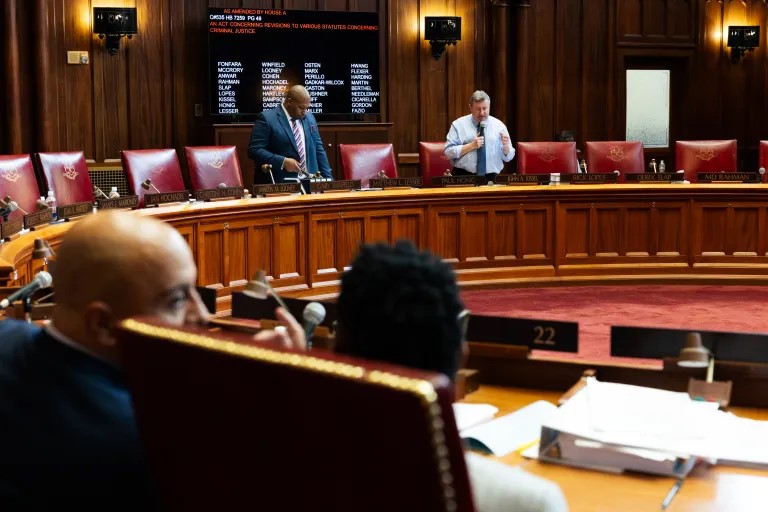
Sen. Gary Winfield, D-New Haven, said people at the public hearing sought to add “teeth” to the current Trust Act, expressing concern that if someone violated the act, there was no way to hold them accountable. Winfield said he’d spoken with constituents who were so concerned that the modifications to the Trust Act would not pass that they had considered self-deporting.
“I don’t have hard data — what I do have are the stories of the people who experience what it is to live with the Trust Act now, and some of them have experienced living without the Trust Act. And they suggest to me that on the whole, the Trust Act is good for them,” Winfield said.
Kissel said he was sympathetic to undocumented immigrants, but he questioned the advantage of the state forbidding compliance with the federal government. “ I find it very hard to believe that if the department of environmental protection of the federal government issued some kind of civil request of our state that we would tell [Department of Energy and Environmental Protection] Commissioner Katie Dykes, ‘Don’t comply with that,’” Kissel said.
Kissel proposed an amendment eliminating the provision allowing someone who is detained by federal immigration authorities because of a violation of the Trust Act to sue the town or city whose police officer or other agent complied with the federal request. The bill also provides for that person to be able to recoup legal fees.
“I find this to be an unnecessary exposure of liability for the municipalities,” Kissel said. He said that since most lawsuits are settled out of court rather than going to trial this would be costly for towns, and that town insurers would not cover these settlements. He also suggested that towns might discourage police from cooperating with federal immigration authorities if there were a chance the town could be sued.
Winfield disagreed, saying the legal recourse was what gave the law teeth.
Sen. Rob Sampson, R-Wolcott, called the Trust Act a bad policy, saying immigration is the responsibility of the federal government, and that there were legal pathways immigrants could pursue.
“We are, by policies like the Trust Act, trying to encourage people to break our legal immigration policies, and to come to this country not through the legal process,” Sampson said. “It is no favor to help someone get into this country or to stay here unlawfully. It’s not.”
Sampson said he agreed that additional crimes should be exempt from the Trust Act, but he questioned why only certain ones were included in the bill. Sampson and Senate Minority Leader Stephen Harding, R-Brookfield, proposed amendments adding more crimes to the list of exemptions. They all failed.
Winfield said individuals who commit crimes have to face the criminal justice system and incarceration. “There’s a prison for people who have committed crimes. Immigration policy is a different thing,” he said.
The Trust Act changes were just one part of a larger bill with several provisions regarding law enforcement, all of which passed the Senate Tuesday evening. The House of Representatives passed the bill last week 96-51 on a largely party-line vote.
The bill also requires the Department of Emergency Services and Public Protection to provide the state’s attorney with any DNA evidence that could potentially exonerate someone alleged to have committed a crime. Kissel referred to the provision as “a long time coming,” noting that taxpayers have in the past had to pay millions in damages to people who have been wrongfully incarcerated.
The bill also creates a process for labeling sexual assault evidence kits, allows people who have served prison time in other states to have that time deducted from their sentence once they arrive in Connecticut, removes tasers or stun guns from being considered “deadly weapons,” and allows police officers to use chokeholds when a third person is in danger.
The bill passed the senate 25-11, and will now go to Gov. Ned Lamont’s desk.
Members of the Trust Act, Now Coalition, an advocacy group representing students, religious congregations, immigrants, unionized workers and others, said they saw the legislation as a “meaningful and hard-won step forward.” But they said they were discouraged by the exemption of certain felonies from the Trust Act and the elimination of a section of the bill that would have prohibited federal immigration authorities from detaining migrants at courthouses.
“Advocates say that more action is needed to prevent our state and local resources from being commandeered to advance the federal government’s cruel mass deportation agenda,” they wrote in a press release.
Emilia Otte is a reporter for the Connecticut Mirror. Copyright 2025 @ CT Mirror (ctmirror.org).


