Fifty-six years of marriage ended for Linda Sterner on a Sunday morning in November, at the scene of an alleged DUI crash in northwest Las Vegas.
Linda Sterner and her husband, Wesley, had a habit of using their cellphones to track each other’s locations. So when she noticed that he had stopped moving on Nov. 2, and when he didn’t answer her calls, she assumed he had lost his phone during his daily bike ride. She drove to the scene to investigate and found him lying motionless in the roadway.
He was dead.
Wesley Sterner, 77, had been hit by a drunken driver who told police he was “going home from a bar” that morning, according to a police report.
A photograph of Wesley Ervin Sterner, a cyclist who was fatally struck on Nov. 2, and his cremains are displayed at his North Las Vegas home on March 2. (Bizuayehu Tesfaye/Las Vegas Review-Journal) @bizutesfaye
“Nobody should let anybody drive drunk,” Linda Sterner, 79, said during a recent interview at her North Las Vegas home. “I don’t care if you’re a bartender or a friend, whatever. You don’t let people drive drunk.”
The majority of states in the U.S. would allow someone like Linda Sterner to sue a business for overserving alcohol to a patron who causes a DUI crash. But Nevada is one of a handful of states that do not have a so-called “dram shop” law that establishes liability for businesses. Nevada’s law even explicitly protects businesses from being sued if they serve a minor who goes on to cause a crash.
Attorneys, activists and politicians say this is intentional — the result of lobbying from the state’s powerful gaming and entertainment industry.
Nevada is tied with Tennessee for the sixth highest alcohol-impaired driving fatality rate in the country, according to 2023 data from the National Highway Traffic Safety Administration. The state’s laws have placed a strong emphasis on holding drunken drivers personally responsible for their actions, and lawmakers have recently increased criminal penalties for DUI fatalities. But victims’ loved ones, like Linda Sterner, are left to question whether Nevada lawmakers are more concerned with protecting businesses from liability than preventing DUIs.
Linda Sterner, the widow of Wesley Sterner, speaks during an interview with the Review-Journal at her North Las Vegas home on March 2. (Bizuayehu Tesfaye/Las Vegas Review-Journal) @bizutesfaye
High school sweethearts
Linda and Wesley Sterner were high school sweethearts who moved to Nevada in 1975 for his position in the Air Force. They maintained active lives between traveling, playing in bowling leagues and going on road trips planned around Wesley Sterner’s love of bicycling. The retiree took a photo of the sunrise on daily bike rides that stretched up to 40 miles throughout the Las Vegas Valley.
Linda Sterner expected to have at least another decade with her husband — he had promised to take care of her through her declining health and recurring lung cancer.
Now, she wakes up every day to a quiet house. She sits in her living room full of pictures, displayed near her husband’s urn and the helmet he was wearing when he was killed.
She spoke with an attorney, because that’s what one is supposed to do after a crash like this, Linda Sterner said. She doesn’t know what bar the driver was drinking at, or the details of how he got to be “belligerently impaired,” as noted in police documents.
A lawsuit wouldn’t bring her husband back, but Linda Sterner said she wanted to find some justice after his death.
“I asked if we could sue, and they said no,” the widow said.
“Dram shop” is an archaic term for a bar or tavern — the term “dram” refers to a small portion of something to drink — and laws governing liability over sales at such establishments vary by state. Some states only allow for lawsuits if an establishment is accused of serving a minor, and other states place caps on the amount of damages that can be won.
Lawsuits filed in other states have made headlines, such as when a Texas jury in 2021 awarded over $300 billion in damages to the family of a teenager and grandmother killed by a drunken driver leaving a bar in Corpus Christi. It was the largest personal injury award in U.S. history, and the family expected the damages to be a symbolic reminder of the dangers of drunken driving and overserving, CNN reported.
Sen. Jeff Stone, R-Henderson, is photographed on March 18 in Henderson. (Benjamin Hager/Las Vegas Review-Journal)
Stricter DUI penalties
As part of a push to enact stricter DUI laws, lawmakers in November increased the maximum penalty for DUI crashes involving death from 20 to 25 years in prison. Defendants can be sentenced to a minimum of two years in prison if they have no prior offenses, or five years in prison with a prior offense.
Sen. Jeff Stone, R-Henderson, sponsored a bill last year that would have made it easier for prosecutors to charge someone with vehicular homicide after a DUI crash, regardless of whether the defendant had a prior DUI or not. During a discussion on the bill, which did not pass, a lobbyist for the Clark County public defender’s office questioned why Nevada was one of the few states that had not enacted a dram shop law as a DUI prevention measure.
“Maybe it’s time to have that conversation. Maybe it’s time to have that conversation for real,” the lobbyist, John Piro, testified during a Senate committee hearing in April.
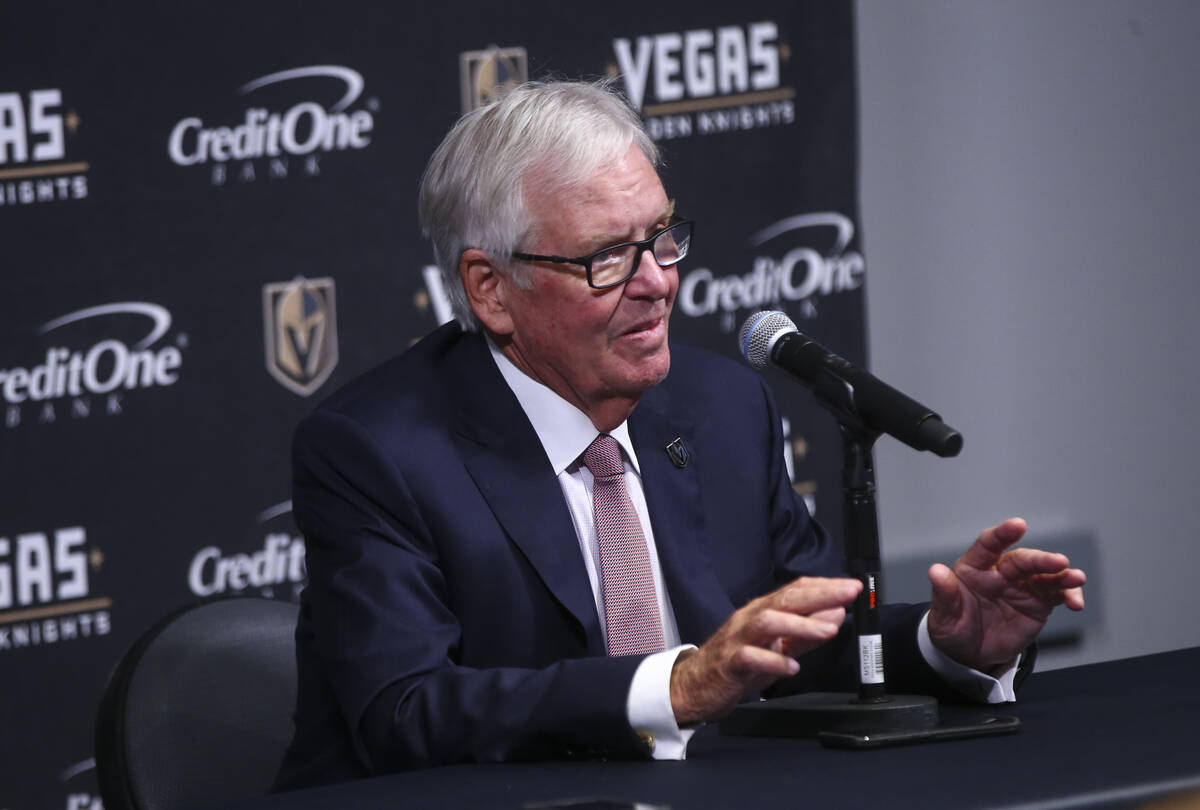
In a recent phone interview, Stone said he has heard rumblings about changing Nevada’s liability laws, and that he would be in support of a carefully crafted dram shop law. But it was a “nonstarter” for most politicians, who aren’t willing to go against the gaming industry’s interests, he said.
“I don’t think anybody was willing to touch it,” Stone said. “You’re basically declaring war on the casinos. They’re going to come back, and they’re going to fight you. That’s the reality.”
Even at the county level, politicians acknowledge that changing dram shop liability in Nevada would be difficult because of the strong influence held by gaming companies.
“When you’re dealing with the industry, it’s a tough hill to climb,” said County Commissioner Tick Segerblom.
Segerblom told the Las Vegas Review-Journal that he would like to see local police track where drunken drivers are drinking before crashes. He said businesses should share some responsibility if they are overserving patrons, but he stopped short of saying Nevada should have a law establishing liability for businesses.
I don’t think anybody was willing to touch it. You’re basically declaring war on the casinos. They’re going to come back, and they’re going to fight you. That’s the reality.
SEN. JEFF STONE, R-HENDERSON, WHO SPONSORED A BILL THAT WOULD HAVE MADE IT EASIER TO CHARGE SOMEONE WITH VEHICULAR HOMICIDE AFTER A DUI CRASH
“That’s so political that I don’t want to get in the middle of that right now,” he said.
Virginia Valentine, president of the Nevada Resort Association, said in an emailed statement that casino employees are required to complete state-mandated training on serving alcohol, recognizing signs of intoxication and preventing underage drinking.
“No one over the legal limit should ever be behind the wheel on Nevada’s roads,” Valentine said in the statement. “Individuals who choose to drink and drive must be held accountable for their own actions and bear full responsibility for those decisions. Shifting blame to establishments misdirects accountability away from the drunk driver.”
Peter Saba, the government affairs and communications manager for the Nevada Restaurant Association, said the organization focuses on training for servers to help combat DUI rates.
“Our association is pro safety, pro responsible service,” Saba said. “But we are skeptical of civil litigation as a DUI prevention tool.”
Sandy Heverly, executive director and co-founder of Stop DUI Nevada, poses for a photo at the nonprofit’s office in Henderson on Feb. 23. (Benjamin Hager/Las Vegas Review-Journal)
Nevada’s ‘social host’ law
Nevada has a “social host” law, which allows for someone to sue the host of a private party if the host knowingly serves an underage drinker who then causes injury or property damage. But the law specifically prevents businesses from being sued for serving a minor or overserving an intoxicated patron.
In 1995, a bill supported by Mothers Against Drunk Driving would have created dram shop liability. But an amendment authored by the Nevada Resort Association created the exception for businesses.
A representative with Mothers Against Drunk Driving told lawmakers that year that the association had reversed the concept of the bill, which then was “gutted” by lawmakers, according to minutes from an Assembly committee hearing.
The law was unchanged until 2007, when lawmakers created the social host liability for people holding private parties. The protections for businesses remain.
Instead of establishing dram shop liability, state and county laws require employees who serve alcohol to complete mandatory training and carry an alcohol education card. Sandy Heverly, the co-founder of Stop DUI Nevada, said activists pushed for the mandatory training laws in response to a lack of dram shop liability.
The nonprofit believes that liability for DUIs should be a “shared responsibility,” Heverly said. Drivers need to be held accountable, and Heverly believes DUI penalties should be harsher — but restaurants, bars and casinos also should be aware of their role, she said.
“The dram shop law, basically what it does — aside from giving another avenue for victims, to help them — is it creates a conscience for those who are selling and serving,” Heverly said.
Fearing the ‘wrath’ of resorts
UNLV law professor Jeff Stempel called Nevada “the citadel of alcohol immunity in America” in a 2014 law journal article. Stempel has argued that enacting a stricter dram shop law in Nevada would incentivize establishments and servers to be more careful in how they serve alcohol, which could help address DUI rates.
According to Stempel’s article, research shows that dram shop laws are effective at reducing alcohol-related driving injuries.
The dram shop law, basically what it does — aside from giving another avenue for victims, to help them — is it creates a conscience for those who are selling and serving.
SANDY HEVERLY, CO-FOUNDER OF STOP DUI NEVADA
Several years before Stempel’s article, the Community Preventative Services Task Force established by the U.S. Department of Health and Human Services concluded that dram shop laws are effective at preventing alcohol-related harms. The recommendation was based on an evaluation of several studies that used data from the 1980s and 1990s.
Stempel recently told the Review-Journal that a dram shop law in Nevada would not mean that plaintiffs could automatically win lawsuits against a business or server. Instead, a plaintiff would have to prove that a business was clearly negligent when it overserved a patron. But the possibility of lawsuits could make businesses more careful when serving alcohol, Stempel said.
Nevada’s courts historically have been reluctant to consider dram shop liability claims and have pushed the issue onto lawmakers, Stempel told the Review-Journal.
“Legislators are going to be disinclined to do it because they fear the wrath of the resort interest groups hurting them as they try to get re-elected,” the professor said.
Fatal 2018 crash
The law that protects businesses was briefly challenged in Nevada’s courts in the aftermath of a 2018 DUI crash that killed Damaso and Christa Puente. On that night, Henry Aparicio drank 13 tequila drinks while at a Dave & Buster’s and a Mexican restaurant named Casa Del Matador, where he also worked.
Aparicio and his girlfriend were noticeably intoxicated — she was falling off a barstool, and he was walking with an “unsteady gait,” according to court documents. The two were walked to their car by an employee of the Mexican restaurant.
Minutes after driving away, Aparicio slammed into the back of the Puentes’ car while they were stopped at a red light, killing the married couple.
While Aparicio faced a lengthy legal battle in the criminal justice system, the victims’ family also pursued a lawsuit against him and the two establishments that they argued had overserved him.
According to the lawsuit, a Dave and Buster’s employee served Aparicio and his girlfriend two drinks each several times over the course of 90 minutes. Surveillance footage showed the two of them at the Mexican restaurant for another hour and a half, and Aparicio had five more tequila drinks there before a bartender appeared to cut him off, according to police records.
The lawsuit was appealed to the Nevada Supreme Court after a lower judge ruled in favor of Dave and Buster’s. Attorneys for the victims’ family argued in appeal documents that Nevada’s law eliminating liability for businesses does not “give alcohol servers a carte blanche license to over-serve and act irresponsibly in Nevada.”
In 2022, the Supreme Court announced that it would not hear arguments from attorneys but would instead decide the case based on the court filings. Within months, the victims’ family had reached confidential settlements with the businesses.
Attorney Josh Benson, who helped represent the family members, said the outcome of the litigation was affected by Nevada’s laws.
“There was clear evidence of overserving, especially at the Matador, but not being able to have that claim really hamstrings what you can do in a case,” Benson said.
But most lawsuits attempting to challenge a business for overserving could be considered frivolous because of the law that protects businesses from liability, Benson said. If a Nevada court were to hear a case, a judge could decide that it’s up to legislators to change the law. Like many experts and politicians interviewed for this story, Benson said that would be an “uphill battle.”
“The casino industry runs the town, and I don’t think there’s any way that they would allow the Legislature to change that rule,” he said.
‘It’s the bottom line’
Linda Sterner said that if investigators know where the driver that struck and killed her husband had been drinking, they haven’t told her.
A cracked bike helmet worn by Wesley Ervin Sterner, a cyclist who was fatally struck on Nov. 2, is displayed at his North Las Vegas home on March 2, 2026. (Bizuayehu Tesfaye/Las Vegas Review-Journal) @bizutesfaye
Charles Carter, 69, has been charged with DUI resulting in death and reckless driving resulting in death. His defense attorney, Justin Wilson, declined to comment for this story.
According to his arrest report, Carter was driving south on Shaumber Road shortly after 7 a.m. on Nov. 2. He struck a curb at Grand Teton Drive, ran over a median and hit Wesley Stern, who was riding his bicycle in the northbound lanes, police said.
Officers who arrived at the scene found Carter sitting on a curb, crying, rocking back and forth, slowly mumbling and nursing a bloody head.
Investigators noted in an impaired driving report that it was difficult to get information from Carter, but he did admit to using marijuana “a while ago” and said he was driving home from a bar.
“Carter did not specify what location the bar was, and would not reply to my question when I asked him when he started drinking, but Carter did admit to drinking an unknown quantity of beers at a party,” an officer noted in the report.
The Metropolitan Police Department denied a records request for the body camera footage of officers who responded to the crash, citing the open investigation. Chief Deputy District Attorney Chad Lexis, who is prosecuting the case, declined to comment on the investigation.
Eric Bauman, a former prosecutor previously in charge of the DUI team at the Clark County district attorney’s office, said investigators will ask if a DUI suspect was drinking at a bar or restaurant. But there’s no formal data showing how frequently that scenario happens.
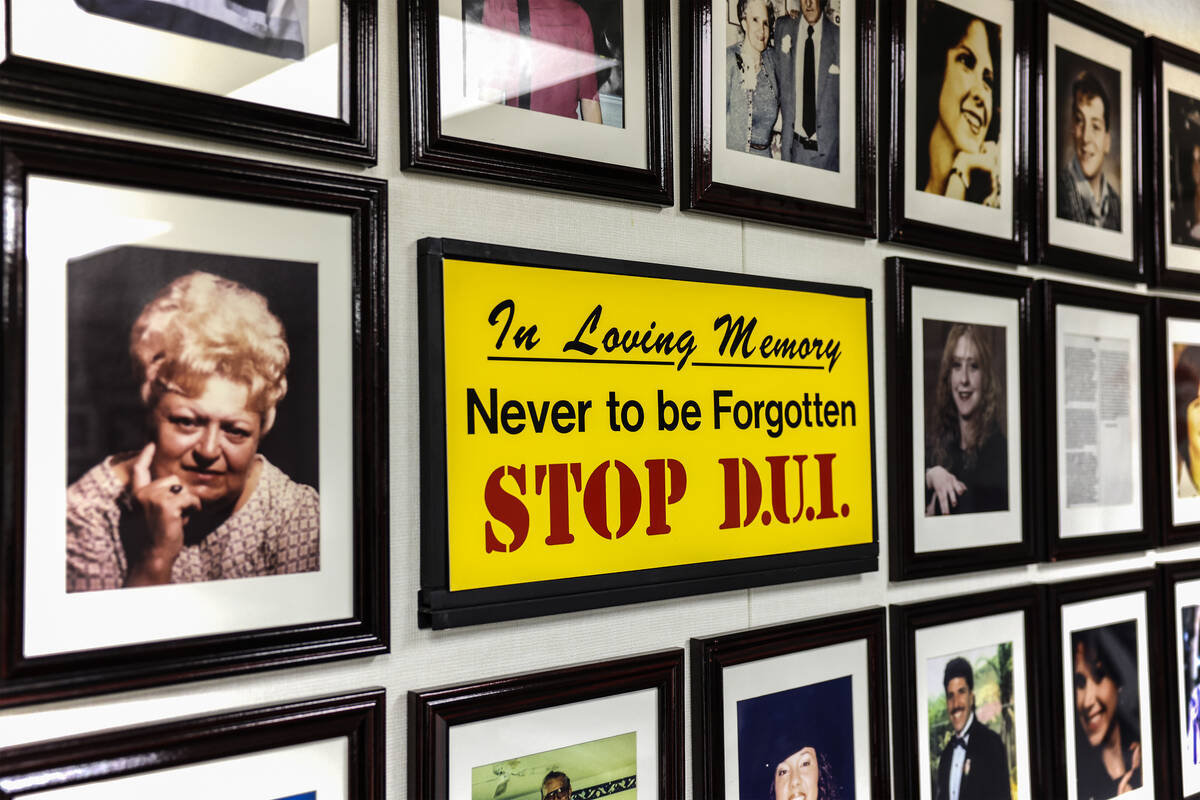
Framed photos of those killed by drunken drivers hang on the walls of Stop DUI Nevada’s office in Henderson. (Benjamin Hager/Las Vegas Review-Journal)
“It’s more often than it should be,” Bauman said.
He believes a dram shop law would decrease DUI rates in Nevada. But he said a law allowing lawsuits against individual businesses would be difficult to enforce, especially in a city where customers can easily walk between a dozen different bars in just one casino.
Linda Sterner said that if she were able to sue because of evidence that the driver accused of killing her husband was overserved before the crash, maybe that would hold businesses accountable and help prevent future tragedies.
“It’s the money, it’s the bottom line,” she said. “If it’s going to cost them money, they’re going to make sure that their employees do the right thing.”
Contact Katelyn Newberg at knewberg@reviewjournal.com or 702-383-0240. Newberg is a member of the Review-Journal’s investigative team, focusing on reporting that holds leaders and agencies accountable and exposes wrongdoing.