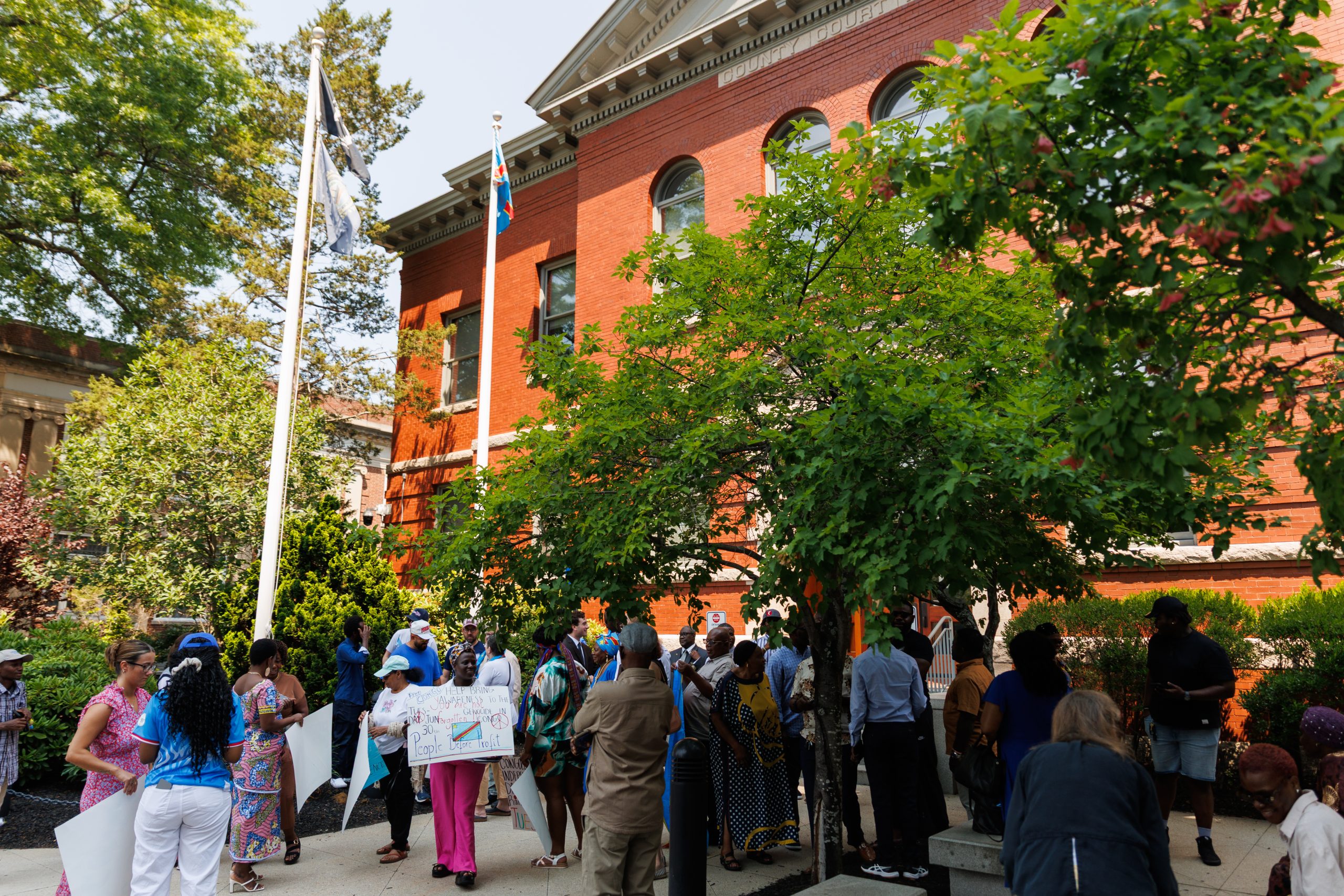
With the melodic notes of “Debout Congolais” echoing across the sidewalk, Tirzah Georges and Sully Masuku hoisted the Congolese flag into the sky above Manchester City Hall.
They were ushered to the flagpole by their elders, who stood with their hands over their hearts as they watched them pull the ropes.
“It feels awesome to raise that flag,” Masuku said. “We really have to advocate for our own people.”
There was no shortage of things to celebrate: Tuesday marked the 66th anniversary of the Democratic Republic of the Congo’s independence and the 17th annual flag-raising ceremony in Manchester. What’s more, the DRC national football team advanced to the round of 32 in the World Cup this week.
Tuesday’s gathering also commemorated a different victory — this spring, New Hampshire’s House of Representatives passed HR 26, a resolution endorsing peace, humanitarian aid and U.S. diplomacy in the DRC.
“These actions are not small. They are not symbolic. They are seeds,” said Representative Mary Ngwanda Georges. “Seeds of justice, seeds of protection, seeds of hope.”
Along with five other representatives and one state senator, Georges sponsored the resolution, whose purpose is twofold: first, to establish support for the sovereignty of Congolese people, and second, to encourage U.S. engagement to end the 30 years of turmoil in the central African country.
“This is a meaningful reminder that even though we are miles apart, we can stand together and support a peaceful and prosperous future,” said June Trisciani, a Manchester alderman at-large and chair of the Victory Women of Vision, a nonprofit providing immigrant aid founded by Georges.
After the Berlin Conference in 1885, Belgium’s King Leopold II claimed the DRC as his personal property, leveraging brutality to force the Congolese to produce rubber for his own enterprise. Following the deaths of millions of civilians, the Belgian parliament annexed the area in 1908, and it remained a Belgian colony until revolutionary Patrice Lumumba led the country to independence in 1960.
The current conflict has its roots in the 1994 Rwandan genocide, which sent refugees westward into the DRC. A collection of extremists assembled militias that battled with Rwanda’s new regime, inviting retaliation from Rwanda and Uganda on DRC soil. Though the Congo Wars officially ended in 2003, military groups still incite violence and extract lucrative resources from local mines.
The New Hampshire resolution also backs the Strategic Partnership Agreement between the U.S. and DRC and the Washington Accords for Peace and Prosperity, a series of peace agreements between the DRC and Rwanda.
For many, the very passage of the resolution in March represented New Hampshire taking a stand on the global stage.
“It shows that the Granite State cares,” said Romeo Masuku, Sully’s brother and the president of the Congolese Community of New Hampshire. “Sending this message is something strong for the international community to see that there are colonies in the diaspora that care about peace and stability in their own country, and hopefully that can lead efforts to ending the war.”
- Manchester resident Glory Mukendi holds a sign as the crowd poses for a photo in front of Manchester City Hall on June 30, 2026. Credit: ALEX MILLER / For the Monitor
- Manchester resident Glory Mukendi holds a sign as the crowd sings the Congolese National Anthem in front of Manchester City Hall on June 30, 2026. Credit: ALEX MILLER / For the Monitor
- State Representative Mary Ngwanda Georges watches as Sully Masuku and Tirzah Georges raise the Congolese flag in front of Manchester City Hall on June 30, 2026. Credit: ALEX MILLER / For the Monitor
- State Representative Mary Ngwanda Georges reads a speech in front of Manchester City Hall on June 30, 2026. Credit: ALEX MILLER / For the Monitor
While Georges addressed the crowd before her as “brothers and sisters,” she stood in front of some of her actual kin, too.
“This resolution is not only for the people here in New Hampshire, which does mean a lot, but also for all the elders that have been coming back and forth,” said Sarah Georges, her daughter and the vice president of the Congolese Community of New Hampshire. “It’s important for them to see that the change is now. All the work they’ve been doing for years, it means something.”
Attendees at the gathering see reminders of Congolese oppression everywhere in the world around them. Mining in the DRC provides the cobalt and tantalum necessary for the hardware of many common devices.
Sarah pointed to the cell phones and cameras in the hands of people standing around at the event.
“That comes from our homeland, from the minerals that get extracted, from the people who have to do all that. These are women and children,” she said.
The House’s resolution provides a glimmer of hope for Congolese people still living in the DRC, as well as those in the United States.
“We really care about the country, and we hope to go back. We hope the kids who are here are able to visit a safe, peaceful Congo one day,” said Glory Mukendi, Sarah Georges’s sister and the assistant director for the Victory Women of Vision. “We just want to strengthen that relationship. It’s not just between the presidents, but it’s showing how, as a population, we want to strengthen that peace and stability.”
As the crowd, wearing sky-blue Congo jerseys and singing along to their national anthem, stood beneath the flag raised by the youngest in their midst, the future was on their minds.
“Congo is rising. Our people are rising. Our voice is rising,” Georges said.