The light had already changed by the time Katie Sermons began working on the trees.
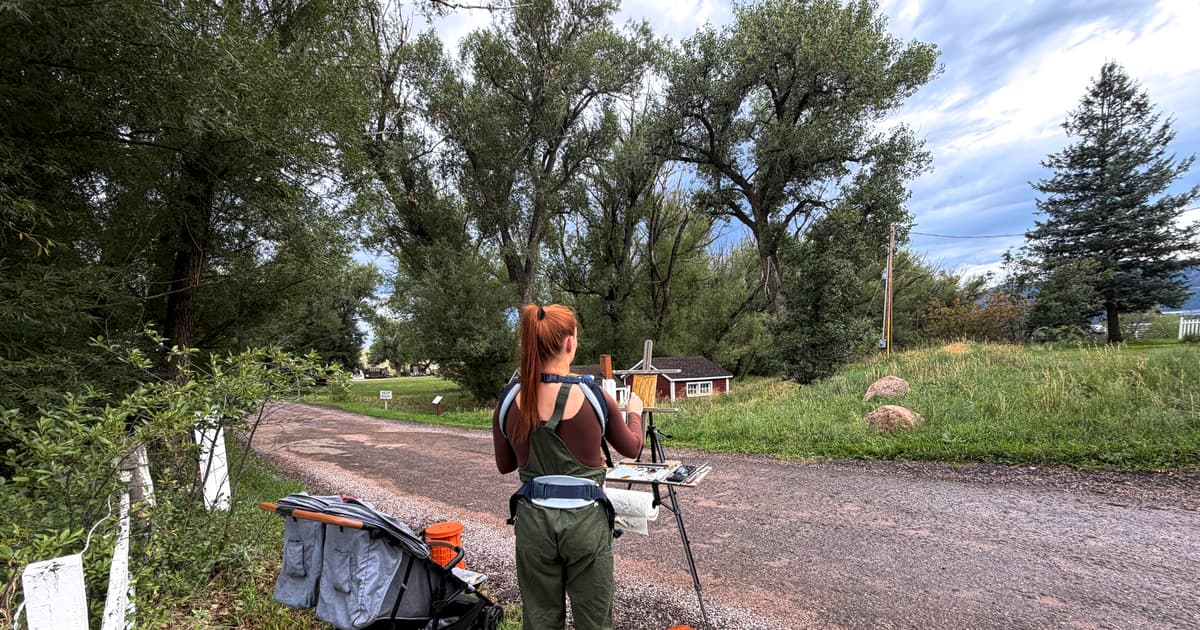
Sermons stood at an easel outside the Western Museum of Mining and Industry in Colorado Springs, looking toward a pair of old bunkhouses. She had blocked in the major shapes and colors, but painting outdoors meant the scene would not wait for her.
“It amazes me how much color changes with light,” Sermons said as she worked. “And that’s all I think about — is what is the light doing right now and how is it changing the color? How would I paint that?”
Her 3-month-old daughter watched nearby from her stroller.
Sermons moved to Colorado Springs earlier this year and began painting the places that caught her attention: Historic buildings, landscapes and structures that offered clues to what the city looked like before it turned into what it is today.
She described Colorado Springs as a large, rapidly growing city with “pockets of really rich history.” She found herself especially drawn to old houses, barns and other places where people once lived and worked.
At the mining museum, that meant the rust-colored bunkhouses.
A barn in Colorado Springs, seen through Katie Sermons’ viewfinder (left) and her plein air painting of the scene. Aug. 28, 2026.
Sermons said she loved that the property had preserved pieces of an earlier Colorado Springs even as the modern city surrounded it.
Her interest in using paintings as a form of record-keeping began before she arrived in Colorado.
While living in Georgia, Sermons had the chance to paint on a roughly 200-year-old sharecropper farm. An antique store and coffee shop on the property had closed, and nature had begun reclaiming parts of the landscape. An old wagon disappeared into foliage. A pond filled with algae.
The experience changed the way Sermons thought about what she painted.
“I felt like what a cool thing and what a worthwhile thing to paint historic places and to remember them as they look right now in 2026,” she said, “because they’re not going to look like that forever.”
Cameras could document the same places more quickly, she said. But painting forced her to spend time looking at them.
Hayley Sanchez/CPR NewsKatie Sermons works on a plein air painting in Colorado Springs. Aug. 28, 2026.
That mattered to Sermons, in part, because she had moved frequently throughout her 20s. She had taught in the Middle East, worked with refugees in Greece, lived in Texas and served in the Army. Moving so often made her conscious that her time in any one place could be temporary.
“Everywhere I go, I’m like, ‘Man, this is fleeting,’” Sermons said. “I’m not going to go back on my iPhone and look at every single picture I’ve ever taken of a place. I’m going to look at my paintings on the wall.”
Painting had also remained a constant through those moves.
Then Sermons became a mother.
“When I became a mom, I stopped painting,” she said. “And quite frankly, it was devastating.”
Sermons said she eventually told her husband she needed to return to art. Now, painting often included a baby at the easel and interruptions from her children. Projects took longer. Outdoor sessions sometimes ended when her daughter Freya decided she had waited long enough.
That new rhythm also changed the paintings themselves.
Hayley Sanchez/CPR NewsKatie Sermons works on a plein air painting in Colorado Springs. Aug. 28, 2026.
Sermons did not aim for hyperrealism. She left visible brush strokes and added only enough detail to make a building, tree or window recognizable. Painting outside — especially with young children — rewarded quick decisions about what mattered most in a scene.
During her evening outside the museum, Sermons stepped back repeatedly to judge the relationships between colors and shapes. Near the end, she added darker windows to the bunkhouse and caught a flash of orange light on its chimney.
Then her daughter began to fuss. And Sermons was forced to make her final marks.
The painting did not capture every board, leaf or detail of the property. But that isn’t the point.
Sermons said she hoped someone could look at one of her paintings decades from now and become curious about the people who had occupied those places before them.
“I want people to wonder,” she said. “I want people to look at my paintings and wonder what happened there, what was life like.”