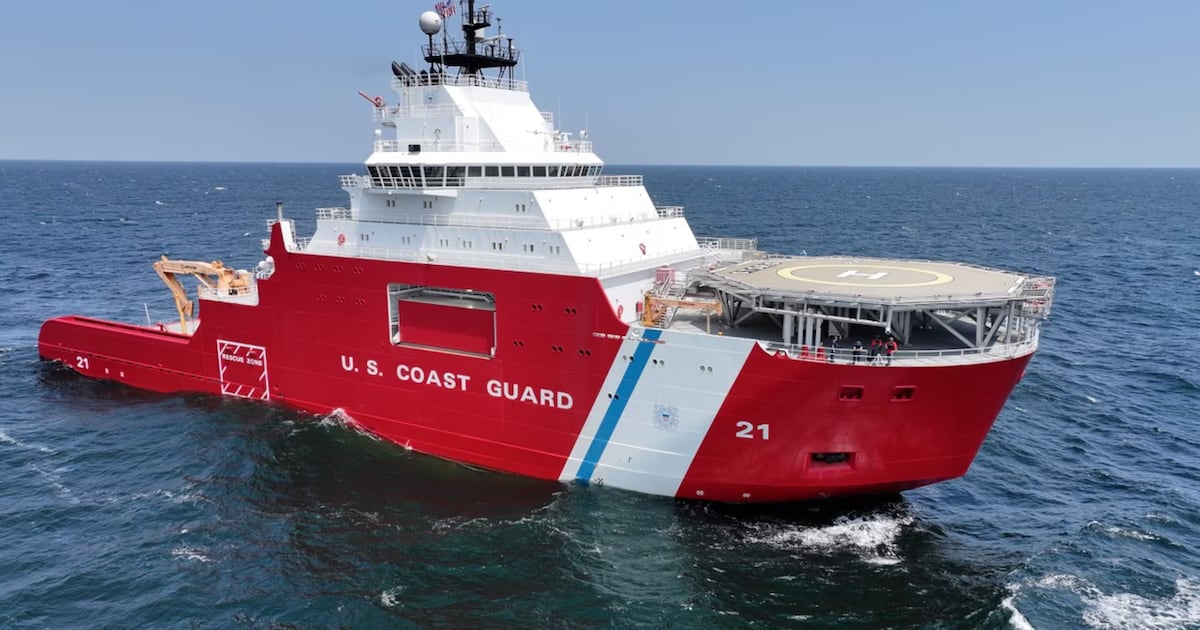
The cutter Storis was the U.S. Coast Guard’s first polar icebreaker acquired in more than 25 years. The vessel was formally homeported in Juneau last summer. (Photo courtesy of the U.S. Coast Guard)
Two new icebreaker vessels will be homeported in Alaska, the Coast Guard said this week, though it has yet to pick the specific communities in the state where the vessels will dock and their crews will live.
Sufficient housing and other infrastructure in Alaska’s coastal communities will be critical to ensure that hundreds of new Coast Guard members and their families call Alaska home, the state’s Republican U.S. senators said following the announcement.
“People can’t get so excited about just the ships, to think that we don’t have more work to do when it comes to making sure that the shoreside infrastructure is funded and then is moved out,” Sen. Lisa Murkowski told reporters Friday.
Still, Murkowski, along with Sen. Dan Sullivan and Rep. Nick Begich, celebrated the Thursday announcement from the Coast Guard as a long-sought victory in an effort to base more icebreakers in Alaska’s icy waters.
Adm. Kevin E. Lunday, commandant of the Coast Guard, said in a statement Thursday that “homeporting Arctic Security Cutters in Alaska underscores the United States’ leadership as a maritime power in the Arctic.”
The latest announcement came after the Coast Guard commissioned its first additional polar icebreaker in 25 years in Juneau in August. However, the new vessel cannot make Juneau its permanent home, for the time being, due in part to lack of housing there among other considerations.
The Republican-backed budget reconciliation bill that passed last year included funding for the construction of new polar security cutters, along with new shoreside infrastructure in Juneau. It is part of a broader effort to respond to an expansion of icebreaker capacity by Russia and China.
But it will likely be years before the new icebreakers are fully built and permanently stationed in Alaska because of the lengthy process of constructing vessels, port facilities, housing and other infrastructure needed by the Coast Guard.
The Coast Guard indicated in its announcement that the first of the icebreakers, which are under construction in Finland, could be complete by the end of 2028.
Murkowski said “there is a long road ahead.”
“As exciting as it is to be designated home-port for these very, very important national security assets, we have a corresponding obligation on the community side to make sure that we are ready to receive these crews and their families, and that’s going to require housing, that’s going to be making sure that there’s good schools, that’s going to be making sure that we’ve got health care facilities for them and their families,” said Murkowski.
The Coast Guard’s existing icebreakers currently spend most of their port time in Seattle. Alaska politicians have long wondered why the ice-breaking vessels do not live closer to the Arctic.
“The dictators in Russia and China certainly recognize the importance of the Arctic and North Pacific, which is why we’re seeing escalating incursions near Alaska’s airspace and waters, including unprecedented joint operations. We are finally making the serious investments and decisions needed to build up our forces in America’s most strategic state to defend our interests in this vital region,” said Sullivan, who is running for reelection this year.
The Storis — the icebreaking vessel that was formally homeported in Juneau last summer — comes with roughly 200 onboard Coast Guard members, along with shoreside maintenance crews, while the newly announced icebreakers will have between 80 and 140 crew members, Sullivan said.
“This is going to be a really, really important part of the economy,” he said, noting the new vessels will provide a boon to local shipbuilders and other businesses.
Based on conversations with Coast Guard leaders, Sullivan said he anticipates an announcement on the specific location in Alaska where the vessels will be homeported in the “summer or fall time frame.”
Several Alaska communities already have a permanent Coast Guard presence, including Anchorage and Kodiak.
The allocation of new Coast Guard assets in Alaska has long conflicted with limited housing in coastal communities, including in Juneau, Sitka and Seward.
“The reality is that the Coast Guard has got to be working with Congress, with the funding, to make sure that when we deliver the assets, the investment has been made on the shore side so that things line up,” Murkowski said. “So we’ve got a lot of work to do.”
Sullivan, too, said housing is “a huge issue.”
“We don’t want the lack of housing or the challenge of housing to be kind of a choke point on getting these assets and the Coast Guard members who are coming with these ships to our state as soon as possible,” Sullivan said.
Despite the limited infrastructure and housing in Alaska’s coastal communities, Sullivan said Alaska may be under consideration for additional icebreakers down the line.
“I’m not going to assume we’re done. But at a minimum, now we got three,” Sullivan said.